
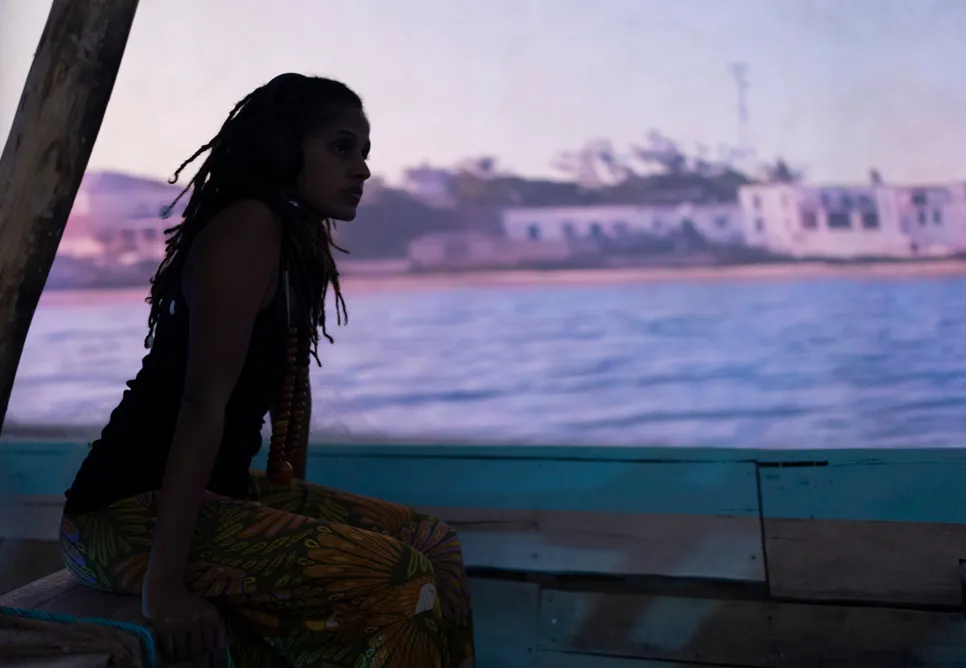
Yara Costa, a Mozambican artist based on Ilha de Moçambique, invites us to dive into her work “Nakhodha and the Mermaid”. This installation, which echoes the culture and history of coastal populations, is also a warning about global warming. Venturing into the old Customs House, we are carried on a journey that unites past and future, in a reflection on humankind's relationship with the sea. In the interview that follows, we not only uncover the details of this creation but also explore the artist's universe and her plans for the future.
What was your main inspiration for creating the installation “Nakhodha (Nahota) and the Mermaid”?
It wasn't just one source of inspiration. I am driven by curiosity and by the unknown. Ilha de Moçambique, where I live, and people's connection to the sea are rich narratives that evoke the past, the present and possibly the future, and they have definitely inspired me. The relationship of coastal communities with the ocean, the bond with nature and the undocumented stories truly captivate me. It is these singular, untold and powerful narratives that fascinate me.
Was the choice of the old Customs House on Ilha de Moçambique for the installation deliberate in terms of symbolism?
Yes, the choice was absolutely intentional. That historic space, until now, echoed a single narrative. Yet it strongly symbolises the Portuguese colonial legacy in the country. The place evokes memories of trade between East and West, of the exchange of spices and ivory and, crucially, of the sale of human beings as slaves. So I felt a need to populate this space with other living narratives that are also part of our legacy and our present.
Has the public's reaction been in line with expectations?
The public's response exceeded anything I could have anticipated. The scale of the work's impact took me to France, where I was honoured with an award by the Minister of Culture and had the opportunity to discuss the project with the French president. The positive comments have been an unexpected gift, suggesting that the installation has the potential to touch even more hearts.
Can you tell us about the inclusion of virtual reality in your installation and the experience it provided for the public?
I see virtual reality as one more storytelling tool. Whether through film, writing or virtual reality, my interest is in telling stories. In my installation, virtual reality symbolises the experience of the Nakhodha, the captain of the dhow, an Arab Swahili vessel, a profound connoisseur of the secrets of the winds, tides and stars. This technology makes for an immersive experience, transporting the viewer to an alternate reality, whether returning to the year 1749 or looking ahead to 2030, which highlights the imminent danger of rising sea levels for the whole region. I want to build a bridge between ancestral and modern technologies, showing that both can coexist and enrich each other.
Was Jorge Jamal Sadique's story the spark for this project, or did you come across it during the research process?
My interest in the subject already existed and was guiding my research. However, meeting Jorge Jamal Sadique, one afternoon by the sea on my birthday a few years ago, was a revelation. I quickly understood that I was in the presence of an invaluable source of wisdom and of perspectives that are rarely seen or valued. Jorge was a doorway to a universe that, until then, I had known only superficially. Learning from him was profound and enriching, and he became a fundamental part of this project and others.
In the past, you focused more on documentaries. Does this transition to immersive installations represent a new phase in your career, or simply a different way of telling stories?
I see it as another distinct vehicle for telling stories. I am, essentially, a storyteller, and the immersive installation is one more tool at my disposal. Some narratives call for this type of representation; in any case, I am also developing a film entitled “Em Busca da Sereia” (In Search of the Mermaid), based on my research. Although it is a pioneering experience for me, this art form is in dialogue with cinema and could even be interpreted as such, but from a different perspective. My passion for sound and for film remains, but technological progress has broadened my possibilities of expression.
How did your previous experience influence your approach to this work? Has your training in various countries influenced the way you see cinema and the art of storytelling?
My training is an intrinsic part of who I am, but it is the people I have met, from all corners of the world and with different visions, who have truly enriched my outlook. This diversity of experiences has guided me in the search for my own unique voice in the art of storytelling. In times of globalised access to culture, the challenge lies in finding our own voice in that vast chorus. The more I expose myself to different influences, the more defined my direction becomes, and the prism through which I want to share stories.
What led you to create the short film about Cyclone Idai? What was it like to film in areas so affected by the catastrophe?
My short film, shot in Donde, Sussundenga, in Manica province, entitled “Ruínas do Rio” (Ruins of the River), grew out of an invitation from an organisation that had a project in the region. Although the invitation was not directly to produce a film about the organisation's work, it encouraged me to experience the place and its inhabitants. When I visited the area, it was some time after Cyclone Idai and, instead of focusing on the immediate images of devastation, I was drawn to a more reflective perspective, one that requires contemplation. Even with clear evidence of the destruction, my main focus fell on how the communities interpreted these sudden changes in nature's patterns. This journey proved extremely valuable, leading me to conceive the idea for the immersive installation and encouraging me to deepen my understanding of the ecological knowledge of traditional societies and communities. I quickly understood the profound ancestral respect these communities have for nature, a knowledge that often escapes us as city dwellers. Unfortunately, the mistaken idea persists that these societies are primitive, ignoring the vast wisdom, science and balance they hold.
What are the biggest challenges you face as a filmmaker in Mozambique, especially as a woman in the industry?
One of the first challenges is to acknowledge that there is no truly consolidated film industry in Mozambique. Although there are dedicated individuals working in film production, to claim that we have an industry is a misconception. A solid industry implies a body of specialised technicians and qualified professionals dedicated exclusively to cinema, something that does not exist in our country. Renowned filmmakers do not survive solely on their films. Therefore, blindly believing in the existence of this industry can be a dangerous mistake, one that distances us from our reality and prevents us from seeking suitable solutions. The real challenge lies in remaining active in a field without a solid structure, facing difficulties ranging from securing funding and distribution issues to the lack of qualified professionals. Being a woman in Mozambique is, in itself, a challenge, and the world of film is no exception. The film sector is not immune to broader social dynamics, and the prejudices and inequalities that affect women in many fields are also felt in cinema. So the obstacles I face do not differ greatly from those faced by other Mozambican women in different professions.
What can we expect in the coming period?
I am currently developing a film entitled “Em Busca da Sereia”, on themes I have been exploring over the past four years. Although I already have some funding from abroad for development, the need for resources for production remains. I believe 2024 will be a year of dedication and commitment to this project, in the hope of bringing it to reality. In parallel, the installation “Nakhodha and the Mermaid” aims to travel to various ports, starting at Ilha de Moçambique and passing through Pemba, Nacala, Quelimane and Beira, with the wish also to appear in Inhambane and to conclude in Maputo. This artistic work is not exclusively mine or that of Ilha de Moçambique; it addresses themes of relevance to all of us, Mozambicans, Africans and, I would say, all of humanity, since it reflects on the environmental crisis, offering possible solutions. It would be a dream to see it travel along the Swahili coast and even reach international ports. Recently, during a visit to France, I was honoured with an award from the French Minister of Culture and had the privilege of discussing with the French president the crucial importance of investing seriously in the arts and culture. It is imperative that we stop regarding culture merely as a folkloric adornment and recognise its intrinsic value as an engine of development. Let us imagine a country where for every church, temple or mosque there was a structured and active cultural centre, and where cultural and artistic education was an integral part of the school curriculum from the very start. What would our future be in 5 or 10 years? My aim now is to project “Nakhodha and the Mermaid” from Ilha de Moçambique onto the global stage.


