
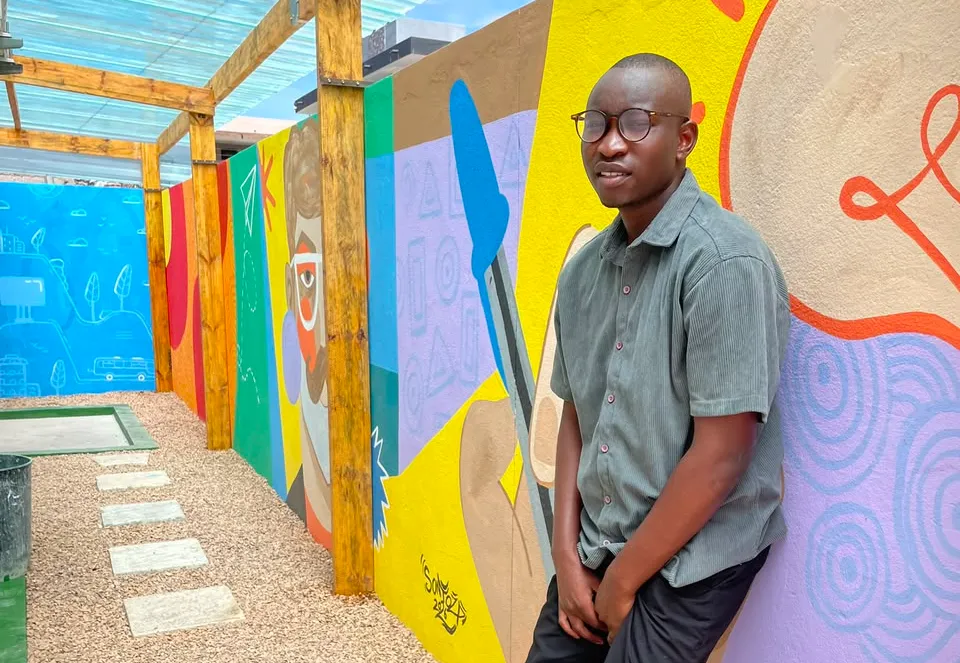
Art has been with Sontoza since his school days, when his first doodles and fascination with murals awakened the desire to create. Years later, he decided to make that passion his way of life. Between the abstract, realism and graffiti, he finds inspiration in people, memories and scenes from everyday life. Still building his artistic identity, Sontoza looks to the future with the ambition of taking his work beyond borders and opening the way for others who, like him, find in art a form of expression.
How did your relationship with painting begin? Do you remember the moment you realised it could be more than an interest and become an important part of your life?
My relationship with painting and art goes back to my pre-teens. Already in primary school I was drawing and doodling, wanting to do graffiti. I was very passionate about the murals and artistic paintings I saw in certain neighbourhoods. It was in 2019 that I decided to work and live from art, as a visual artist and art teacher. I had three and a half years of experience as an art teacher.
What path did you take to become the artist you are today? Did you have artistic training, or do you think you learned mainly through practice and experimentation?
Yes, I trained at the National School of Visual Arts, on the Ceramics course, which is a little different from my current field of work in the arts. I also had various experiences with the artist Dji Nafita. He gave me my first lessons in painting and graffiti, from basic techniques and concepts to the first murals of my life, which I did on his own commissions. I also took part in several painting workshops that Toca Criativa Studio organised at the time.
How would you define your artistic style? What elements, techniques or characteristics make a work recognisably yours?
I am still in a period of study, but I have been working more with the abstract, realism and graffiti.
Where do your main inspirations come from? Are there people, places, memories, events or aspects of Mozambican culture that often appear in your work?
My inspirations come from being around people, from certain places, memories and, above all, from events and scenes that mark my life.
When you begin a new work, do you already know exactly what you want to create, or do you let the painting find its own way during the process?
It depends. I have works where I already know what I want to do, but there are others where I do not. I let myself be carried by certain feelings of the moment and finish the work according to the concept that emerges during the process.
Among all the works you have created, is there one that has a special meaning for you? What is the story behind it?
Yes. The works De Ti para Tu! and Mãe de Moçambique have a very deep meaning for me, because they portray situations from our daily lives. De Ti para Tu! came about with the intention of making people aware of the importance of looking after themselves first and then others, especially women. The aim was to encourage them to look after themselves in the prevention of breast cancer, because by caring for themselves first, they will be better placed to care for others. Mãe de Moçambique portrays the effort of the many mothers who leave home early in search of better conditions for their children and families. These are women we see on street corners, at bus stops, in markets and on many avenues of the city of Maputo and across Mozambique. Through their efforts, they also contribute to a better society.
Have you taken part in any exhibitions, solo or group?
At the moment, I am still looking for the opportunity to hold a solo exhibition. I have only taken part in one group exhibition, in my final year of training at the National School of Visual Arts. It was in 2022, at the ENAV graduates' exhibition, held at BCI.
Have you had the chance to collaborate with other artists, brands, institutions or projects? What did these experiences add to the way you create and the way you see art?
Yes, I have had the opportunity to collaborate with companies. Those experiences made me look at art in a different way and realise that it is a field in which there is still little investment, but one that is worth being part of and contributing to its appreciation.
How do you currently see the space given to the visual arts and to painters in Mozambique? What opportunities exist, and what obstacles continue to limit artists' growth?
There is little appreciation on the part of those in charge. Cultural centres have given support, above all by making spaces available for artistic creation, but there are still few opportunities and calls for applications that would allow artists to grow.
Is there an artist, Mozambican or international, with whom you dream of working one day or sharing an exhibition? What attracts you to their work?
I have some Mozambican references, such as Butcheca, Dji Nafita, Mateus Sitole and Naguib Abdula. Among international artists, my references are Titos Ferrara, Carlos Bobi, Ed Mun PDF, Ten Hun, Salehe Bembury, Mr Bailey, Negrito, Jono Dry and Fabian Utta.
When you think about the future, how far would you like to take your art? What dreams do you still hope to realise, whether in terms of works, exhibitions, recognition or a presence beyond borders?
I would like to hold my own solo exhibitions, become a reference for others and open an academy or art school for the many people who would like training in this field. I also want to take my art beyond borders.


