
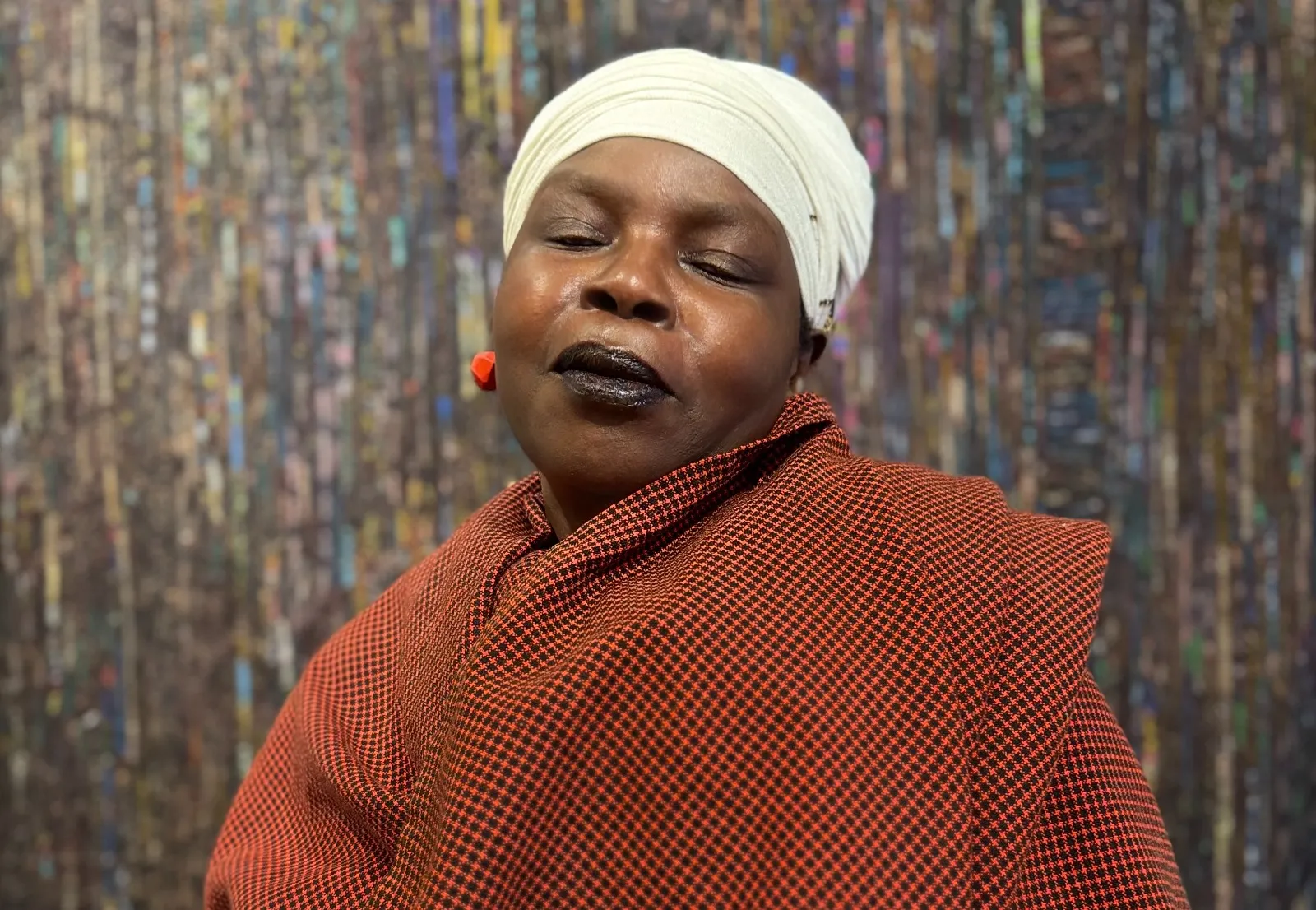
For some artists, creating is a way of turning memories, emotions and experiences into a language that can reach others. For Lizette Chirrime, that language found one of its most powerful means of expression in fabric. The Mozambican artist has built a career shaped by identity, the human condition and her own lived experience, taking her work to different countries and important international venues. In this conversation with Xonguila, Lizette returns to the origins of her journey and talks about her relationship with fabric, the moments that marked her career and the dreams she still hopes to realise.
Where did Lizette Chirrime's story as a creator begin?
Lizette Chirrime's story as a creator began when I was working at Generic Engineering. It was the first time I had been able to pay the rent on a decent home, and I needed to furnish it. I made my own furniture from discarded materials, my own rugs and various other things. I have always had a great fondness for art, craft and natural things. But it was only in 2003 that I took up art as a full-time profession.
Fabric occupies a central place in your work. What did you find in this material that you did not find in other forms of artistic expression?
I found a home, a safe place, something I had always been looking for in human beings and found in fabric. When a baby is born, before finding its mother, it finds a piece of cloth that wraps around it.
Your works are born of very personal memories, emotions, places and experiences. What inspires you most when you begin to create?
Everyday life, the environment, dreams, and so on. I use fabric as the basis of my expression and communication.
Looking back over your career, which moment marked you most and, in some way, changed its direction?
I had two very powerful moments. The first was the day I stopped chasing my family's attention and validation. I dived deep within myself and found the tools for my liberation, expression, communication and self-sufficiency. The second was when the Universe took away everyone I used to call friends and left me completely alone, with no friends at all. In effect, the Universe forced me to focus on myself, on my son and on my career. From then on, I began to see the wonders and to feel the power of it all.
Your work has already taken you to different countries and continents. Which places have been part of that journey, and which of those experiences left a special mark on you and on your work?
In London, at the 1-54 fair, there was an occasion when several people bought my work. The very same piece. Another moment was when I took part in a group exhibition at the Vestfossen Kunstlaboratorium in Norway, alongside many very great, powerful and famous artists. In Paris, last April, I presented and spoke about my work at the Louvre Museum. I shared the stage with several important artists and curators, such as Ernesto Neto, and led three workshops at the Centre Pompidou. During my stay, I had the honour of meeting the great artist Anna Maria Maiolino, who was exhibiting at the Picasso Museum, and also of meeting the grandson of the celebrated artist Pablo Picasso.
You took part in an artistic residency in France, supported by the Calouste Gulbenkian Foundation and Thanks for Nothing. What did that experience mean to you and to your creative process?
It was a moment of great stimulus and a reaffirmation that I am on the right path.
You recently presented «A Negligência do Sagrado Portal da Vida», an exhibition dedicated to mothers and motherhood. How did this project come about, and what message did you want to convey through it?
This exhibition was born at a time when I felt a great urgency to make people realise that, after all, woman is the portal of life, and that she needs to be respected, listened to, understood and protected.
Fashion has also been part of your journey and continues to appear in your artistic universe. What is your relationship with clothing today, and how far would you like to explore this dialogue between art and fashion?
Fashion is a way of being; it is an expression of the self that I am. My relationship with my clothing is that of a tool that allows me to remember where I come from, who I am and where I want to go. I began making clothes with the aim of discovering my true identity, because no one is the same as anyone else, even though we may be alike. People began to take an interest in my clothes, and I decided to create pieces and the corresponding fashion shows, which are now developing beyond borders.
After so many years taking your work to different parts of the world, what does it mean to you to create from Mozambique and to carry with you a Mozambican and African identity?
As a Mozambican, I feel a duty to serve my country, and it was through art and culture that I found my voice and the tools to better represent Mozambique and its cultural diversity.
What are you working on at the moment, and what new paths, exhibitions, collaborations or dreams would you still like to realise?
My greatest dream is to restore my space so that it can welcome artists from all over the world for cultural exchange and offer mentoring to disadvantaged teenagers.


