
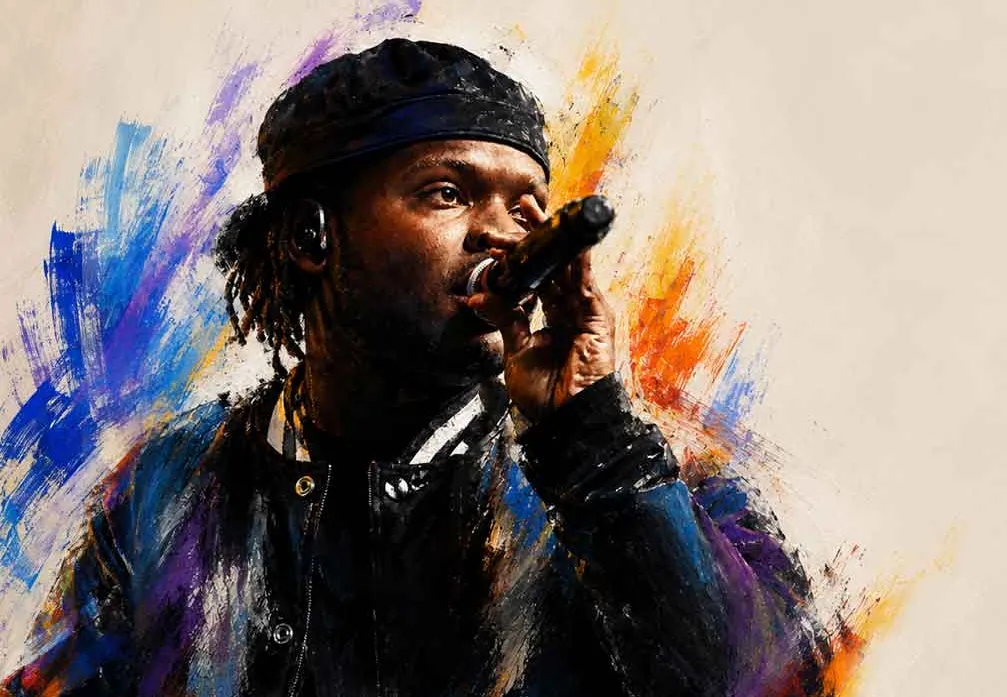
Some artists keep pace with their time. Others prefer to challenge it. Over more than two decades, Valete has made rap far more than music. He has turned it into a space for reflection, intervention and resistance, where the word remains a way of questioning the world. Without yielding to trends or to the logic of numbers, he continues to defend art as an act of freedom and commitment. In this conversation, he speaks of the responsibility of those who hold a microphone, of his friendship with Azagaia, his deep bond with Mozambique, African youth, capitalism, culture and hope. Between memories and convictions, he reveals a way of thinking that remains faithful to the mission he set himself from the start: to make art that withstands time, because some causes outlive generations and some struggles never grow old.
Some artists keep pace with time. Others end up confronting it. Where do you feel you stand today?
I'm still in the same place as always. I have an artistic mission and a social mission. Time doesn't frighten me or scare me. I'll get things done at my own pace. Obviously, I know I'm in a country with a fragile music industry. Most established artists don't even make a living from music. So it's about carrying on in my own time, at my own pace. The mission is the same as it was from the beginning.
The Valete of earlier days seemed to write with fire and urgency. Today there is more silence, more observation, almost another rhythm. Has time brought serenity, or just different anxieties?
I think they are two things that don't have much to do with focus and urgency. Obviously, when you're younger you have more time and fewer responsibilities. My life, perhaps 20 years ago, was just rap. All the free time I had was for making rap. Today things are different. I have other concerns besides music. And there's also the matter of standards. Today I don't consider myself just a lyricist. I'm a lyricist, a composer and a musician. I have higher technical standards. I want to mix well, master well, make a good music video. It has more to do with that. I try to make sure that the product I want to present to people is of the highest possible quality at every stage. Obviously, 20 or 25 years ago I didn't have that concern. That's why things end up taking a bit longer.
For Valete, the speed at which music is consumed today says a lot about the times we live in. The internet has opened doors that once seemed impossible, but it has also brought a new way of measuring art, where views, likes and followers have come to weigh more than the content itself. Even so, he believes that not everything has been lost. There will always be those who look for works capable of withstanding the noise of the moment and travelling across generations. That is where he still wants to be, creating music that outlasts time and not merely the algorithm. This transformation inevitably ended up reaching hip-hop as well.
In his reading, this culture too has been absorbed by capitalist logic. But, as in other eras, he believes that resistance always finds new ways of being born. Between fashion and counterculture, between the market and intervention, there will always be room for those who choose to challenge the present rather than simply go along with it.
Your connection with Mozambique goes far beyond music. What did you find here that perhaps you wouldn't have found elsewhere?
I think Mozambique really is a hip-hop country. I don't know whether Mozambicans are very aware of it, but you breathe hip-hop like few countries in the Portuguese-speaking world. The way you understand hip-hop and the way you perform it is very different from other countries. I identified with Mozambican rappers very early on. You have great rappers. Then, I have great friends in Mozambique, truly great friends. Azagaia was, is, a kind of brother from another mother, a brother I never had. Azagaia was the artist I made the most songs with. The artist I collaborated with most was a Mozambican, a brother who was thousands of kilometres away from me. And all this on top of Maputo being my favourite city. My favourite city is Maputo. So I have a very strong connection to Mozambique. I've already played some concerts there that were historic, and I want to do many more. I'd say that in Mozambique, I'm at home, without a doubt.
Today you seem more interested in building than merely denouncing. Is Horizontal 360 born of this desire to leave seeds that run deeper than the music itself?
Yes. Valete is a social project. It represents hip-hop, hip-hop culture and segregated immigrant communities. Essentially, that is what Valete represents. I try to be more than music. In whatever I can do to help strengthen hip-hop, to help immigrant communities and young artists, I will do it. I don't have the capacity to help 100,000 people, but I've also learned that helping one or two already makes a great difference. We don't have to be megalomaniacs in activism; there's no need. Today, by helping one person, you're already making a great difference. By helping your child, your mother or your grandmother, that already makes a great difference. And I also try to move more towards a mode of practising more than preaching.
Despite his critical view of the world, Valete rejects absolute pessimism. He believes that great transformations often begin with small gestures and that positively influencing a single person already represents a victory. Today, he says, he is further from the great revolutionary utopias and closer to the idea that changing the world begins, above all, with doing good in everyday life. His view of the world, he admits, has also not changed significantly over the years. He continues to look at reality with the same critical spirit, convinced that many of the structures of power remain intact. Even so, he prefers to concentrate on what he can control: living according to his principles and continuing to resist, without being gripped by the obsession of knowing how history will end.
Africa remains full of youth, creativity and human strength. What do you feel is still missing for that energy to be fully realised?
That youth and that creativity are naturally very dependent on political will and economic stability. There's no point in thinking about culture or music if there is no investment and political interest in culture. That creativity is going to suffer greatly. In fact, I believe it is already happening. There is a waste of talent in Africa that is almost criminal. I would call it a cultural genocide. There are many talented young people, writers, videographers, singers and visual artists who cannot thrive or continue their careers because there is no political support for culture in our countries. And we're talking about the Lusophone world, the PALOP countries. I really feel there is an abandonment of culture in Africa on the part of governments. Obviously, young people are going to suffer greatly from this, art is going to suffer greatly from this, and so is that creative force.
Over the course of the conversation, it becomes clear that Valete never saw himself as part of the system he has so often questioned. On the contrary, he believes it was precisely because he chose the margins that he preserved the freedom to create without compromise, even when that meant meeting more obstacles than opportunities. It is from this independence that his music continues to be born, along with a restlessness that extends far beyond rap.
When he speaks of the future, he does not give the impression of an artist seeking to close a cycle, but of someone still searching for new ways of telling the world's story. Life changes, themes multiply and stories are renewed with each generation. Between music, fiction and the written word, Valete sees a territory without borders, where there is still much to explore. Perhaps that is why his work continues to withstand time: because, before writing songs, he never stopped trying to understand people and the world around them.


