
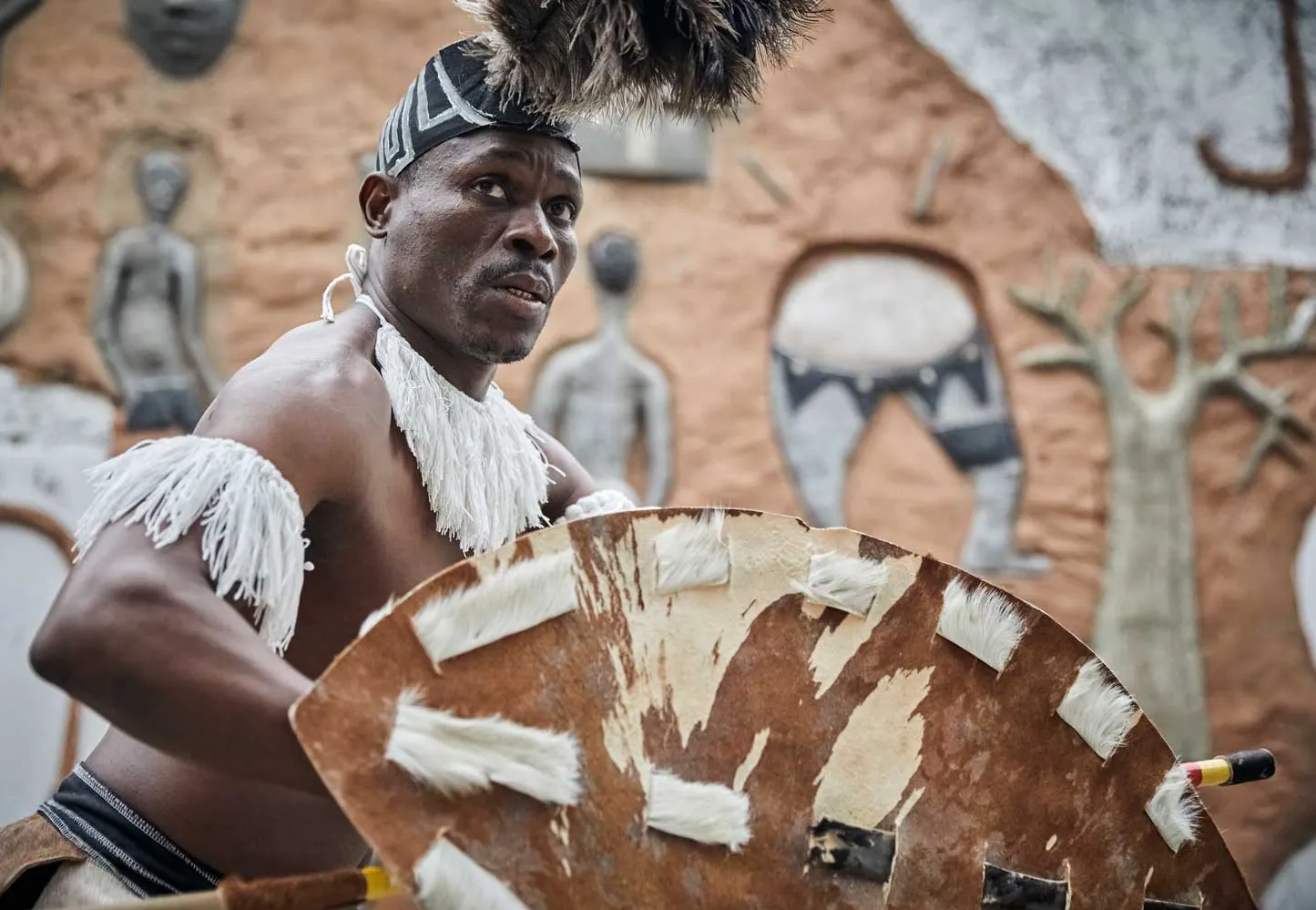
Steps armed with freedom, to the infectious rhythm of the drum, announce, amid battle songs, a dance laden with meaning for the Mozambican people. Xigubo is one of the country's greatest forms of cultural expression, a traditional Mozambican dance that represents colonial-era resistance, especially in the south. Practised mostly in the interior of the provinces of Gaza and Maputo, the dance can also be found in other neighbouring countries, such as South Africa and eSwatini (Swaziland until 2018).
Xigubo is a traditional Mozambican dance that represents resistance to colonial penetration
“Xigubo is a warrior dance. It was a form of resistance against colonial occupation. Our ancestors did not have the conventional weapons we have today. They used spears and shields to defend themselves, so while the dance is being performed some of these elements can be noticed,” said Alex Coana, dancer and teacher at the Companhia Nacional de Canto e Dança (CNCD). It is believed that the name of the dance is associated with one of the main instruments used to perform it, the drum. Indeed, the main drum of this cultural practice is called the xigubo, a name which, according to some oral and written sources, is linked to the intense, far-reaching sound it is able to produce when played individually or collectively, a sound represented by the onomatopoeic expression gubu-gubu-gubu.
Xigubo is the dance speaking for freedom, the power of culture in favour of peace. During his life, the poet José Craveirinha showed his admiration for this warrior dance. A clear example is his first published work, entitled “Xigubo”. The poet defined the dance as “a cultural and traditional practice that symbolises the country's colonial resistance, especially in the south of Mozambique”, having served “as preparation or a call to arms for defensive or offensive war”.
Combat steps in times of freedom
Xigubo was danced to celebrate military victories and also as a way of preparing warriors, physically and militarily, which is why it was, at the time, practised exclusively by men. It consists of a certain number of men (dancers) lining up in one or two rows, duly adorned with objects made of fibres, seeds and skins, around the neck, on the arms and on the legs. They wear skirts made of animal skin, accompanied by a defensive implement called a xitlhango or assegai. “The Xigubo dancers dress like our ancestors. In the group of dancers there is a leader who gives the command, the last word, the cry to advance. There is a moment in the choreography when two dancers face each other. Through a choreography of their own, the two confront each other and simulate, through dance, a fight,” explained Alex Coana, teacher.
As for the instruments used to produce the sound, besides the aforementioned xigubo, two other drums help bring this warrior dance to life: the Ngoma and the Ngulula, each producing a specific sound. While the drums are played, songs are chanted extolling the strength and courage of the dancers. “When the dancers perform the dance they do not smile. It is a dance that is not done with joy, because it is about combat and preparation for war. Soldiers do not smile,” added the teacher.
Nowadays this dance is performed on various occasions in the lives of Mozambicans and is not restricted to men. New steps are introduced, uniting the modern with the traditional, which makes the dance even more beautiful. “Years later, Xigubo still has its reserved place in Mozambican culture. The additions that are made help to give it more and more life. As a teacher and lover of dance, I am very happy because I feel this need to keep Xigubo alive, which means so much to Mozambican culture,” concluded Alex Coana.


