
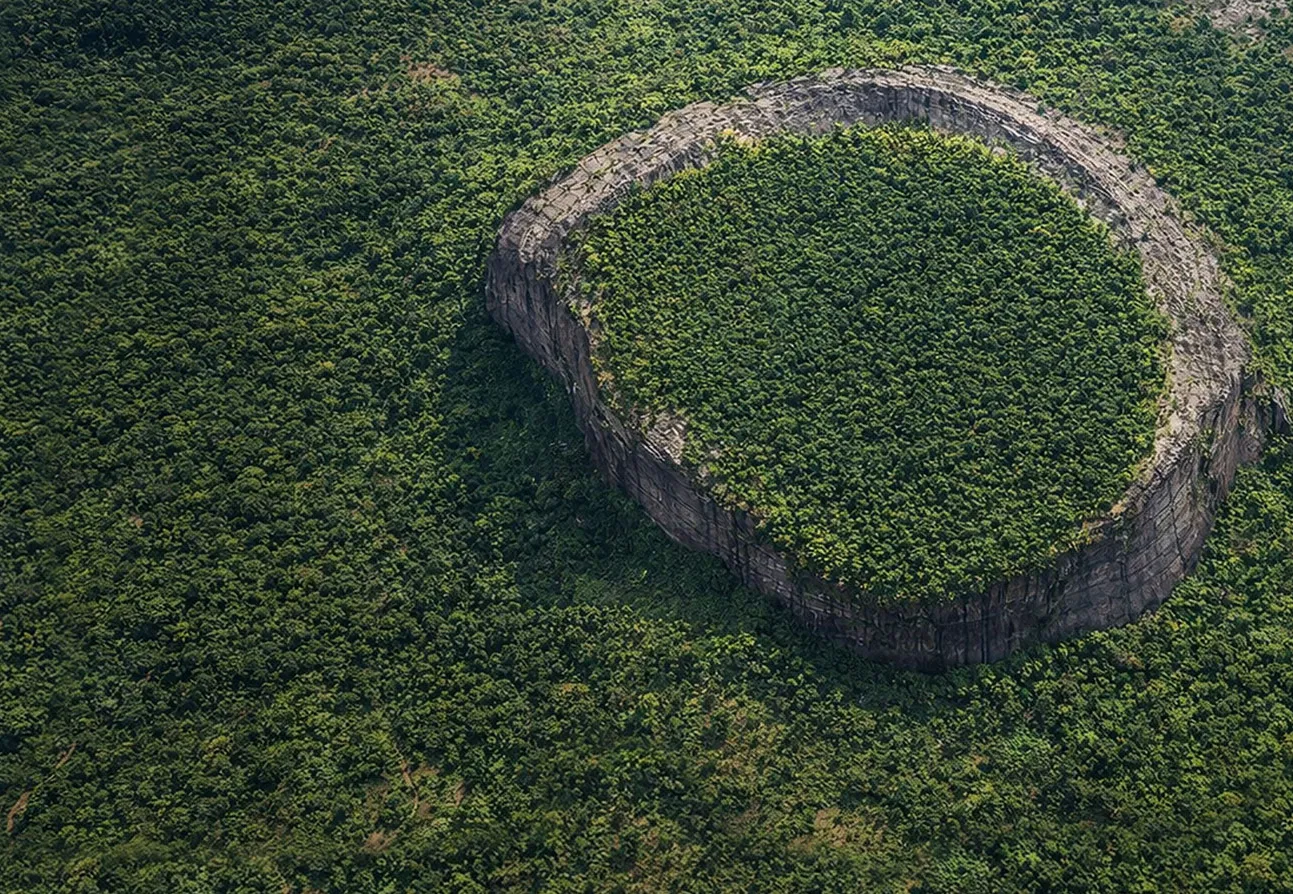
In northern Mozambique, in the district of Alto Molocué, in Zambézia province, rises Mount Lico, a singular mountain that, for centuries, remained practically inaccessible. Seen from afar, it does not look very different from other isolated heights in the region, but it hides an extraordinary secret. At about 1,100 metres in altitude, it stands out for its sheer rock walls, which rise to about 700 metres above the surrounding landscape, forming a true natural fortress that has practically prevented a human presence over time.
On top of this mountain lies something even more surprising: a small primary tropical forest, isolated within a natural crater-like depression. This forest covers only about 30 hectares, but it has remained protected for centuries thanks to the cliffs that surround the mount. For a long time, it was believed that no one had ever managed to enter that space. It was only in 2012 that the biologist Julian Bayliss, of Oxford Brookes University, identified Mount Lico through Google Earth images and realised that the summit might hide a completely intact ecosystem.
Six years later, in May 2018, a scientific expedition finally managed to climb the walls of the mount and reach the isolated forest. What they found there surprised the researchers. The vegetation showed signs of great antiquity and of a rare ecological balance, possibly preserved for thousands, or even millions, of years. The forest soil proved unusually deep, a sign that the ecosystem may be much older than imagined.
Among the trees and dense vegetation, unexpected creatures also began to appear. Rare species of butterflies, amphibians, reptiles and small mammals were recorded, some possibly new to science. One of the most curious finds was a snake-like underground amphibian, known as a caecilian, found near the researchers’ camp. Small chameleons, toads with an almost grumpy expression and an impressive diversity of insects were also observed.
Curiously, although it was thought that the summit had never been visited, the scientists found clay pots beside the source of a small stream. Nobody knows exactly who left them there or when. Perhaps they were placed by someone who, a long time ago, managed to reach that isolated place.
What is certain is that, while many corners of the planet have already been explored in detail, on top of this Mozambican mountain there still exists a small, almost secret forest. A piece of nature suspended in time, where each step may still reveal an unknown species, or an ancient story hidden among the trees.


