
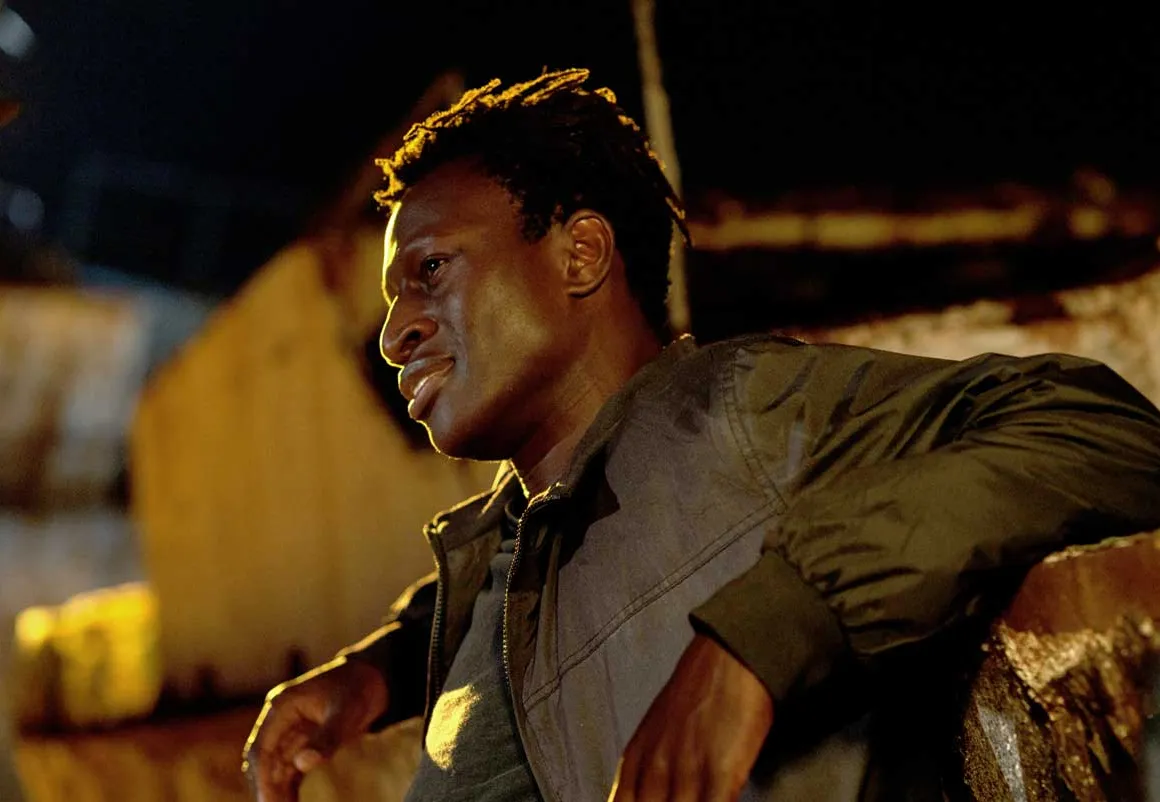
Actor, director and transdisciplinary artist, Welket Bungué traces an international path in which cinema, performance and thought are intertwined. Between Guinea-Bissau, Portugal, Brazil and Berlin, his work springs from a simultaneity of identity and from the power of the body as a language. Through memories, displacements and gestures that precede the word, he reveals a form of creation that is healing, intervention and reinvention. In this interview, he opens the door to that sensitive territory where cinema becomes encounter, rite and transformation.
Your life began in a village in Guinea-Bissau and extended across worlds that never entirely touch. When you close your eyes, what is the first memory that still lights the path of the artist you have become and reminds you why you began?
Truly, I was born in a Balanta village in the south of the country called Xitole. Curiously, it was only in December, in November 2023, that I passed through it again, on a journey during which I crossed the country between Bissau and Quebo. So much so that this moment is recorded in my most recent film, Contemplação Impasse Tentativa. As you know, I left Xitole very young, and the kind of recollection I had of that place, the sensations that came closest, came when I was in Guinea-Bissau from 2019 onwards. Being able to feel again the smell of the earth, whether parched or damp from the rain, the sounds of the frenetic city that is Bissau, the taste of the fruit, the conversation between people beneath the mango trees. All those sensory memories took me back to a time long gone, distant.
And, well, I think our memory is also a construction. We do not necessarily describe things as we saw them, so our brain has this capacity, the so-called neuroplasticity, and over time it brings us illusions. And these illusions serve to help us better understand the things we lived through and saw at a given moment in our lives.
So, if we are to speak of a memory that lights my path up to here, it is not necessarily in Guinea-Bissau. I would say it is more in Portugal. During my childhood, the years I lived in Ramada, which is in the Serra da Amoreira, between Caneças, Arroja, Montemor and Odivelas. I grew up in that area and, as children, we played a great deal in that eucalyptus grove, a wood made up of eucalyptus trees nearby. We were migrant families, the only migrant family living in the only block of flats in an area made up of villas, private houses. We spent a lot of time playing together in the street or in the woods.
And, as you know, the 90s were years in which, for us kids, you still watched on television, on SIC, Buéréré, or else on TVI, Batatoon. These were children's and youth programmes that showed animations such as Dragon Ball Z, Sailor Moon, Samurai X, X-Men. These cartoons stirred my imagination enormously, and many of the games we played were related to the fantastical universe of those characters and stories.
Naturally, being a very imaginative child, this led me to create those fantasies as something that could be materialised, brought about. And that, combined with watching action films, above all James Bond films, films with Schwarzenegger, Eddie Murphy, Bud Spencer. All of this meant that the universe of animation could be compared to the universe of action films, with all their fictions and special effects. This is a seed that is planted in my head and that, I would say, at around 10 or 11 years old makes me begin to imagine that I could be an actor.
But, having grown up in Portugal, there were no clear or obvious references to people with my profile, that is, who were Black and could work in national fiction. So much so that, at the time, I practically did not watch Portuguese cinema, because in my family there was no such habit. The closest thing was the Globo soap operas, in which I saw people speaking Portuguese and where references did appear, such as Taís Araújo, Lázaro Ramos, Milton Nascimento. They made me perceive the possibility of being an actor, even if in a distant country.
Perhaps that also stayed lodged in my subconscious, and it is no coincidence that later, in 2012, I came to Brazil to study, to do a postgraduate degree in performing arts, because the Conservatório, the Lisbon Higher School of Theatre and Film, had an agreement with UniRio here in Rio de Janeiro.
Basically, what I mean is that it was the cartoons and action films I watched between the ages of 5 and 11 that made me begin to have the desire, and to voice the possibility, of becoming an actor one day.
And of course, there is a very significant moment, if I remember rightly on 2 January 1998, when I go to the cinema for the first time. We go to see the film Perigo Público, with Will Smith and Gene Hackman, at the São Jorge cinema. It is the first time we go into a cinema auditorium. Until then we had seen films at home, on television; it is there that we see a film on a giant cinema big screen, with an incredible sound system, and that I see a Black man in cinema on a megalomaniac scale, as is the case with Will Smith. I believe that, from that very moment, he took on that character in the film Perigo Público and I was left completely fascinated. I said to myself: “Wow, this is what making films is.” After all, there were the films watched on the small television set at home, and when you are an actor, and you take part in action films, the explosions can have this kind of impact.
From then on, that milestone meant this seed began to find fertile soil. And so it was. At some point in 2006, already in the Alentejo, aged 15, I had the opportunity to take part in an introductory theatre workshop led by David Silva, who was at the time a young actor and director who had appeared in Morangos com Açúcar. He gave us two weeks of training and, from then on, we created an amateur theatre company. We worked for a year and made our debut with the production of Hamlet, by William Shakespeare.
From then on it is the fulfilment of a desire expressed up to that moment. It was proven that I could be a stage actor and, after that, I would go on to appear in the documentary Caravelas e Naus – Um Choque Tecnológico nos séculos XV e XVI, which came first among 62 documentaries in a Discovery Channel competition and was shown on several continents.
From then on I began to go to castings to take part in film productions in Portugal, but also in projects by final-year film students, both at the Lusófona University and at the Higher School of Theatre and Film. Until I enrolled on the degree in theatre, acting stream, at the Conservatório Nacional. From there, we all know the rest of the story.
You carried a childhood marked by displacements and silences that shaped you from within. How did that story, which could have remained in the shadows, come to be transformed into a root that sustains you and returns you to your centre?
I would not necessarily say that my trajectory was marked by silences. Perhaps it was marked by a certain invisibility, that is, a lack of obvious living references of non-white, non-hegemonic artists who could serve as a reference for me, being a person of African descent, the child of migrants in Portugal.
And this made my path, already as an amateur artist, that is, an amateur actor and then an academic theatre actor and later a professional, more difficult, because there was not, I would say, a foundation of fellowship with other peers of mine who could, in a social or associative context, share the experiences that artists of African descent older than me had already been through in Portugal.
Because that is an element that strengthens the individual on their own journey as an artist. So much so that I only came to acquire it when I arrived in Brazil, which is where I saw other Black artists, men and women, taking part in productions with budgets that allowed them to be paid decently for their participation in the stories. Although there were still many stigmatised characters or stories with more predictable narratives, the artists, beyond those works, had a certain self-esteem and a certain autonomy in the production of thought, but also in the production of narratives diverging from the hegemonic narratives reproduced by the traditional vehicles of audiovisual entertainment.
By this I mean that my path could not remain in the shadows, contrary to what would have been most likely, given that scarcity of references, as I described a moment ago, and the fact that artists of African descent, namely Black artists, in Portugal, have for a long time competed for minimal opportunities, when there is a great variety and diversity of non-hegemonic artists.
When I say non-hegemonic, I mean artists who do not match a profile privileged by their ethnicity, that is, by being white or people who were born into a network of contacts that allows them to access certain means of artistic production more easily. That is hegemony. Non-hegemonic is any individual or community that does not belong to that privileged group, which maintains those opportunities and legitimises the stories that may or may not gain visibility or be told.
That said, I think that, to a great extent, this centre, if we wish to call it that, that is, this autonomy and this subjectivity nourished by this transit, by this state of someone who manages to move through and arrive at various places and allow those places to reach me, is the concept of the peripheral body that I develop in my book.
All of this also happens because I had a privileged education, not only within the family, given who my father was, Paulo Tambá Bunguê, a forestry engineer, poet and man of very wide human formation, but also through my mother, Mrs Maria de Fátima B. Alatrache, and through the people who raised me at boarding school.
I think that, because of this confluence of worldviews and cultural outlooks, I managed to thrive and adapt to the various vicissitudes inherent in the individual who goes in search of opportunities outside their comfort zone.
Hence the importance of this idea of simultaneity that I often speak of: that you understand yourself not just as one thing, but as the confluence of the various things that make up your identity and, consequently, produce an art that expresses itself through this multidimensionality that the individual has by nature, but which can only vibrate in that place with assertiveness when outside their comfort zone.
You have lived between Guinea-Bissau, Portugal, Brazil and Berlin, like someone breathing in several directions. What does the body learn when the word “home” is not a fixed point but a continuous movement, and what part of that learning still goes with you?
This notion of home is something I have been working on for many years. It is precisely because, when you are a migrant, for reasons of mental and emotional sanity, we need in some way to uproot ourselves from that place we call home and become more fluid and more simultaneous in our conception of belonging. I think, first and foremost, we must be able to find that axis of belonging within ourselves. To speak of ourselves is to speak of crossings, and those crossings, for me, begin from places of affection, not only human affection, but also philosophical and cultural. Which are the places, the people or the contexts that validate us, that accept us in our integrity.
So, this conception of belonging is associated with those places and those people who accept us in our wholeness, our integrity. From there we begin to stitch together this place, which can be a physical one, a home, that spreads across the various spots where we have people we can relate to, people, things, places, understandings. But it can also be an emotional or mental territory that activates in us a sense of wellbeing and security, of fulfilment. And to be a peripheral body, insofar as it is a politicised body that understands itself as a political body, displaces the various centres constituted by those people rooted in this idea of nationalist culturalism.
Contrary to what for many people is the idea of home and belonging, which is to belong to a nation, to a culture and, consequently, to a patriarchal or nationalist idea, being this peripheral body means being a body that understands itself as simultaneous. It is no longer crossed only, or not solely, by its ancestral and historical heritage, but also accumulates the various cultures with which it comes into contact during the journeys it makes through the world. It means being someone who arrives in places and is aware that, on arriving, they bring to those places other knowledge, other questionings, other perceptions, while those places also reach them and bring about, in that newcomer, other notions of being and existing that place you in listening and in self-reflection with yourself. When we arrive at a certain place, we transform it, just as that place also transforms us.
For me, this is a matter of reconfiguring the personality, the understanding and the sense of belonging that we have, which, in my view, is not volatile but organic. It is the fruit of a constant becoming, because it is reaffirmed according to the awareness we gain of who we are being or who we are becoming as we move and travel through the various territories that make up the world.
By this I mean that Guinea-Bissau, Portugal, Brazil, Berlin, which lie in quite distinct cultural and economic places, are in the end carried with me each time I travel through these places where work has taken me, especially work. And, so as not to despair and not to submit to this traditional and fixed idea of home, it is important to create strategies and methods that are not only divergent, but that can also sustain life and the idea of personality we have of ourselves.
I think that, when one has a more solid, profound and broad understanding of what belonging is, which for me does not stem only from concrete experiences of this chronological existing, but also from an understanding of the trajectory of our ancestors until we could arrive at the moment where we are, knowing that this moment is a continuation of what has been done up to here. The philosophy behind the idea of belonging has to do with a movement that began a long way back. And this gives me a certain security, a certain faith that the places we go to always have something of us. Even if it is no more than the contacts and connections we make in those places, they serve to awaken some kind of memory or knowledge that we have and that, at some point, was forgotten.
Your cinema is born of small gestures, of restlessness that does not explain itself at once. When you begin a project, do you follow emotion, the body or that subtle sensation that insists on calling you and asks you to turn it into an image?
I can say that what leads me to make films is, first and foremost, the desire to communicate and to provide a space where I can enter into dialogue, for a better understanding of that theme, but also so that we can understand ourselves differently as agents of space and time. We as human beings, creatures and creators.
Creation also stems greatly from this sensation that runs through me and that sees in the image, that is, in the audiovisual, a platform, a medium for architecting, constructing, combining and editing materials, or the result of a reflection in progress. This filmmaking, with an implicit performance, necessarily stems from gestures that are often incomplete. Gestures that intend to communicate, but that do not necessarily constitute a determinate language in the grammatical sense of the term. Because my cinema often takes shape, or can come to be understood as such, in the editing suite. Most of the films I have made did not initially have a script. I had a camera in my hand, an idea in my head and that inconsolable desire to communicate, to create. And that, I even like to joke, brings me closer to what I understand to be the autonomy of a painter.
The painter, when he wishes to portray something, when he wishes to distil onto the canvas some sensation, idea or vision he may have, makes use of all his skill to create form and use colours, to give body to what he has in mind or in his heart and what disquiets him.
So, what lies at the origin of making a film is, for me, that inconsolable need to communicate. And there is also a certain clairvoyance when I am faced with a situation or a theme that I feel could potentially be impactful or necessary, profound, and that therefore must be shown to the public, to the world.
And that is where my role comes in, that role of intervener and channel between what the world offers as possibility and what I can receive and transcribe through my artistic craft, so that others can access that beauty, that material, that production with aesthetic contours and political implications which is, at bottom, art.
There are memories that move forward with us and others that wait to be understood. What is the memory that still calls to you and that perhaps one day you will find a way to film?
That is a very thought-provoking question. Not long ago I read that, for cultures of African origin, memory is movement, it is not static. If we think of the idea of spiral time, memory is revisited. It is no coincidence that our ancestors were griots and that orature was preferred by them to the static nature of the written word.
If I think of memory, the memory I would like to film at some point would be the memory of Guinea-Bissau before the arrival of the Portuguese. I try to do this exercise by seeking, at bottom, a metaphor for that time gone by, in which identity was not crossed by the aspects or assimilation arising from colonialism. In my first film, Buôn, made in 2015, I think I unconsciously try to make this recollection, this re-reading of another time in which I did not have to understand myself as Portuguese as well. At that time I felt the need to make a break with precepts so culturalist and deterministic that, in a way, they obscured my identity. I sought to break conventions and expand myself more.
I have been capturing images in Bubaque this year, and the idea I have is to make a film that portrays the battle of Kansalá, which took place in Gabú. Although I cannot have narrative images that could portray what must have been an epic battle and a period of great resistance by the peoples who had animist practices against the Islamisation brought by the Fula people, forcing the Mandinka to convert. One of the great moments of that resistance is the hecatomb of Mandinka women, which takes place as a demonstration of their disapproval of the imposition of Islam in that area of the territory.
The husbands had been converted by force and the women, renouncing that Islamisation, threw themselves into a well as a form of protest and, naturally, died. I find that moment charged with great symbolism, not only of resistance, but also of courage and self-affirmation. After that period came the catechisation imposed by the Portuguese and, later, we arrive at the period of colonisation, which takes place there from the 19th century onwards.
If I think of a memory I wish to film or portray symbolically, it is that moment. And it is no coincidence that I will make an experimental film portraying it, and that I intend to combine it with images of a Guinea that was once freer, though imperfect, than the Guinea we have today, and which is contained in the images I made in 2019, when I was in the country for the first time.
That said, we have the power to forge future memories. If the future is ancestral, as Ailton Krenak says, I think we can also embrace the idea that cinema, art, human interventions serve above all to produce utopias. And what would a just utopia be? To imagine a Guinea-Bissau in which the various ethnic groups, the original peoples, could live together, allowing us to have an almost “Wakandised” perception of the virtues of the various peoples who inhabited the territory we now know as Guinea-Bissau.
Amid everything you do, there are moments when it seems the body goes ahead and the mind merely follows. How do you find your own creative centre amid these identities that cross within you?
Truly, for me, it has become very evident that the body is my medium of work, but also of existence. I am a believer in Hermeticism and, therefore, I embrace that universal law that everything is mental, the law of mentalism.
From an existential and ontological point of view, there are roughly four dimensions of the body: the mental body, the emotional body, the physical body and the etheric body. From what I have been discovering and researching in recent times, there is a logic or a state of existing that does not bend to the constraints or direction of the rational mind, but rather to a knowing that precedes the knowledge of language itself.
The performance I have been practising, which was initially much more technical and exploratory, in that I worked with signs external to myself until arriving at the construction of meaning from movement, nowadays I try to work more from internal sensations, in communion with my perception of the environment that surrounds me. Whereas this work was initially done in an urban setting, where we had the infrastructure of more urbanistic architecture and where the techniques themselves interfered in the construction of movements and choreographies, besides resorting to techniques already researched by other theorists and practitioners of biomechanics and of body work in theatre and performance, today my performativity and, consequently, the kind of cinema I have been producing is much more connected to the idea of the body as part of a larger body, which is this planet, which is a geoid.
Gaining an awareness of these ontological principles of existing, knowing that our body is not detached, in energetic or empirical terms, from planet Earth, has made me seek more and more to make a cinema that relates the human body as form, as a fragment of that larger body that is planet Earth, man on Earth, and then the whole cosmology to which he also belongs. That said, it is possible to be left with the idea that my body is indeed, in many of the works that were recorded, the very material of study. We can make these observations, recordings and inferences precisely because they were recorded. Had they not been recorded, we would hardly have the fixed and tangible element to serve as a basis for research.
By this I mean that I have been seeking to work more and more with the idea that the body, or actions and gesture, are not dependent on impulses or mental constructions that define movements, whereas our whole ancestral heritage also carries movement, carries gestural synapses, for want of a better term. It is in this place that dance, movement, performance, the theatre stage and cinema find investigative space to deal with these movements and with these constructions of meaning, with the body as centre and platform of media, in this case a medium for this kind of intervention.
If you have the chance to see my book O Corpo Periférico, there are several chapters and there is one chapter in which I speak of non-narrative creation, of interventions in which one of the aims is to investigate what can spring from our gesture or our gestuality from a state in which we manage to control our mental state, not allowing it to override the innate intelligence of the body. It is a training that demands practice, demands meditation, but also demands a sense of error, restarting and readjustment, without any pretension of working from objective references.
These techniques are much more interested in creating, from spontaneous gesture, a signifier that is not interpretive in basis, but communicative. For the performer, this implies distancing and detachment from the gesture and from meaning itself.
In cinema this takes on another dimension, because we can perform the idea of performance as an event, as momentum. And, because it is recorded, that event comes to have another reading, because the observer may also be the observed and vice versa. With the audiovisual as the media platform for this performative work, we can use sound, light, colour and textuality to transform, transmute or re-signify the meaning of what is seen and, consequently, of what is felt and of what one believes one is seeing.
Because of this work and this recycling of meanings, I believe my films can, in a post-contemporary way, continue to dialogue with audiences seeking works capable of expanding the senses of understanding, but also with academics or film researchers looking for audiovisual works that try to cross the barrier of interpretation, which is such a tender and dominant sense in our culture, especially where the image is concerned. Even though the image is such an overexploited resource in our society, still, when it comes to films that have the body of a human being acting according to their objectives and limitations, there is an intention.
I am talking about the more recent films I have made, not the social realist ones. I mean works such as Urubu é o Amigo Desconhecido, É Bom Te Conhecer, Mudança, Contemplação Impasse Tentativa, Intervenção Jah, or Bustagate, about the case of Cláudia Simões. In their cinematic language, all of these films aim to take understanding beyond what the image or its context states.
How does this kind of film speak to us beyond the issue it portrays? Beyond the signifiers that are inherently tied to the body we see there on the screen? How can the possibility of resolving problems, or of deconstructing something taken as truth, help us become better people and, in turn, contribute to a better world, making practical use of the tools each of us has within the roles that fall to us?
Ultimately, the dialogue my cinema seeks is to activate that space in which each person understands the world we live in.
Portugal gave you a voice, Brazil gave you a body, Guinea-Bissau gave you your origins. What has each of these lands tattooed on you that you can no longer separate from your work today, and how does that blend continue to transform you?
I would say that, as I often put it, I speak of simultaneity, an identity simultaneity, but also a simultaneity of perceptions. And when we talk about this triangle, this triangular axis of Portugal, Brazil and Guinea-Bissau, if there is something they have in common, it is, first and foremost, the presence of Blackness, in my view. Second, what seems most obvious: the Portuguese language.
Language, as a means of communication, is perceived through something else, which is body language, that is, the intention to communicate that precedes spoken communication proper. If there is something I have come to develop, not only by moving through these territories but also by moving through the world, it is the awareness that body language, the intentionality underlying the desire to communicate, allows us to cross barriers, especially linguistic ones, but cultural ones too.
In that sense, there are things I cannot give up, namely the pride I take in my Guinean and Balanta ethnic and cultural heritage, but also the connection I have with this language, the connection of the heart and the imagination, which is activated by the signifiers and the sound of Portuguese. And, on the other hand, all the musicality I have discovered in its many dimensions here in Brazil, I would say.
These are the aspects that, in a more philosophical way, I understand as the result of the influences of these territories, which ended up shaping my personality and the attitudes that most characterise me as an artist.
There is a firm tenderness in the way you film, as if you were saying that sensitivity also resists. For you, can delicacy be a form of struggle, and what place does that struggle hold in the creator you are now, in search of borders or of a territory where you can finally settle?
For me, making cinema or expressing myself through art is a gesture of affection and of identity. It is a gesture that asserts my worldview, the way I see and feel the world.
This question guides us quite well towards my way of understanding art as a movement and as a state of being. When I make films, my main aim is to create, through the film, a possibility of dialogue, a possibility of dialogue with those who are interested in understanding more fully and in greater depth the many dimensions of existing and the many dimensions of communicating.
Since these are delicate themes, themes that in my cinema often meet a certain ambiguity of discourse, that ambiguity tries to steer clear of moralistic or judgemental readings. This multidimensionality has to do with invoking the various possibilities of understanding that can exist in relation to a topic. It connects to my idea of the peripheral body, the body that moves through the world and communicates with the various cultures and identity crossings that make it up.
My cinema, being a cinema of self-representation, is forged from a subjectivity that understands itself as fluid, a subjectivity that inhabits identity simultaneity. I am not solely Guinean or Portuguese. I understand myself as African, European, Balanta, Guinean, Portuguese, Alentejan, Brazilian. So the gaze I bring to film production and to the themes it addresses must convey that understanding of the world.
The aspects that reveal a character of resistance, of resilience, or that denounce injustice must also communicate a desire for concertation, a desire to invite the other in and bring together different points of view, knowing that the main aim, as I said a moment ago, is dialogue. But it is a dialogue whose goal must be to find constructive solutions, as opposed to separatist or reductionist ones.
There is a certain dissidence in my filmmaking, because many themes and stories begin from a place of injustice, insufficiency or discontent. Cinema finds in this impassiveness towards those themes, stories or subjects a chance to reinvent the possible. That reinvention of the possible implies the notion that limitations, limits, can be seen formally as borders or conceptually as ideologies. As limiting factors, they can be subverted. And that subversion does not mean dismantling destructively, but rather shaping and sculpting the perception of truth, through a sprinkling of feelings and a more constructive vision of the world.
This only happens if the individual is vigilant and interested in deconstructing what is called nationalist culturalism, which often ends up tainting the vision of those who do not travel, those who operate mainly within their comfort zones, in the so-called comfort bubble.
Making art, especially working with the image and with self-image, implies an idea of re-signifying the individual's body and the gesture of filmmaking. For those of us who are actors but also authors, and who live in transit time and again, unable to stay permanently in one place or to consolidate rigid, lasting working networks, it becomes necessary to continue this work of constant reconciliation with the history of Portugal, Brazil and Guinea-Bissau, in order to find a heightened sensitivity that can continuously nourish this attitude of being involved with the people of those places, with their problems and also with their sorrows.
Ultimately, the dialogue I seek through filmmaking is, in itself, a gesture of healing.


