
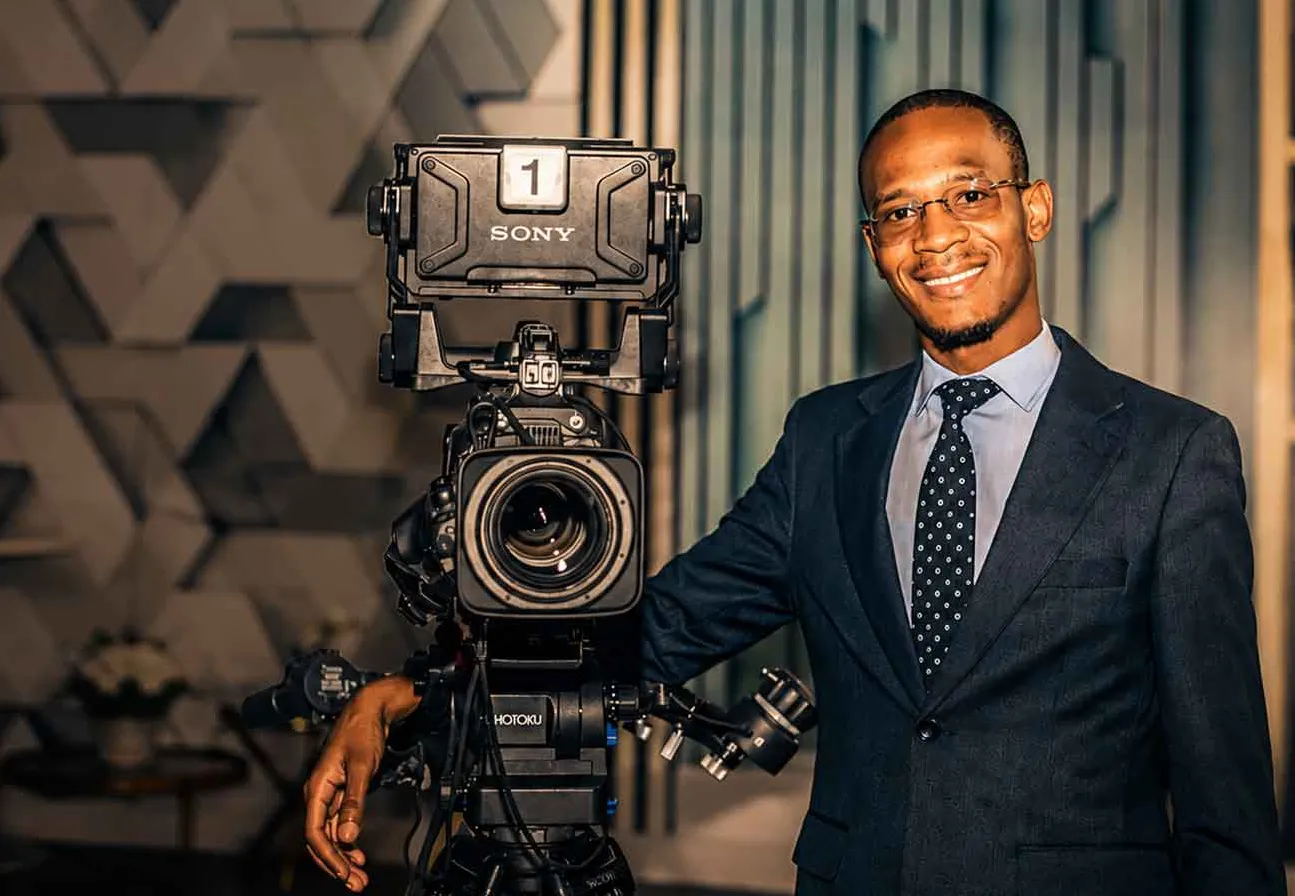
Among microphones, cameras and stories that never quite left his memory, Rochet Libombo has come to learn that informing also carries weight. What began in childhood, with programmes on Rádio Moçambique, has become a life made of decisions, responsibility and encounters that go on echoing long after the report is over. In this conversation with Xonguila, the journalist and current deputy head of TVM’s Central Newsroom talks about rigour, courage, faith, family and the unseen side of a profession in which silence, too, often communicates.
You began by communicating with children and young people. What of that beginning still lives in you today?
I must say that the best memories I have of the world of communication, since I began, are precisely those built during my childhood. I started in broadcasting at the age of 12, at Rádio Moçambique, and that is where my journey began, on children’s programmes. As I grew older, I also went on to present programmes for young people.
They were very memorable moments, typical of children entering a new field, travelling in a dream and setting out on a journey. We covered many subjects that also affected our own lives, and we taught other children. But what I keep from that time is the rigour, because professionals working with children believe they are more prone to mistakes. So there was a great deal of rigour, a great deal of teaching and a great deal of demand that this knowledge be genuinely put into practice. I keep the rigour and, above all, the passion that drove me then and still drives me today to work in communication.
Rochet Libombo joined Televisão de Moçambique in 2015, at the same time as he began studying Journalism at Eduardo Mondlane University. It was there that he began to realise that communicating would never be merely a matter of speaking to a camera or relaying information. “Journalism means a set of permanent, almost daily decisions,” he says. The move from children’s and youth programmes to a more serious approach made him aware of the weight of the choices made within a newsroom. For Rochet, practising journalism and making decisions go hand in hand, because every message has consequences, impact and responsibility. At the centre of these decisions is always the viewer, especially the one who has little chance of making their voice heard and who often depends on the media to be listened to. “Journalism must not only inform, it must also educate,” he argues. Along the way, he has also learnt that journalism lives daily with pressures and interests. “Journalism is a war, because where there is truth there are interests,” he says. Even so, he believes that rigour and editorial principles must accompany the whole process, right up to the moment the news reaches the public.
Do some subjects demand more courage than others?
Undoubtedly. And here I should take the opportunity to say that, unfortunately, many newsrooms in Mozambique, ours included, have generalist journalists. That is, a single journalist writes about economics, culture, politics, social affairs, science and technology. And there are subjects that require a great deal of courage. Although the decision is very important in these matters, it cannot take the journalist himself into account, only the viewer. It does not tolerate a journalist who dwells too much on “and then what?” “What will happen to me? Where will I end up with this?” Courage flows when the motivation is: “What am I defending with this piece? Whom can I save with this approach?” Strategically, I will not bring up here the subjects that demand more courage, but I will say, for example, that writing the story of a woman who leaves her children every day to go and sell tea and small cakes is different from writing the story of a director-general who devised a scheme to embezzle 400 million meticais. These are matters that show the difference in the courage required at certain moments of our profession.
Artificial intelligence is already changing the way journalism is done. What will disappear first?
Technological tools, generally speaking, do not disappear when they arrive. On the contrary, they evolve and challenge people to adapt. So I think artificial intelligence will evolve over time, but I also think journalism will not disappear. Journalism is already old, and its future has always been questioned with the arrival of radio, television and the internet. But journalism adapted to the technologies that emerged and coexisted with them. I think that is exactly what will happen now. We journalists will have to make this tool, artificial intelligence, our own in order to build narratives and craft stories. So there will be this coexistence, and we need to understand this reality quickly so that it is not a risk to the profession but an opportunity.
Journalism taught Rochet Libombo to love stories, people and whatever lies beyond the immediate answers. Today, he says, he no longer conducts interviews merely out of professional duty. Each conversation has become an exercise in listening and understanding.
Over the years, some reports have stopped being merely work and have taken up permanent space in his memory. One of them took place in 2018, in Vilankulo, while covering the municipal elections. The team received a call about an accident on the EN1 and, when it arrived at the scene, the bus had just overturned. Five people died. “That cry from the people, that agony, still comes back to me today,” he recalls.
Among the victims was a child who was still crying, trapped inside the bus, while people tried to save her. The crying gradually turned into silence. The child lost her life. A year later, in Cabo Delgado, while covering the effects of Cyclone Kenneth, he came across a woman sitting among the rubble of her own home, with a child on her back. Not knowing what to say, he asked her simply: “And now?” The woman began to cry and put exactly the same question back to him. “Stories do not always stay in the archive,” he says. “Sometimes they move us, they stir something in us and they create very hard memories.”
But there are also stories that gave him back hope about the impact of journalism. He recalls the case of a young man who saved passengers from a vessel about to sink at the Maputo ferry pier and who ended up injured and without assistance. After the report aired on TVM’s news bulletin, a campaign of help was mobilised.
It was there that he once again grasped the real reach of the profession he had chosen. And, despite the weight of some stories, he has never felt like giving up communicating. “I thrive on it,” he confesses. “It is remarkable how much I enjoy what I do.”
Does growing up in such an exposed environment force you to adjust who you are, or to defend who you already were?
I think it is always defending. I have always believed I would be a communicator. At least since I have known myself as a person, I recognised that I wanted to be a journalist. And I often say that this is one of the few realities in Mozambique in which a young person manages to achieve their dream, because it is very hard to achieve dreams in our country. But I always decided I wanted to be a journalist and I have always defended that. It is not a question of adjustment under any circumstances. It is truly a question of defence.
Between what you show and what is left unsaid, where do you find yourself?
I think I always find myself in what is left unsaid. And here I come back to the question of pressures, the environment in which I work, the political nature of the country and the editorial line we follow at my institution. Already at university we learnt that institutions have editorial policies and codes, and that the journalist needs to know the code of the institution he is going to work for and try to respect it, because there are consequences when it is not observed. Which often feels like an affront, because journalism knows no limits. Journalism wants freedom, wants to seek, wants to speak, and cries out to tell the truth always. So I think there is always something missing, a message that has not been exhausted and an opportunity to offer a different version of each story we tell. There is always a chance to deepen the narrative. So I prefer to stand on the side of what is left unsaid.
Although he is a reserved person, Rochet Libombo insists that silence, in his life, is a choice and not a necessity. He prefers to speak when he feels he truly has something important to say and when he believes his words can have an impact. When the days weigh heavily, it is to his family that he returns. Curiously, not to silence, but to the noise of conversation, music, dancing and company. It is there that he finds peace, balance and inspiration. “Family ends up being the reason for my struggles and my greatest inspiration,” he says. It was also in the family and religious environment that the first signs of the communicator he would become emerged. He grew up attached to the Presbyterian Church of Mozambique, where he took part in activities such as theatre, recitation, writing and singing. It was in that setting that he caught the attention of a friend connected with radio, who would end up opening the doors of broadcasting to him. Since then, he has never strayed from that path. Rochet says that faith continues to accompany every decision in his life. “God sustains everything I have dreamt, everything I have achieved and everything I still dream of achieving,” he says. Today, he keeps alive the Christian faith he inherited from his family, which continues to guide the way he moves through the world.
After so many stories told, is there a question you are still waiting to ask, or to answer?
Well, perhaps a question I would like to ask. That is also my role as a journalist: asking questions. Journalism is often written to bring about change, all for the benefit of people, nations and the world. And it is sometimes painful when we seek to bring about change and it simply does not happen. We write the same stories year after year. When there are floods, we talk about the people who live in low-lying areas. For years we have been writing about transport in Maputo. These are problems we have been denouncing for a long time and for which we still see no change. So perhaps the question is: what does my profession lack for these changes to occur? Or perhaps: what is the insensitivity of those who should bring about these changes and do nothing? And we should not look at this question merely from a political standpoint, as if only those in government should act. All of us, as a society, have a responsibility. Since I came to journalism, I keep talking about the same problems. What is missing?


