
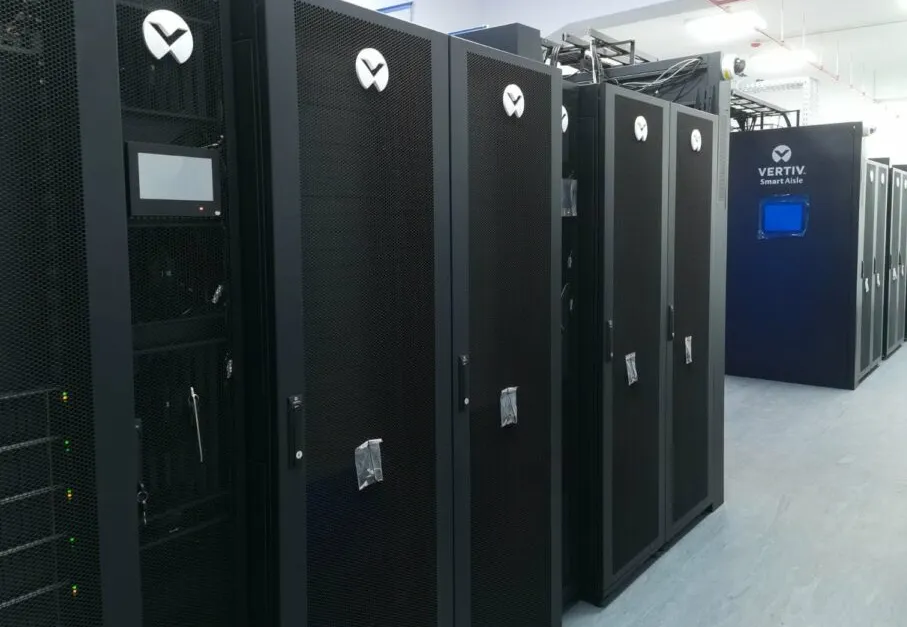
Eduardo Mondlane University (UEM) took a strategic step this Monday towards strengthening the technological capacity of Mozambican higher education, with the inauguration of a new Data Centre designed to support the country's digital transformation. At the ceremony, held on the institution's Main Campus, the Minister of Communications and Digital Transformation, Américo Muchanga, argued that universities must take on a central role in producing knowledge, in innovation and in training skills able to meet the challenges of the digital economy.
The minister considered that the new infrastructure embodies the Executive's strategy of modernising public services and accelerating national digitalisation, stressing that technological progress depends directly on the ability of higher education institutions to train the professionals who will lead this process. “It is not possible to carry out a digital transformation without knowledge, or without innovation,” he said.
During his address, Muchanga also challenged Mozambican universities to take over management of the Mozambique Research and Education Network (MoRENet), currently coordinated by the Ministry of Communications and Digital Transformation. In his view, administration of the network should pass to the academic and research institutions themselves, following models already adopted in several countries.
The minister explained that MoRENet currently has a bandwidth of 60 Gbps, secured by funding lasting 15 years. However, he warned of the need for universities to start preparing now mechanisms to ensure the platform's financial sustainability, in order to guarantee its continuity and future expansion.
“Fifteen years pass quickly. Conditions must be created so that, when this period ends, universities are able to secure new connections and meet the technological demands, which will certainly be much greater,” he cautioned.
Américo Muchanga also stressed that digital transformation requires ongoing investment in strategic areas such as cybersecurity and artificial intelligence, advocating close cooperation between the Government, academia and the private sector to ensure that these technologies are put at the service of Mozambique's economic and social development.
On the same occasion, he pointed out that artificial intelligence holds both opportunities and challenges, and that it falls to universities to develop research and knowledge that make it possible to maximise its benefits and mitigate the risks associated with its use.
“Our challenge is not to stop artificial intelligence, but to ensure that it serves our economy, the improvement of public services and national development,” he said.
Another aspect highlighted by the minister was the sustainable component of the new infrastructure. The Data Centre incorporates a solar-powered supply system, reducing exclusive dependence on the conventional electricity grid and reinforcing the commitment to environmental sustainability.
In his view, this model could serve as a reference for future data centres to be installed in the country, especially at a time when processing artificial intelligence applications requires high levels of energy consumption.
Besides strengthening the technological resilience of Eduardo Mondlane University, Muchanga argued that the Data Centre should evolve into an infrastructure of national interest, capable of hosting, in future, services from other universities, public institutions and strategic platforms linked to the education sector.
Among the possibilities mentioned is hosting digital content for primary, secondary and pre-university education, making use of the installed capacity to serve an ever wider range of users.
At the ceremony, the rector of Eduardo Mondlane University said the new Data Centre forms part of a set of investments intended to strengthen the institution's scientific and technological capabilities. Among these initiatives he highlighted the recent inauguration of the Robotics and Automation Laboratory and the opening, later this month, of an Artificial Intelligence and Robotics Room.
According to the rector, the new infrastructure, together with the guidelines the university is preparing to promote responsible use of artificial intelligence, will help consolidate a technological ecosystem geared towards strengthening teaching, scientific research, innovation and the delivery of digital services.
He added that the Data Centre will significantly increase UEM's capacity to host its systems, strengthen cybersecurity mechanisms and create better conditions for developing projects in data science, artificial intelligence and advanced computing, thanking the Government, through the Ministry of Communications and Digital Transformation, for the support provided in bringing the project to fruition.


