
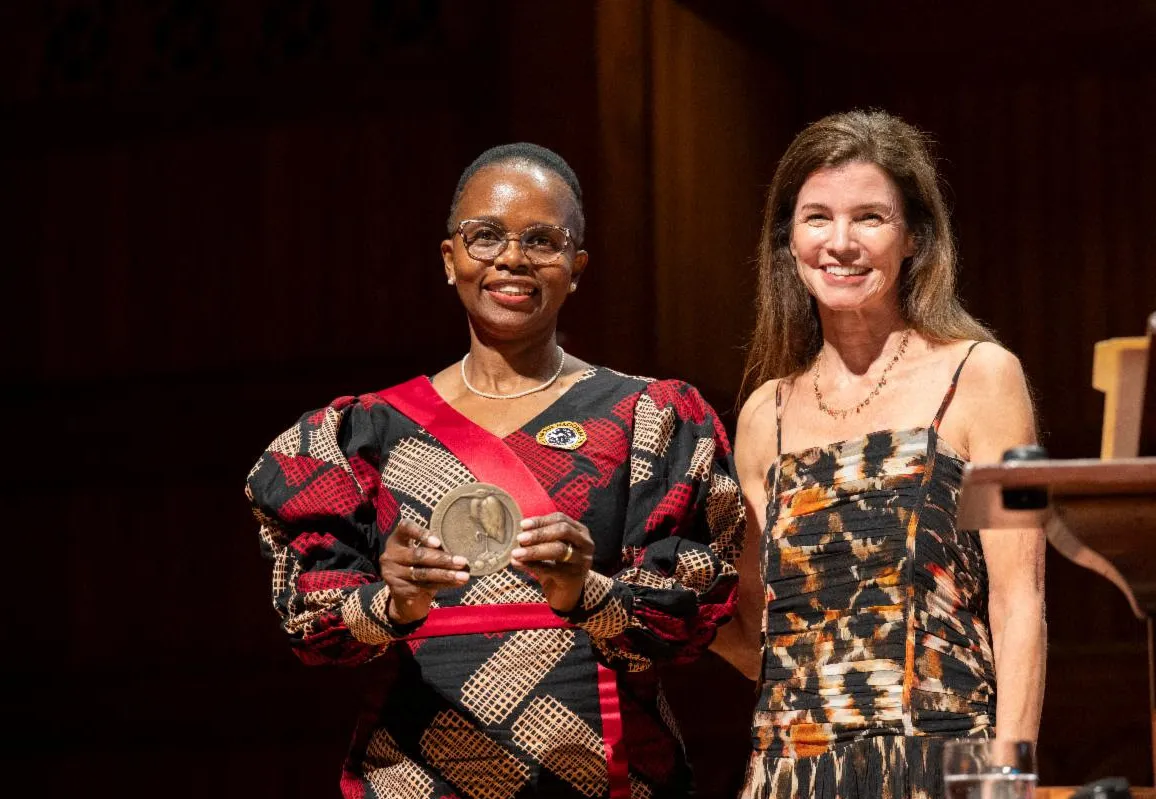
Gorongosa National Park has once again placed Mozambique in the international spotlight. More than two decades of wildlife recovery, scientific research and community development have earned the Gorongosa Restoration Project the E.O. Wilson Legacy Award for Transformative Conservation Leadership, an international distinction recognising initiatives that have made a significant impact on biodiversity protection.
The award was presented on 12 October 2026 during the Half-Earth Day celebrations at Harvard University's historic Sanders Theatre in Cambridge, Massachusetts, United States. The ceremony brought together scientists, conservationists and institutional representatives to honour a project that has transformed a landscape devastated by war into one of Africa's most remarkable examples of ecological recovery.
Aurora Malene, President of the Gorongosa Restoration Project, accepted the award from Dr Paula J. Ehrlich, President and Chief Executive Officer of the E.O. Wilson Biodiversity Foundation, on behalf of the scientists, conservation rangers and teams working with communities surrounding the Park in education, healthcare, forestry and agriculture.
Gorongosa thus became the second recipient of the award, which was established in 2025 and first presented to American actor and conservationist Harrison Ford.
The symbolic passing of the baton took place through a video message in which Ford recalled biologist Edward O. Wilson's profound connection with Gorongosa and highlighted the commitment of Mozambican professionals to preserving its natural heritage.
"Ed Wilson loved Gorongosa. He said it was just as it had been before humanity arrived," the actor recalled.
Ford emphasised that the Mozambican rangers, scientists, teachers, doctors and young people involved in the project had devoted more than 20 years to protecting and restoring the Park, describing the recognition as thoroughly deserved.
The ceremony opened with the screening of a film narrated by Greg Carr, revisiting Wilson's experiences in Gorongosa and showcasing the work of young Mozambican researchers who are now carrying forward his scientific legacy.
In her address, Aurora Malene sought to convey the deeper significance of environmental restoration, beyond the visible results of recovering wildlife populations and ecosystems.
"Perhaps the greatest measure of restoration is not just what we bring back. It is what we make possible," she said.
Following her speech, Malene took part in an onstage conversation with Dr Susana Carvalho, Gorongosa's Director of Science, moderated by presenter Adrienne Keene.
Among those attending was Mozambique's Ambassador to the United States, Alfredo Nuvunga, who was part of the Mozambican delegation at the ceremony.
For the diplomat, Gorongosa's significance extends beyond environmental conservation and reflects the country's own historical journey.
"For Mozambique, Gorongosa is much more than a national park. It is a living symbol of peace, reconciliation, resilience and hope," he declared.
Nuvunga said the Park's recovery demonstrated how nature and communities can rebuild after periods of adversity, drawing a parallel between Gorongosa's transformation and Mozambique's capacity for renewal.
From devastation to wildlife recovery
Gorongosa's recent history has been marked by one of the most profound ecological transformations recorded in Mozambique.
Between 1972 and 2000, largely as a result of Mozambique's civil war and its aftermath, the Park lost more than 90% of its large animals. Entire mammal populations were drastically reduced, leaving one of Africa's most important ecosystems in an extremely vulnerable state.
Restoration efforts began in the early 2000s and gained fresh momentum in 2008 with the establishment of a public-private partnership between the Government of Mozambique and the Carr Foundation.
Since then, biodiversity recovery has been accompanied by investment in scientific research, the training of Mozambican professionals and improvements in living conditions for communities living near the Park.
The results reveal the scale of this transformation.
Today, Gorongosa's wildlife biomass exceeds the levels recorded in the 1960s, before the civil conflict, surpassing 100% of the benchmark established for that period.
Species such as elephants, waterbucks, impalas, hartebeests, kudus and bushbucks have returned to extensive areas of the landscape, alongside a rich diversity of birds, reptiles, amphibians and fish.
The recovery of the lion population is one of the most striking indicators of this process. In 2004, fewer than ten lions remained. Today, the population exceeds 250.
For those responsible for the project, these figures reflect a transformation that goes beyond the return of wildlife: they also represent the rebuilding of the conditions needed to ensure the long-term survival of ecosystems.
The scientific legacy of E.O. Wilson
Edward O. Wilson's connection with Gorongosa began in 2008, when Greg Carr had just concluded an agreement with the Mozambican Government to restore the Park.
Carr, who regarded Wilson as the most influential biologist since Charles Darwin, shared the news of the partnership with him.
The scientist's reaction remained etched in his memory.
"He looked at me and said, 'That makes my heart leap,'" Carr recalled.
Wilson would visit Gorongosa on three occasions, spending approximately a month there on each trip.
During these expeditions, he and his team identified more than 200 species of ants, including 20 previously unknown to science.
The scientist also involved young Mozambicans in research activities, welcoming them as field assistants and helping to inspire a new generation to pursue scientific careers.
The experience inspired part of his book A Window on Eternity, published in 2014, in which Wilson presented Gorongosa's extraordinary biological richness.
His name remains associated with the Park's principal research centre, the E.O. Wilson Biodiversity Laboratory, located in Chitengo, where a significant proportion of the scientific work now receiving international recognition continues to be carried out.
Mozambican research gains international recognition
Science has become one of the fundamental pillars of Gorongosa's recovery.
More than 80 universities currently collaborate on research activities in the Park, including internationally renowned institutions such as Harvard, Princeton, Stanford, Oxford, Cambridge and Lyon.
Scientific work conducted across the Greater Gorongosa landscape has documented more than 8,000 species, approximately 200 of which were previously unknown to science.
Training Mozambican researchers is central to this strategy.
The Park hosts the world's only Master's degree programme in Conservation Biology conducted entirely within a national park, having already trained 48 Mozambican students.
Graduates now hold positions in national parks, universities and government institutions, helping to strengthen the country's scientific and technical capacity.
Meanwhile, six members of the Park's teams have secured competitive scholarships for doctoral programmes at leading universities in the United Kingdom, Portugal and South Africa.
Scientific output has already exceeded 100 articles published in specialist journals.
Among the studies attracting the greatest international attention is research published in the journal Science, which demonstrated how decades of ivory poaching contributed to an increase in the proportion of tuskless elephants.
Another study, published in iScience, documented the discovery of the first fossil sites at the southernmost end of the African Rift System, expanding knowledge of the region's geological and biological history.
Research continues to reveal new dimensions of local biodiversity.
In July 2026, a team from the E.O. Wilson Biodiversity Laboratory, led by Dr Jacinto Mathe and coordinated by engineer Dadzie Tarua, conducted an 11-day scientific expedition.
During this period, approximately 592 taxa of plants, animals and fungi were recorded.
Of these, 48 had never previously been documented in the Park, including 25 insects, 20 fungi, two plants and a frog species identified as Afrixalus crotalus.
The researchers also identified a dung beetle belonging to the genus Drepanocerus, which may represent a species new to science.
For Susana Carvalho, these advances demonstrate the importance of placing Mozambican researchers at the centre of scientific knowledge production.
"Our work is now led by Mozambican scientists and reflects the very essence of what Gorongosa represents: science in the service of people and nature. We believe science only has value if it develops people alongside knowledge," she said.
Greg Carr reinforced the same perspective, arguing that scientific research should guide ecosystem management, protect biodiversity and simultaneously contribute to sustainable human development.
"Science is at the centre," he summarised.
An award recognising tangible achievements
Established in 2025 by the E.O. Wilson Biodiversity Foundation, the E.O. Wilson Legacy Award for Transformative Conservation Leadership honours individuals and organisations that make exceptional contributions to protecting biological diversity.
The recognition is based on three fundamental dimensions: scientific contributions to conservation, public engagement and the ability to mobilise initiatives that deliver measurable results.
The award seeks to perpetuate Wilson's vision that humanity finds one of its noblest expressions when confronting great challenges in defence of all forms of life.
The 2026 edition of Half-Earth Day also held particular significance, marking the tenth anniversary of the launch of the Half-Earth movement.
The initiative emerged from Wilson's call to protect half of the planet's land and oceans, with the aim of ensuring the conditions necessary for the survival of other forms of life.
The celebration was jointly organised by the Harvard Museum of Comparative Zoology, Harvard University Herbaria, Harvard University Native American Program, Harvard University's Salata Institute for Climate and Sustainability, and the E.O. Wilson Biodiversity Foundation.
A legacy spanning generations
Edward O. Wilson, who lived from 1929 to 2021, was one of the most influential figures in modern biology.
A professor at Harvard University, he distinguished himself as a world authority on the study of ants and became an internationally recognised figure in biodiversity research and conservation.
Throughout his career, he received two Pulitzer Prizes and was awarded the United States National Medal of Science.
Frequently described as the father of biodiversity, Wilson left a scientific legacy that continues to guide researchers and conservation organisations in different parts of the world.
In Gorongosa, that legacy remains visible in laboratories, scientific expeditions, the training of young researchers and the daily work of protecting wildlife.
Remembering the scientist, Greg Carr highlighted a quality that, in his view, went beyond Wilson's intellectual greatness.
"Ed Wilson was a great man, but he was also a good man. And it is not very often that those two qualities come together in the same person."
The award now presented to Gorongosa therefore represents more than recognition of environmental recovery. It marks the continuation of a project in which science, conservation and human development are closely interconnected, with a new generation of Mozambicans assuming responsibility for preserving and building upon that legacy.


