
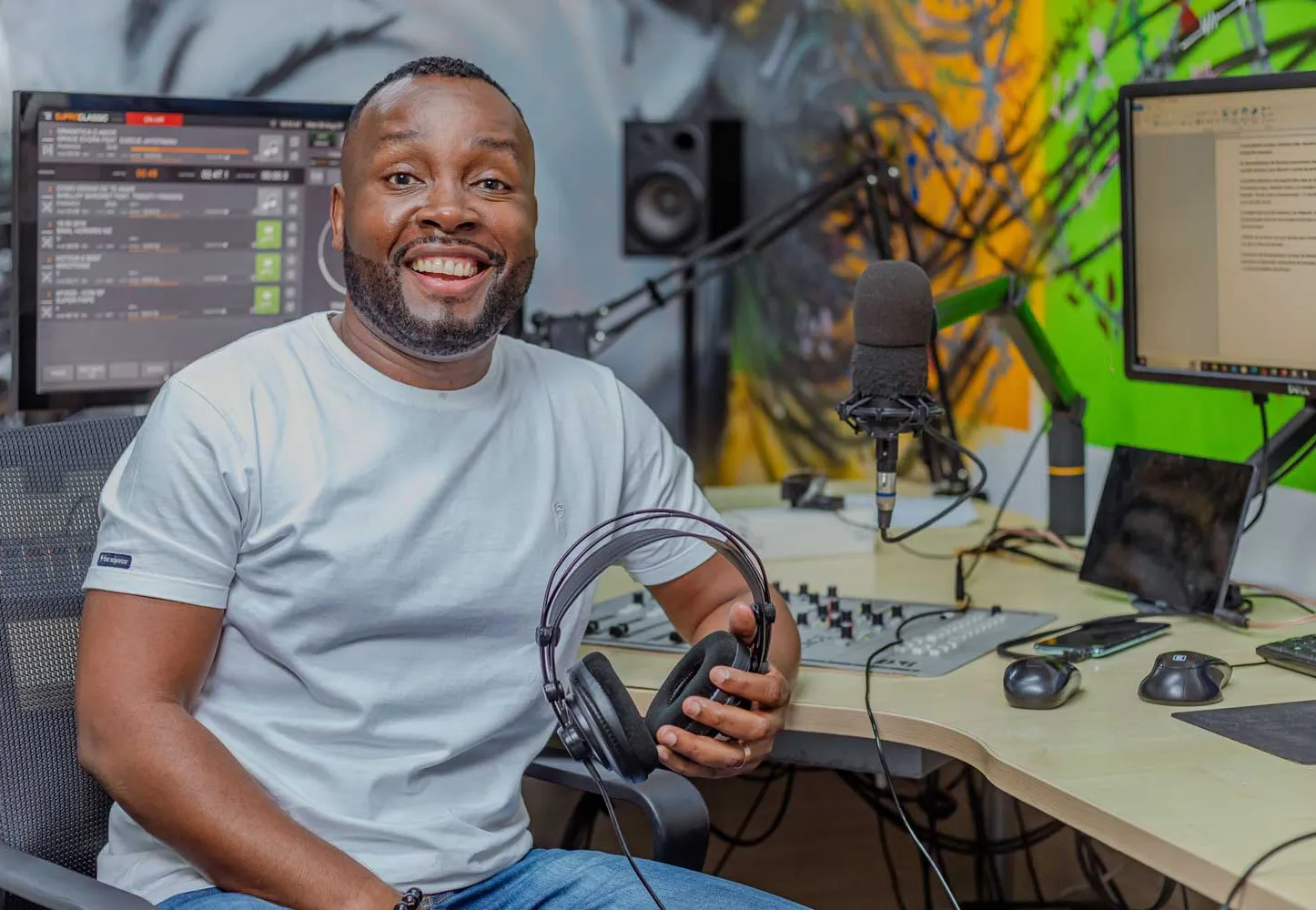
Sérgio Faife's voice is not merely familiar — it is a presence. For more than thirty years, it has crossed generations in radio and television programmes that became part of our collective memory. Behind the “ambassador of joy” and the record-holder of radio marathons, there is also a man made of silences, losses and profound choices. In this conversation with Xonguila, Faife tells us about the little boy who dreamed of helicopters, the pain of losing his mother, the value of family and the responsibility of continuing to speak — even when life asks for a pause.
Your story with radio begins very early. What fascinated you so much about that world of sound, when you were still a child under the table imagining a helicopter?
I can't understand why, but it's a very old passion. I remember sitting under the dining table and imagining a helicopter. That was also because, back then, I used to watch a series in which an actor had an all-black helicopter — that helicopter worked wonders. I would sit there giving commentary: look, now the red car is going past, the traffic light is green. My mother would find me talking to myself and I would be left feeling terribly awkward. Then I started following the radio programmes, glued to the speaker, as if the person might step out of it — and it fascinated me. I even created an imaginary radio station, Faife Star Radio 2010, with a full schedule. There was also a phase when I would take my father's radio, turn the volume up during the songs and, when the presenters spoke, turn it down and talk over them. I would take Mozambican songs, change the lyrics and put in something of my own. Radio has always been present in my life. Always.
You have worked on more than 25 radio programmes and 12 television ones. Which of them left the greatest mark on you — and why?
The television programme that left the greatest mark on me was the first one, Ritmos, on Miramar. And then Alô Família, my first on public television, with which I won many awards. Mozambique came to a standstill on Fridays to watch Sérgio Faife. I had a countdown: "It's one, it's two, it's three, it's four, it's Faife!" — and people would shout: "Alô, Família!" That programme was considered by CNN to be the best talk show in Southern Africa, and a team came here to understand how we did it. I treasure it dearly. On radio, what left the greatest mark on me were the marathons of uninterrupted hours, reaching 60 hours. But perhaps it was 9 Loucuras, on 9FM (later 99FM), because I could finally do what I wanted. Bruno Morgado and Nelson Camal told me: "Shine, do whatever you want!" — and that moved me deeply.
When did you realise that your voice had power?
I realised it when, near the Escola 16 de Junho, I was chatting with the musician Zé Pires. At the time I was presenting Alô Família and he said to me: "Look, Faife, you have enormous power. You have a microphone at your disposal, a huge audience. With it, you can change things, work wonders and have a positive influence. Use it to help others." I think that was when it clicked in my career.
You are known as the “ambassador of joy”. But behind the smile, there have been difficult moments. How do you turn pain into positive energy?
I turn pain into positive energy through the love I have for radio, for television — for my work. I love what I do, I love my family and I love seeing people happy. Even on the days when I am feeling low, the simple fact of bringing joy to someone, whether on radio, on television or outside those worlds, changes my frequency.
The loss of your mother was a turning point in your life. How did that moment shape you — and if you could interview her again today, what would you like to ask her?
This is a powerful one, because when people talk about my mother, I change completely. Many times people ask me: "What was the saddest moment of your life?" Before they have even finished the question, I am already answering: it was my mother's death. Because it was something that… no, no… it isn't a wound — it is a wound that, to this day, is still open. It is open. And it is very, very hard. Very hard. Did that moment shape me? I think so. Perhaps that is when I began to value life more. I really began to value life. And family union too, the unity within the family. To make the most of it. To be closer together. I changed a great deal, truly. Today I am very attached to these things. I want to see all my brothers and sisters, Dad, the family, all together. And when that doesn't happen — when we fall out over little things and can't get past them — it hurts me. It pains me greatly. Because we are only passing through, and we have to make the most of every moment. Family is that core where people… it is where we know one another. We know one another better than anyone else does. And when we can't overcome obstacles together… for me, that is hard. I can't digest it. How can families not manage to be united? I think there shouldn't be borders within families. There shouldn't be any borders. There shouldn't. There must be love. Compassion. And, above all, empathy. Empathy. What would I like to ask her? Well, this question of death… it is something that — right — I would like to understand better. Because I believe very much… I wanted to speak about a topic that perhaps wouldn't open up so many other debates. But interview her? No… right now, I would just like to hug her. Yeah. Perhaps… an endless hug.
Have you ever presented a programme pretending to be fine when, inside, you felt you were falling apart? How do you bear that?
I have done several programmes like that. Really, quite a few. But, as I said before, when we love what we do… when the director says "you're on air", look, the frequency changes. If I was on the wrong frequency, the right one arrives there and then. And that joy comes, that good humour — even when, inside, I am bleeding. On radio it is exactly the same. How many times have I left home with no feeling at all, and arrived at the radio station still with no feeling…, but when the microphone opens, the spirit fills with energy. For example, you have just reminded me of a very difficult moment in my life. I became seriously ill. Very close to losing my life. And I was in no condition to present a special edition of my programme. At the time, the programme was called Sérgio Faife — it was on TVM. I think I am telling this for the first time. I was seriously ill, bedridden, without strength; I lost a lot of weight. And we had a special edition prepared some time before: outside the television studio, with an audience, a live crowd, guest musicians, two football matches — everything was going to be broadcast live. The Chairman of the Board of Directors was going to be present. It was a great joy for all of us... but I was in no fit state. I remember that, two days before, I went to the doctor almost crawling. I told the doctor: "I need medicine that works instantly, because on Sunday I have a special programme." Even with the medication, I wasn't recovering. But I ended up presenting the programme anyway. When it began… I don't know where that energy came from. I managed to present from beginning to end. But, as soon as I got into the car, I collapsed. I went back to square one. And one of the things that touched me most was that my brother was there. At the end of the programme, I heard him say to someone: "That young man who was jumping about there — wasn't he the one who was ill? He was jumping about there and presenting the programme..." Yeah, it's something surreal. It's something I myself can't explain either.
What have you never said on air because you knew it could change the course of a life?
Many things. I am planning to launch a book in 2026 with texts I have shared on social media. But I want to leave another one, to be published only after my death, with the rights going to my children. Perhaps then I will answer this question.
You are the only broadcaster in Mozambique whose radio marathons have reached 60 hours. What drives you to break these records?
It is a way of giving of myself and of proving to myself that I am capable. It is a personal challenge; I am not there to compete. Proposals to do more hours have already come up, but I cannot lie to myself. I take the opportunity to share joy and positive messages, and people interact with me throughout those long hours.
Is there a song you keep just for yourself, one you have never played on air?
I really like Paradise by Coldplay, and I have already played it on air. It is the song I would like to be played at my funeral, because I truly love Paradise.
You have a very affectionate relationship with the public. Have you ever feared losing that affection?
No. I have been present in people's lives since I was 11 and have never felt fear. I have always taken things naturally and built a real and beautiful relationship with the public. As for social media, I embraced the change straight away and adapted to the new dynamic, which I consider very important.
Between the power of the image on television and the intimacy of radio, where do you feel people know you better?
I think they prefer listening to me on radio, where I loosen up more and am more myself. On television, I often present programmes that already come with their own dynamic, although I try to add my own touch. That is why I am fighting to have a weekly programme of my own, with an audience, a band and a big studio, where viewers would get to know more of me. I have many influences, such as the broadcaster José Baleira, and also Brazilian, Portuguese and North American ones. Mozambican culture has shaped me a great deal, especially since the programme Ritmos, where I interviewed the great names of Mozambican popular music, an experience that helped me become the true Sérgio Made in Mozambique.
Is there a place in Maputo that brings back memories without you asking?
The Prédio Guimarães, next to the Ministry of Health, on Avenida Eduardo Mondlane. I grew up there, in the Central district, and whenever I pass by the memories come flooding back: my childhood, playing with the neighbours, my parents before they separated. There was a neighbouring couple, Portuguese, with two children, Carlito — whom I called Quitos — and Nádia. Today they live in Portugal and South Africa. I have good memories.
Finally, Sérgio: when you switch off the microphone and the cameras, who is Faife offstage?
I think I am the same. I like television, listening to international radio stations, watching the news, series and films on YouTube. I really like being at home — it is my safe nest. I lived alone for many years and that means that today I appreciate silence. I like being alone, meditating, thinking about myself, reading, watching television or writing.


