
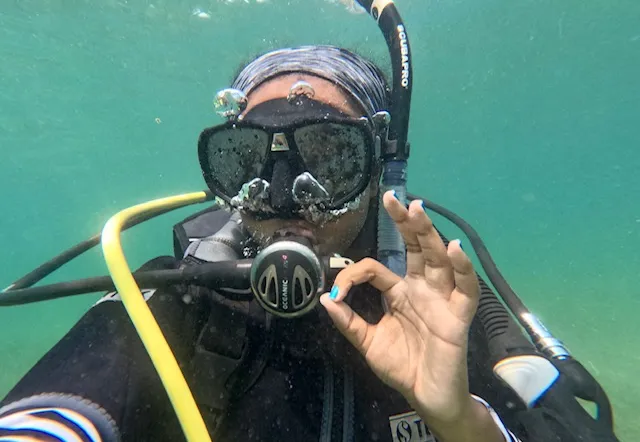
On the historic Mozambique Island, where the deep blue of the ocean embraces centuries-old stories, Samira Jamú was born and raised. Today, she is an example of strength and determination, using the sea and its culture as tools to protect legacies and inspire the future. A scientific diver, founder of Orampelela and advocate of sustainable development, Samira has turned challenges into bridges to progress. "I am just a girl from the Island who loves the sea and is full of dreams", she says, with the humility of someone who has never forgotten her roots, but with the determination of someone who dared to go beyond them. Her journey reflects not only a story of overcoming obstacles, but also a deep love for the natural and cultural heritage of the Island.
Childhood on the Island: between waves and dreams
In a community where the sea was traditionally male territory and women devoted themselves to household tasks, Samira found in the ocean something that went beyond sustenance: an endless source of possibilities. From an early age, she was driven by curiosity to know what lay beyond the coast. Her childhood was marked by moments of fascination as she swam, collected shells and watched fishermen and divers. She was also inspired by the archaeologists who visited the Island, bringing with them stories of submerged worlds. Despite cultural and gender barriers, Samira learned to dive while still young, breaking limits and forging new paths. She became the first young female scientific diver on Mozambique Island, an achievement made possible by the Slave Wrecks project, dedicated to the study of shipwrecks linked to the slave trade: “Underwater archaeology gave me a new perspective on my history and identity. Every dive is like stepping through a portal into the past and connecting with my ancestors.”
The birth of Orampelela
Samira's first scientific dive revealed to her an underwater world of rare beauty and diversity, which awoke in her the desire to protect that fascinating ecosystem and share it with her community. Thus Orampelela was born, a project that combines environmental conservation, the promotion of marine biodiversity and heritage education. The initial difficulties were many: from the scarcity of resources to cultural criticism for being a woman working at sea, wearing diving suits, considered "improper". "It wasn't common for women to work at sea, let alone wear diving suits. But I decided that nothing would keep me from my dreams", Samira recalls. Today, Orampelela carries out activities such as coastal clean-ups, environmental awareness-raising and workshops, especially involving young people. This work has already brought significant changes to Mozambique Island, creating regular beach-cleaning systems, collecting data on marine species and protecting coral reefs. Recognised on global platforms such as National Geographic and CNN, Samira has also won awards for underwater photography, amplifying the impact of her work. "Community inclusion has been one of the greatest triumphs. Seeing children, young people and local leaders take part in the initiatives gives me hope for a sustainable future", in her own words.
Education and sustainable tourism
For Samira, education is the pillar of social transformation. "When we teach good practices, we help people to understand the value of the resources they have and to use them consciously", she stresses. She also believes in the potential of sustainable tourism as a tool for development. For Samira, Mozambique Island's status as a World Heritage Site is an opportunity to generate benefits, provided there is a joint effort between communities, tour operators and institutions.
Dreams and futures
Samira dreams of creating the Island's first community diving centre, dedicated to sustainable underwater tourism and to building the skills of young people, especially women. "We want local young people to be protagonists in the management of the natural and cultural heritage of our Island", she explains. The wish to complete a master's degree is a personal goal, but her greatest aspiration goes beyond that: "I hope my story inspires others to pursue their own dreams." To young women facing cultural barriers, she offers a piece of advice: "Don't be afraid to occupy spaces and to question traditions. Some practices need to be reviewed, and diving is a wonderful way to explore and protect what is most valuable to us."
The story of Samira Jamú is an invitation to look at the ocean and the world with fresh eyes. After all, as she says: "The important thing is to know how to use the resources we have to build a better future."


