
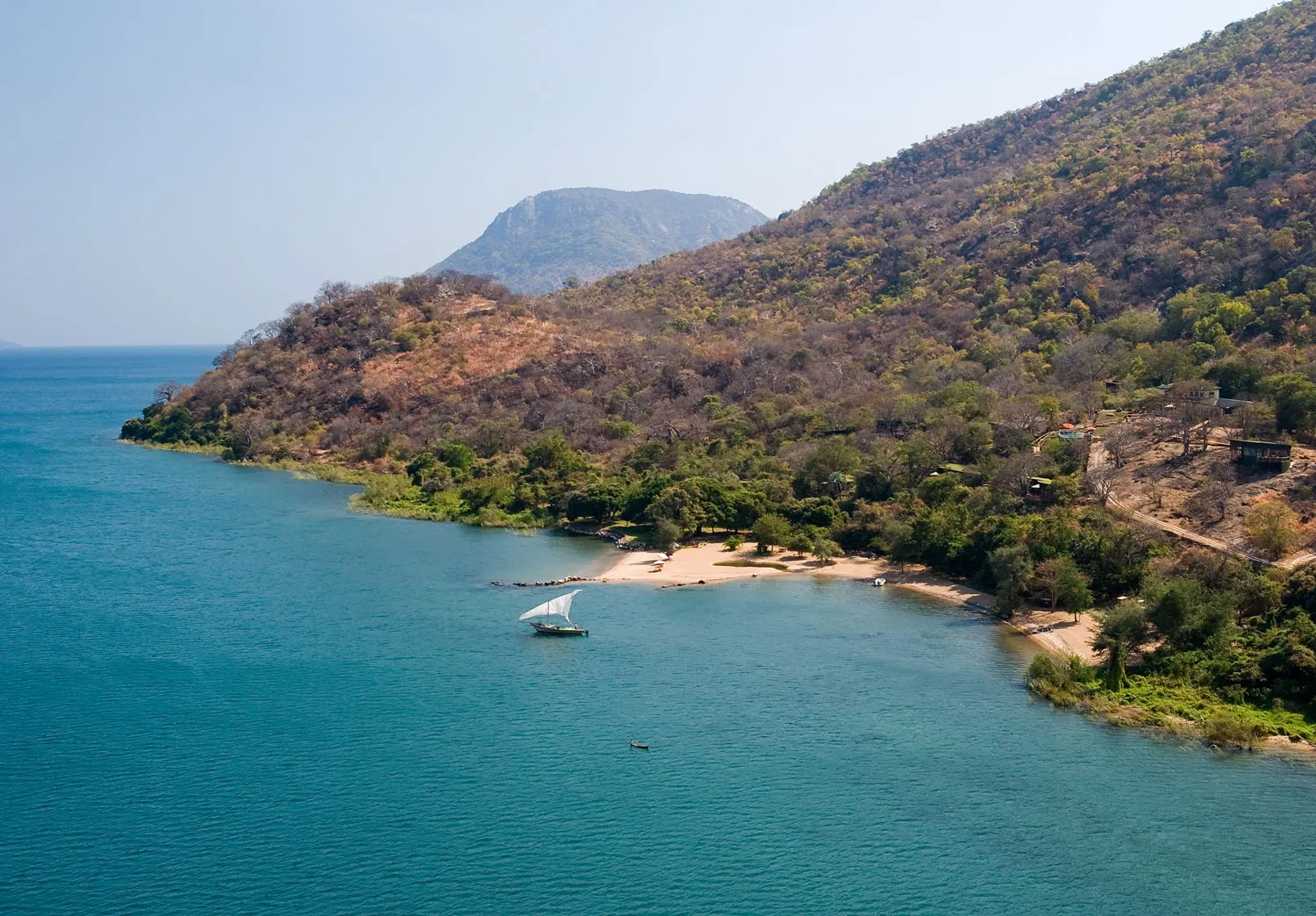
Did you know that Mozambique has one of the lakes with the greatest diversity of species in the world?
Lake Niassa, estimated to be between one and two million years old, is one of the African Great Lakes, the third largest on the continent after Lakes Tanganyika and Victoria, and ninth in the world ranking. With a length of 560 kilometres, a width of 80 kilometres and a depth of 700 metres, it lies in the Great Rift Valley, at the junction of Mozambique, Malawi and Tanzania, over an area of some 31 thousand square kilometres, of which 6,400 are Mozambican territory. It sustains nearly 10 million people in the three countries.
Its limpid waters, abundant in hydrocarbons, possess a rich biodiversity of fauna and flora, amounting to 700 thousand different species, which gives them a high value for scientific research. Some thousand species of cichlids (a family of freshwater fish) live in them, about 30% of all known cichlids.
Lake Niassa is one of the African Great Lakes, the third largest on the continent, and ninth in the world ranking
The Mozambican Government has devoted great attention to Lake Niassa, declaring it a reserve in 2011. In the same year, the Lake and coastal zone were added to the list of wetlands protected by the Ramsar Convention, the Convention on Wetlands of International Importance. The natural beauty of the lake invites swimming and boat trips, giving the region immense tourism potential.
It should be mentioned here that relations between Malawi and Tanzania over the ownership of a portion of the lake have not been easy. While Malawi, on the one hand, claims exclusive ownership of that portion under a treaty signed in 1890 between Britain and Germany, the former colonial powers of the two countries, Tanzania, on the other hand, rejects the idea that colonial-era agreements remain in force today, arguing that international law advocates the sharing and enjoyment of resources if territorial boundaries so require. This dispute began nearly 50 years ago, when the two countries became independent, and escalated in 2012, when the late president of Malawi, Bingu wa Mutharika, granted a British company the rights to explore for oil and gas there.
As a curiosity, it may be said that, in the Chinyanja language, spoken on the shores of the lake, Niassa (or Nyasa) means “lake”, and the name of the people who live there, the Nyanja, means “people of the lake”.


