
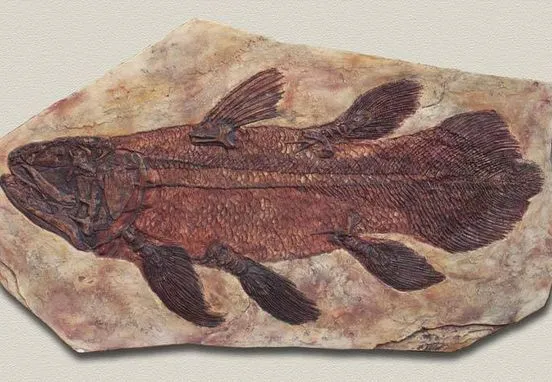
The coelacanth is a prehistoric fish that is considered a true living relic. It was first found off the coast of Mozambique in 1938, after having been thought extinct for more than 65 million years. Since then, its discovery has fascinated biologists and nature enthusiasts all over the world. Its skin is covered in hard, protruding scales, and its colouring is bluish-grey, which allows it to camouflage itself in the depths of the sea. This prehistoric fish can reach approximately two metres in length and weigh around a hundred kilos.
One of the coelacanth's most curious characteristics is its ability to survive at great depths, down to 800 metres below the surface of the sea. This is because it has special organs that help it regulate its body density, allowing it to float at will in the depths of the sea. Another interesting feature of the coelacanth is its unique bone structure. Unlike other fish, the coelacanth has no swim bladder, which gives it an advantage for survival in deep waters. Instead, it has a set of special bones that work like a sort of buoyancy jacket, allowing it to float effortlessly, which helps it save energy.
It was first found off the coast of Mozambique in 1938, after having been thought extinct for more than 65 million years.
Despite its historical and biological importance, the coelacanth is considered a rare and threatened species. Because of its ability to survive at great depths, it is very difficult to study, and little is known about its population and way of life. In addition, overfishing, habitat degradation and pollution have contributed to the decline of this population worldwide.
The discovery of the coelacanth in Mozambique was an important milestone in the history of marine biology and, since then, the country has become one of the few places in the world where it can be seen with some regularity. The coast of Mozambique is a prime environment for observing the coelacanth owing to the presence of corals and sandbanks, places where the fish tends to live.
Before a living specimen was discovered, the coelacanth was believed to be a close relative of the first vertebrate to leave the water, giving rise to a new group of vertebrates known as tetrapods, which includes humans. New discoveries indicate that the coelacanth genome holds information that may help us to better understand the evolution of tetrapods.


