
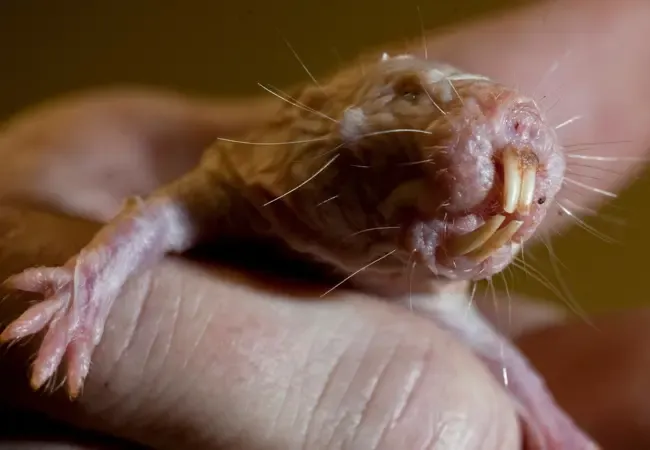
At first glance, they would hardly be chosen as a symbol of longevity. They live underground, have no fur, and their elongated bodies often lead to comparisons with little sausages with teeth. But it is precisely in the body of the naked mole-rat that scientists have found a genetic clue that may help to understand why these animals live so long.
A study has concluded that the naked mole-rat developed, over the course of evolution, a particularly effective DNA repair mechanism, a trait that may be related to its extraordinary longevity.
This species of mammal lives in burrows and can reach around 40 years of age, an exceptionally long span for a rodent. It is, in fact, considered the longest-lived rodent known on the planet.
The study's findings were published in the scientific journal Science in October 2025. The results may also help to explain another peculiarity of these animals: their resistance to several diseases normally associated with ageing.
Naked mole-rats show resistance to cancer, arthritis and deterioration of the brain and spinal cord. These characteristics have made them a prime subject of research for scientists seeking to understand the biological mechanisms of ageing.
The research was led by a team from Tongji University in Shanghai, China, and focused on the process of DNA repair, a natural and essential mechanism that takes place in the body's cells.
When a strand of DNA — which contains part of the genetic information needed for the body to function — is damaged, cells activate systems able to use an undamaged sequence as a template to correct the affected region.
It was precisely in this process that the researchers found a surprising difference.
The team concentrated on a protein called cGAS, involved in detecting cellular changes and in several damage-response mechanisms.
In humans, this protein can interfere with certain DNA repair processes. Scientists believe that this interference may contribute to the development of cancer and, potentially, to reduced longevity.
In the naked mole-rat, however, exactly the opposite happens.
The researchers discovered that the version of cGAS present in these animals promotes the repair of DNA strands and helps to preserve the integrity of the cells' genetic code.
For Gabriel Balmus, a professor at the University of Cambridge in the United Kingdom who specialises in DNA repair and ageing, the discovery opens up a new line of research into the mechanisms that allow these rodents to live for so long.
The researcher considers that the results represent only “the tip of the iceberg” in the attempt to understand what makes the biology of the naked mole-rat so unusual.
“You can think of cGAS as a biological piece of Lego,” explained Balmus. “The basic shape is the same in humans and in naked mole-rats. But in the mole-rat, some connectors are reversed, making it possible to assemble a completely different structure and function.”
According to the scientist, millions of years of evolution seem to have allowed the naked mole-rat to reprogram an existing biological mechanism and use it to its own advantage.
The discovery now raises new questions.
How did evolution make the same protein perform practically opposite functions in different species? What changes occurred during that process? And is this transformation an isolated case or part of a broader evolutionary pattern?
For the researchers, there is also a question with direct implications for humans: will it be possible to learn from these animals how to prevent age-related diseases and extend healthy years of life?
It is this possibility that makes the naked mole-rat especially interesting for medicine.
“I think that if we can reverse-engineer the biology of the naked mole-rat, we could develop many of the therapies needed for an ageing society,” said Gabriel Balmus.
Underground, then, one of the most improbable-looking mammals may be holding one of the most promising clues to understanding one of the great challenges of modern science: growing old for longer without losing health.


