
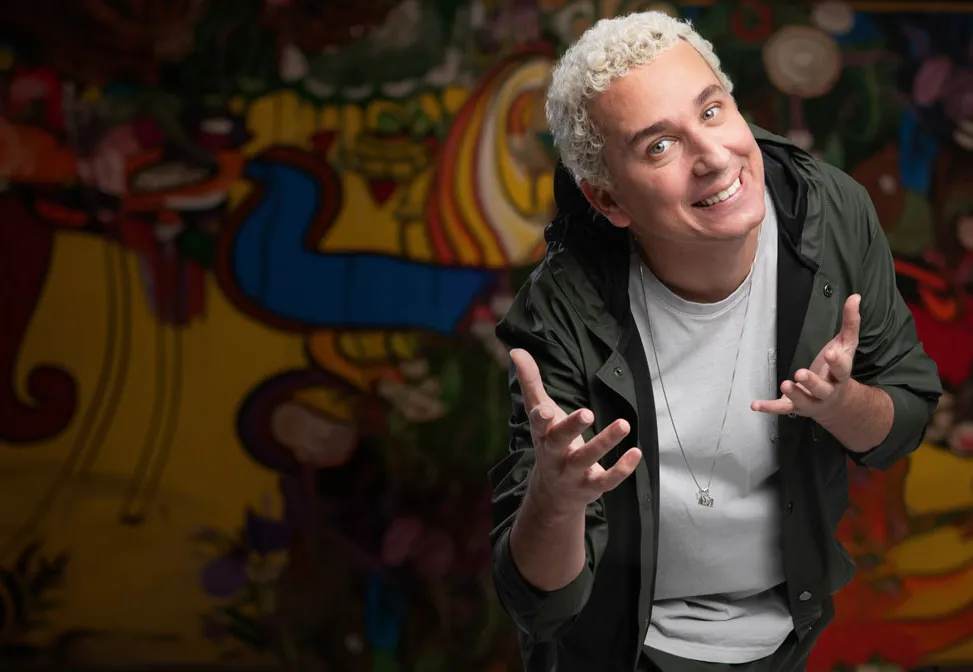
Actor, singer, songwriter and comedian, Rafael Portugal is one of the most popular and acclaimed names in the new generation of Brazilian comedy. Successful in theatre, television, streaming and film, he has won several awards, including Best Actor and Best Comedy, and it has been said of him that he is “joy in the form of talent, in its purest simplicity and truth”. Since 2015 he has been part of the team at “Porta dos Fundos”, one of the biggest Brazilian channels on YouTube, known for its comedy sketches, sarcasm, political satire, absurd humour and dark humour.
Rafael Portugal, aged 38, was born and raised in Realengo, a suburb of Rio de Janeiro, in a family of modest financial means, and it was by taking part in a neighbourhood project that he entered the world of the arts. To learn more about his career and his many artistic facets, Xonguila had the great privilege of interviewing him, and presents him here in his own Portuguese. He told us he is dying to bring his live comedy to Mozambique and to get to know us up close.
How did your upbringing in Realengo influence your humour and your art?
I am privileged! I had a wonderfully rich childhood, even though I was poor: the best friends, stories, family... I always say my friends are fountains of inspiration. Life in Realengo gave me everything I am today as a professional.
What does success in comedy mean to you, especially coming from a suburban background?
I am grateful for this recognition. Being the pride of my friends, neighbours and family is what makes me feel like a fulfilled person. Today, I am happy with my work, and my work is comedy. And having been born in the suburbs gave me all the material I need, both in the difficult moments and in the moments of victory.
How did having a fee of only 5 reais at the start of your career teach you about the entertainment industry and the value of your work?
Wow, it was hard! Many times I thought about giving up, you know? I always knew that the only thing I knew how to do in life was act and make people laugh, and that was it. I would ask myself: “My God, what am I going to do with my life if this doesn't work out? I don't know how to do anything else.”
What inspiration lies behind the creation of “Coração Suburbano” and what are your expectations for the series?
What I found, in fact, were the many incredible lives lived in the suburbs, the many artistic expressions that never reach the asphalt, that live on the hillside, in the far-off corner, in the suburbs. I laughed, but I was far more moved, and I grew. I saw how privileged my own story had been, and I found people genuinely struggling. I wanted to tell those stories!
How important are music and songwriting in your life and career today?
I have always loved music. In my house we always sang everything, and I wanted to learn to play the guitar. I thought the person who played the guitar among a circle of friends was fantastic. One day I learned, and I became that person. However, I didn't know many songs, so I began writing my own, which came to me as I discovered new melodies.
How has the song “João de Barro”, performed by Maria Gadú, affected your path in the music industry?
I have written many songs already, and I even have songs recorded today with L7, Papatinho and PK. But nothing compares with “João de Barro”. In my life, it is so huge, and it has reached so many places. People always ask me: “Is it really yours?”
How do you deal with your insecurities and self-judgement as a public figure and comedian?
Ah, insecurities... I have many, really many. Whatever I'm invited to do, I always hear it with great joy. But I always think that, for whatever it is they're inviting me to do, there is a better person for the job. I sort of have to work through this in my head many times. Because, I think, sometimes the ideas are so good that they invite me to certain projects and I always think of someone else. In fact, the things I write, the scripts and texts I've written, I've always done so thinking of other people performing them. I rather like that outside perspective, you know? But, many times, it sabotages me. I don't feel that courage, I'm afraid of getting in the way, of harming someone else's work, because I don't feel capable. Anyway, I live in this constant process of understanding that I can, yes, do it, and that I can do it very well. So, well... I do, in fact, have the insecurities, this self-judgement. I don't like watching myself; I have an absurd difficulty watching the finished piece, afterwards... I have all of that, all of that is real. But I am happy to be doing work that I really wanted to do. To this day, I have never done anything I didn't want to do or been there out of some obligation, you know? Since I joined Porta dos Fundos and began doing comedy sketches, I have always done everything I wanted to, there, and in the other projects that have come my way. I am very privileged in that regard. I have the privilege of doing incredible things and working with incredible people, with directors and scriptwriters. And that has always been very good for me.
How does self-criticism interfere with your process of creating jokes and sketches?
Ah, I have ideas... I think about it all the time. Everything I see is a scene, and it's even hard to control, because sometimes I don't want to talk about... But everything I hear, everything I see in my day-to-day life, I find a reason to be writing some story, something, you know? I see humour in many things, you know? Whether the most tragic things or the truly very funny ones. Sometimes, things I see and know that people will identify with because they end up doing that very thing in their day-to-day lives. You know? I feel that, and my way of creating and doing is very much rooted in that, in the everyday, in other people's day-to-day lives, in my experiences in Realengo, in the things I saw happen in Realengo. In the many characters, so many funny people, you know? So many entertaining people. I always say this: that my friends are much funnier than I am. If people could see them, my childhood friends are the funniest people in the world and they are my inspiration. So I have that. My sketches are born, more or less, from day-to-day life, from my jokes and from what I feel, you know? Obviously, as far as criticism goes, I feel that today I already have an audience that knows my way of doing comedy and knows my work. So, in comedy, I stay very much in a comfort zone of the things I do, knowing there is a crowd out there that will like my way of doing comedy. I am very grateful for that.
In one of your videos for Porta dos Fundos, you tackle the subject of Portuguese colonisation. This is a topic that resonates in the history of both Brazil and Mozambique. How do you see the role of humour in discussing and even demystifying the legacy of colonialism?
Humour has that power. I have the privilege of making Porta dos Fundos with extremely intelligent scriptwriters. In fact, with a channel that offers a great deal of criticism, using humour as a path, you know? So that we laugh, look, see and say: “Wow, is that how it was?” You know, that wound, that bite that humour puts there for you to see? In fact, they are often obvious things, but which sometimes are not seen or people don't want to see. But, by laughing, we manage to put you in that place of: “Look, it's like this, it was like this, okay? It was this way.” Even though we may be adding something extra that seems exaggerated, and that may often seem like things merely punctuated with humour, it was the plain truth, right? Of error, of sarcasm, of cruelty and of everything you can imagine. And Portuguese colonisation was that! We have many videos on this theme, you know? We really like to hit out, to poke fun, to poke fun at the oppressor, right? The one who oppressed. That is the big point.
Are there elements of the culture of the PALOP countries that influence or inspire your work as a comedian and artist?
Without a doubt, the influence and inspiration that we absorb from childhood in music and culture...
Do you know of any up-and-coming comedy artists or groups in Mozambique and, if so, how do you assess the style and comedic approach they are bringing to the international comedy scene?
I know Maira Santos, who I think is super talented and whom I have, in fact, been following. Besides comedians, I have been enjoying, and laughing a lot at, the big Rap battles.
Bearing in mind that the people of Mozambique show a notable fondness for Brazil, perhaps owing to the historical ties stemming from a shared colonial past, do you believe comedy can serve as a bridge to unite and intertwine the cultures of different countries, such as Brazil and Mozambique?
Of course!!! I think there should be a comedy festival with comedians from Brazil and Mozambique together on one stage.
After being interviewed by Xonguila, Fábio Porchat saw opportunities arise to tour Mozambique. Do you think that, after our conversation, there might be interest in, or the possibility of, taking your stand-up show to Mozambican audiences?
Without a doubt. In fact, I have been part of the same production company as Fábio for some years now, SAYD Produções, which produces our show in Brazil. I hope to perform at the same venues in Mozambique.
What aspects of Mozambican culture and traditions do you think could be explored through comedy to promote deeper understanding and appreciation?
Comedy gives you the opportunity to express yourself in many different ways, and I think Mozambican culture should be expressed in all its aspects. I watch some Mozambican channels on YouTube and, in fact, for some time now I have been following two teachers from Mozambique who make videos reacting to comedy content from “Porta dos Fundos”, “A Culpa é do Cabral” and other Brazilian productions. They give their point of view, always looking at what is similar to Mozambique, among other things. One of them, Pereira Horácio JR, is in Brazil right now, and I even intend to meet him. I want to take him to see a recording of “Porta dos Fundos”.
Would you like to take this opportunity to leave a special message for our audience in Mozambique, who have welcomed Brazilian comedy with such affection and enthusiasm?
Hey, Mozambique! I am dying to meet you in person and to bring my humour to you live. Here I am, counting the days. A big kiss to everyone, and let's make this festival happen!


