
An unknown 'influencer' in contemporary dance
Who is Horácio Macuácua?
Written by: Jaime Álvaro
"I do not know who I am! I am a person who has to discover myself every day." This is Horácio Macuácua, a (little-)known Mozambican choreographer and dancer, who began his career in traditional Mozambican dance in 1996. He says he does not know who he is, but he knows what defines him. Dance is not a mere passion or his profession; it is much more than that. Besides being his life, dance is his soul.
Horácio Macuácua was young when he began dancing, so young that he had never tried anything else. From an early age, dance became his lifestyle, and his artistic destiny was quickly mapped out, with particular dedication to street dance. In 1999, he was a founding member of CulturArte, one of the first contemporary dance companies in Mozambique, where he took part in different performances directed by fellow Mozambican choreographer Panaibra Gabriel. In contemporary dance, he had the opportunity to work with internationally renowned choreographers, such as the Brazilian Marcelo Evelin, the South African George Khumalo, the American Mark Tompkins and the Frenchman Boris Charmatz, among others.
Horácio was born in the city of Maputo, but developed outside the country. Like many children of his time, Horácio discovered his talent in the streets of his neighbourhood. He started with street dance, before specialising in traditional dances, at Casa Velha, and long before learning to dance on the tips of his fingers. "I started at Casa Velha, in the 1990s. I was a teenager, 16 years old. I danced street dance in the neighbourhoods, in competitions, before traditional dance. Casa Velha was a cultural house that welcomed every kind of amateur artist. Casa Velha was a haven for talent," he stressed.
From Casa Velha to the Old Continent: Horácio’s talent was so great that it could not be hidden from the world. In 2001, Horácio travelled to Europe for the first time to present his work. Three years later, he met his mentor, the Venezuelan choreographer David Zambrano: "I met David Zambrano in 2004, when he came to Mozambique. He invited me to go to Austria for training, to work with him in his company, and also to learn the techniques he teaches," is how the young dancer described the encounter that changed his life.
David Zambrano has been dancing for more than 30 years. In his work as a creator and educator, he has already visited 63 countries, worked with thousands of dancers and performed in hundreds of venues around the world. His pieces range from set choreography to structured improvisation and pure improvisation. Born in Venezuela, Zambrano spent 15 years in New York and now lives between Amsterdam and Brussels, continuing to perform and teach around the world. Horácio’s talent makes him an inspiration to many artists in the field and, in a short time, Horácio became a much sought-after teacher in Europe.
The teacher with no school
Horácio never trained at a formal dance school. His true school was the street. It was there that he found himself, that he learned that the movements of the body could replace the voice as a means of communicating with the universe. "My training in dance was mostly watching, because in Mozambique there are no professional dance schools. I come from a street school. But today, thanks to the luck I have had, I teach dance at universities in Europe," he said, with great pride.
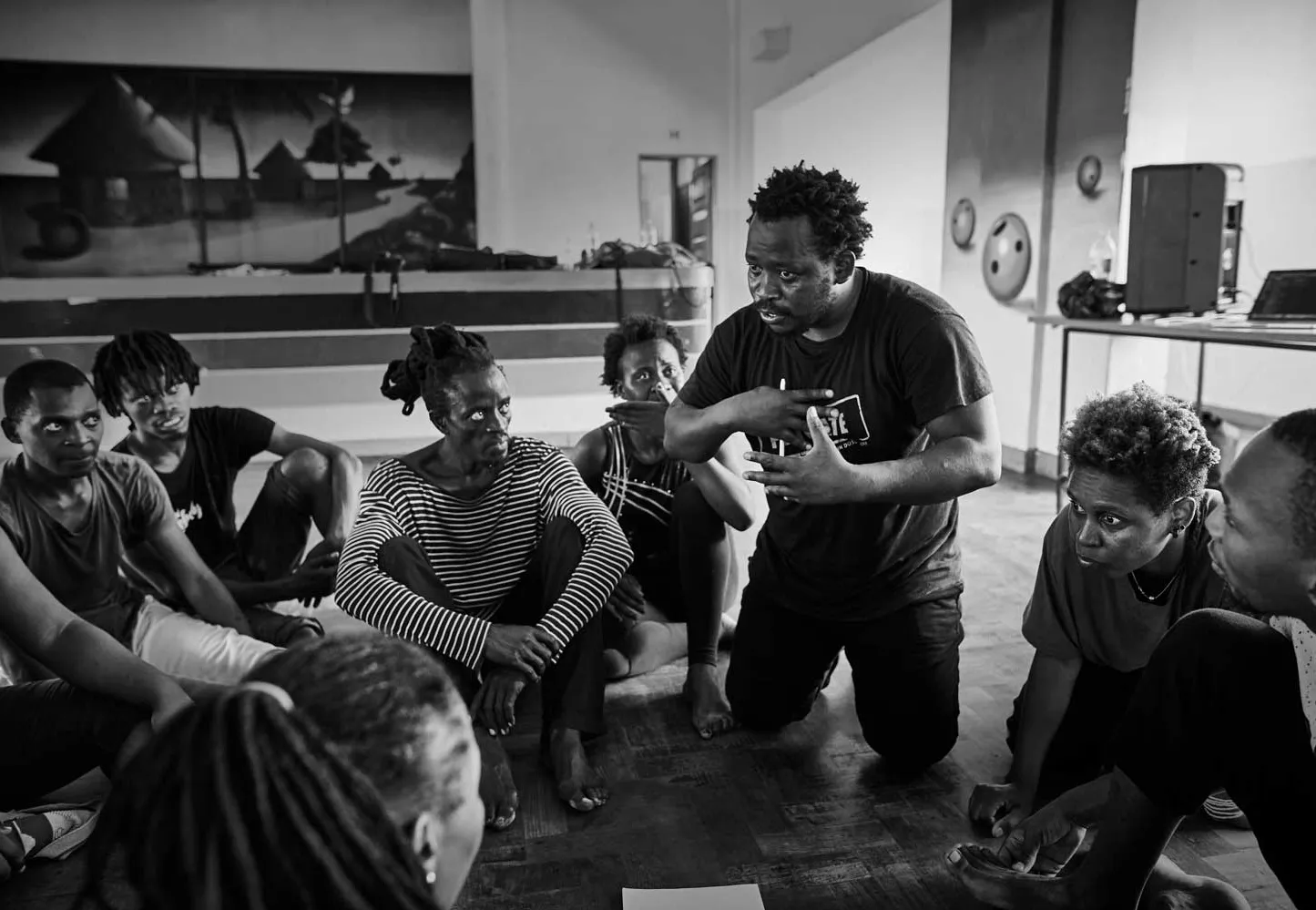
In 2005, Horácio won a scholarship from his mentor to specialise in contemporary dance in Europe, specifically in Austria. As an apprentice of the Venezuelan choreographer David Zambrano, he took part as a performer in several of his creations, researching and developing his techniques, such as Flying Low, which consists especially of floor work, allowing the dancer to explore the relationship between his weight and the surface. This technique uses simple movement patterns involving breathing, speed and the release of energy through the whole body to activate the relationship between the centre and the joints.
Horácio also works as a teacher, having already taught in Mozambique, Belgium, France, Germany, the Netherlands, Sweden, Spain, Brazil and Portugal: "I have been to various universities around the world, to schools, whether giving classes, running workshops, composing pieces or passing on my experience. I am constantly moving from one place to another sharing my cultural baggage. I am in a place I do not know, but I know that my diary is 'full'; for some reason I cannot fathom, people like what I do," he shared.
Horácio plays an important role in national contemporary dance. He loves what he does and passes on everything he knows with love and enthusiasm. "My mentor made a special request of me. He asked me to share the knowledge I acquired in Europe with other professionals in Mozambique, because he could not take everyone. Since then, I have not charged a single cent for teaching my students the techniques I learned in Europe," revealed the artist, who laments the egocentrism of some colleagues. "There is a bit of egocentrism among experienced artists, which prevents a new artistic class, a new generation, from emerging. The baton is not passed on. The festivals that exist feature many artists, many companies. Meanwhile, these collectives, these artists, only appear at that annual or biennial event. What do they do during the years without festivals? This way of promoting art, of promoting artists, has to change. The current way is not sustainable."
The rule “destroyer”
“Works of art make rules, but rules do not make works of art.” This quotation belongs to the French musician and composer Claude Debussy, but it could be Horácio Macuácua’s. For Horácio, the “rule” is not a law but an exception. The artist uses it rarely (or almost never) in his creations and/or performances. Improvisation is his only method, his only discipline, when he appears on stage. "I do not like a fixed idea. I am like a blank canvas on which I let the paints give shape to outlines that lead us down a path that has not been preconceived. I am not interested in making a defined art. I like to surprise myself; I do not define the structures of my pieces much. It is more surprising when I myself do not know the ending of my own pieces," he emphasised of his artistic singularity.
With all his artistic baggage, the dancer began investing in authored artistic work, the first being “Comum”, from 2007, which blends performances in indoor and outdoor settings. In 2009, Macuácua created “Orobroy, Stop!” for the 3rd edition of Kinani – Maputo Contemporary Dance Platform, receiving the “PUMA Creative” Grand Prize. The following year, 2010, he won first place in the Danse l’Afrique Danse competition – Choreographic Encounters of Africa and the Indian Ocean, held in Bamako, Mali. The Company then began performing across the African continent, in countries such as Benin, Chad, Congo, Nigeria and Togo, and in Europe, in the Netherlands, France and Belgium. In 2012, Horácio created the piece “Smile if you can”, performing in Portugal, South Africa, France and Poland. In 2014, he made the work “Convoy“, in collaboration with four Spanish performers. His most recent works are the pieces “Migrations to paradise” and “Paradise is not in the sky”.
Horácio has no doubt that his future is on the stage, and, wherever he may be, the flag and the name of Mozambique always go with him: "I will certainly stay in Europe, but travelling around the world, always taking the name of Mozambique wherever I go. I feel I have to do something for my country, so I have a project to open a studio in Mozambique to share my experience," he concluded.
Horácio Macuácua has lived in the city of Granada, in Spain, since 2009.


