
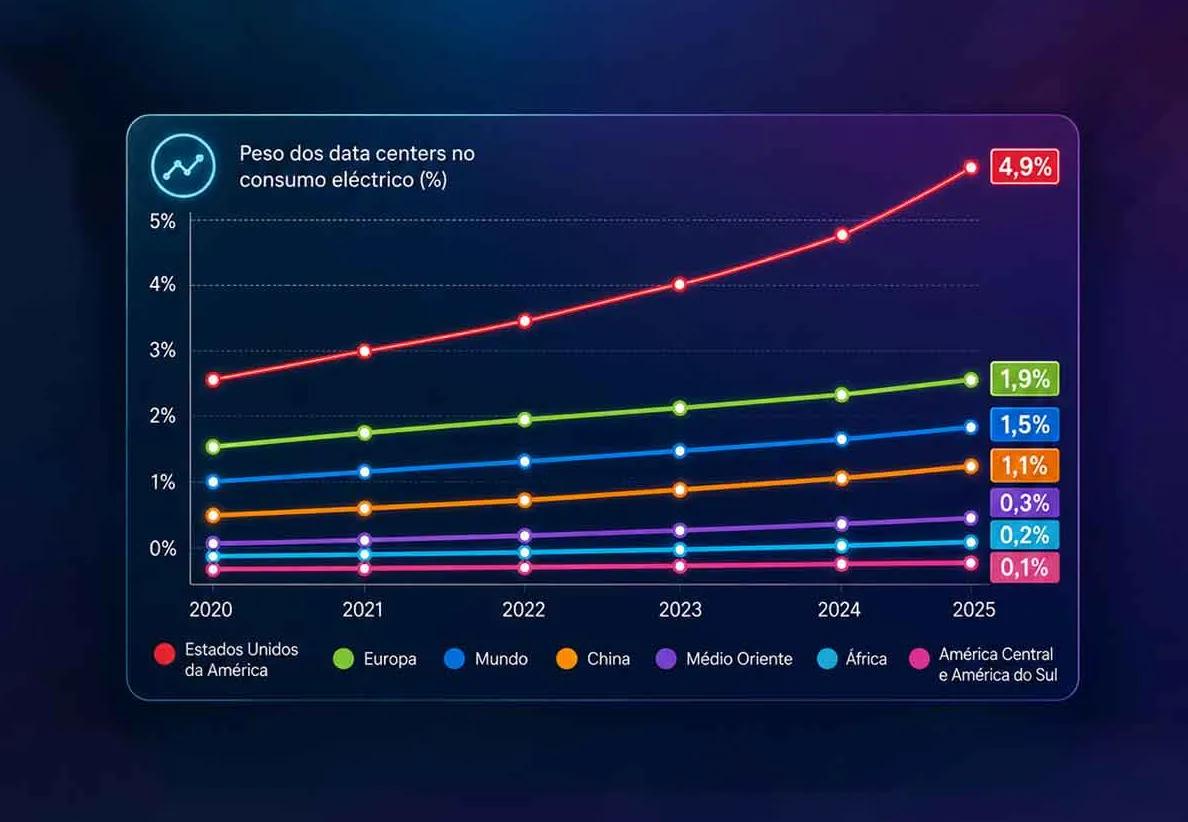
The expansion of Artificial Intelligence is turning data centres into an increasingly significant force in global energy consumption. Calculations suggest that in 2025 these facilities absorbed around 1.5% of all the electricity produced on the planet, an estimated total of 485 TWh.
Of that consumption, approximately one third was directly associated with Artificial Intelligence. AI-dedicated data centres are thought to have consumed around 330 TWh, the equivalent of 0.5% of global electricity, while data centres as a whole accounted for the remainder of the 1.5%.
But the pressure on electricity grids is expected to intensify in the coming years. Projections for 2030 suggest that total data centre consumption will almost double, reaching around 945 TWh, equivalent to 3% of the electricity produced worldwide.
Artificial Intelligence is expected to be at the heart of that growth. Within four years, AI-focused data centres could consume approximately 465 TWh, coming to represent 1.5% of the world's electricity — half of all the energy used by the sector.
The figures also reveal strong regional differences. Between 2020 and 2025, the United States of America recorded the steepest trajectory, with the share of data centres in electricity consumption approaching 4.9%. In Europe, the proportion is around 1.9%, while the world average reaches 1.5%.
China stands at 1.1%, followed by the Middle East, at about 0.3%. At lower levels come Africa, at approximately 0.2%, and Central and South America, at about 0.1%.
The growth in data centres' energy demand thus ceases to be merely a consequence of global digitalisation. Projections indicate that most of the increase expected by 2030 will result directly from the rapid expansion of Artificial Intelligence.
The data presented are based on calculations by Our World in Data, drawn from data and projections by the International Energy Agency (IEA).


