
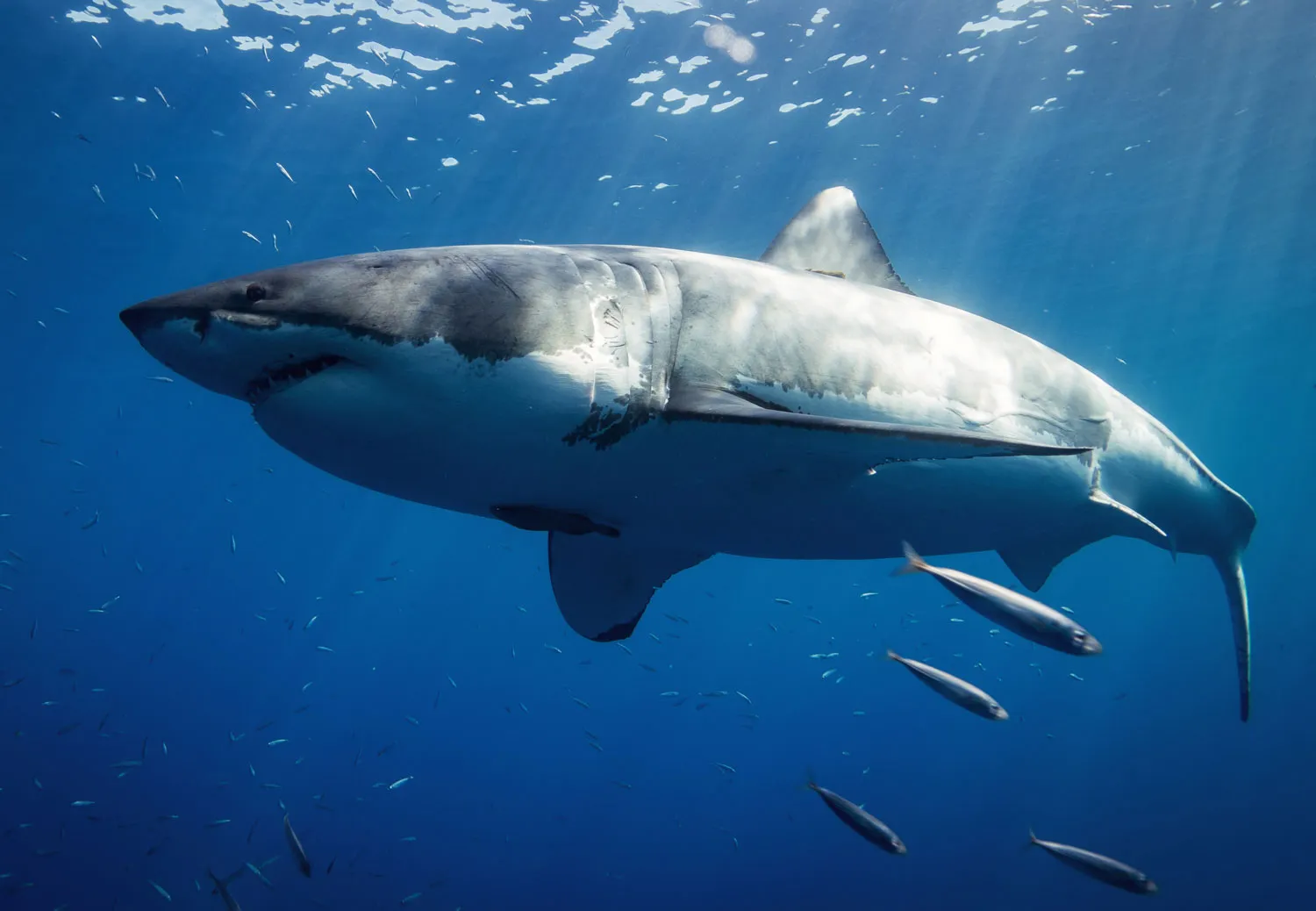
The role of sharks and rays in marine ecosystems
Sharks and rays play an important role in marine ecosystems, whether as predators or as prey. They are fundamental to many ecosystems, and changes in their presence and diversity can provide a barometer for measuring the health of the oceans. Sharks are particularly known for controlling the abundance of the organisms below them in the food chain, maintaining balance and their ecological functions.
In Mozambique, approximately 147 species of sharks and rays have been documented to date, and the south of the country is part of a global hotspot for shark and ray species richness, endemism and evolutionary distinctiveness.
There is, however, global concern about the increase in catches of sharks and rays and the consequences of this for the populations of many species in these groups in many areas of the world’s oceans. Slow growth rates, late maturity and low reproductive potential make sharks and rays highly susceptible to overfishing. There is considerable fishing pressure in Mozambique and, very often, sharks and rays are target species or are caught as bycatch. As such, sharks and rays are heavily overexploited in the country, with 65 species (44%) currently considered threatened with extinction (vulnerable, endangered or critically endangered), and a further 18 species (12%) classed as data deficient on the International Union for Conservation of Nature (IUCN) Red List of Threatened Species.
By joining the High Ambition Coalition (HAC) initiative at the end of 2019, Mozambique committed to protecting around 30% of its land and marine environment by 2030
Partnership between the Wildlife Conservation Society and the Government of Mozambique
Wildlife Conservation Society (WCS) Mozambique has been working with the Ministry of the Sea, Inland Waters and Fisheries (MIMAIP), in particular with the National Institute for Fisheries Research (IIP), to increase knowledge about sharks and rays in the country, in order to support the definition, preparation and implementation of appropriate measures for their management and conservation. In this context, since the end of 2018 WCS and IIP have been collaborating to obtain detailed information on this biological group. The research activities include periodic surveys at artisanal fishing landing sites of coastal communities in the provinces of Cabo Delgado, Nampula, Zambézia, Inhambane and Maputo, and biological sampling using baited remote underwater video surveys (BRUVs). The work has been supported by other partners, such as the Faculty of Natural Sciences of Lúrio University, the World Wide Fund for Nature (WWF) and the South African Institute for Aquatic Biodiversity (SAIAB) (with the support of donors such as the John D. and Catherine T. MacArthur Foundation and the Shark Conservation Fund).
The data obtained to date through sampling have shown that southern Mozambique is extremely important for the conservation of sharks and rays. BRUV sampling made a remarkable discovery possible, as it produced the first records of the species Pseudoginglymostoma brevicaudatum (formerly Ginglymostoma brevicaudatum) in Mozambique. This is the most threatened shark species (currently listed as critically endangered on the IUCN Red List) that is endemic to the Western Indian Ocean. As a result, a scientific paper documenting these findings was published in the journal Marine Biodiversity.
These data are now being explored by WCS and IIP, through a spatial analysis of biodiversity, in order to develop scenarios for the potential expansion of the national network of marine protected areas, so as to achieve the protected-area targets the country has committed to meeting.
Support for legislation – the new Marine Fisheries Regulation (REPMAR)
Until the end of 2020, marine fisheries were regulated by the 2003 Decree (Decree 43/2003 of 10 December). In January 2021 the new Marine Fisheries Regulation (REPMAR – Decree No. 89/2020 of 8 October) came into force, which updates the previous decree, introducing significant elements into the national marine fisheries framework, and is expected to help make this activity more sustainable and its management increasingly participatory.
The revision of the old REPMAR was carried out over the past few years, in a process led by MIMAIP, with the work of the National Fisheries Administration (ADNAP), the National Institute for Fisheries Research (IIP) and the National Directorate for Maritime and Fisheries Policy (DIPOL) standing out, with the support of various cooperation and conservation partners.
Throughout 2019 and 2020, WCS provided technical and logistical support for the development of this document, and funded the final technical workshop for its preparation.
The technical support given by WCS was directed at the chapter on the conservation and protection of fisheries resources, in particular the drawing up of the list of species whose capture is prohibited (Annex XIII of the new decree). Support was also provided in defining the framework by which marine protected areas and resource recovery areas can be established and how they relate to the law and regulation on the protection, conservation and sustainable use of biological diversity.
WCS also supported ADNAP in developing Section III of REPMAR on the participatory management of fisheries resources, which recognises the concept of community-managed fishing areas. This important innovation in fisheries legislation allows artisanal fishers, through community-based organisations, to co-manage the areas of customary use of their community, ensuring the sustainable use and management of existing coastal and marine resources, as well as the conservation of natural resources and of sites of historical, religious, spiritual and cultural importance, thus contributing to sustainable development.
Together with the SwioFish project, led by the World Bank, with WWF and RARE, WCS is supporting ADNAP in developing specific guidelines for the legalisation of community-managed fishing areas, and for their management and enforcement.
Protected marine species in Mozambique
There is global and national concern about the increase in catches of various marine organisms and its consequences for the populations of many species in the region. Mozambique has joined several international conventions and initiatives that established measures to promote better management and conservation of sharks, rays and other marine species. In October 2019 a meeting was held between ADNAP, IIP, WCS and WWF to define the criteria for choosing the species that would need protection.
Initially, species were proposed on the basis of their global threat status (using the IUCN Red List of Threatened Species), the Convention on the Conservation of Migratory Species of Wild Animals (CMS), the Convention on International Trade in Endangered Species of Wild Fauna and Flora (CITES), the species protected under the resolutions of the Indian Ocean Tuna Commission (IOTC), and also taking into consideration the protection status of the species in other countries of the Western Indian Ocean region. However, the species included in the final list were those listed in Appendix I of the CMS and the prohibited species determined by the IOTC.
Sharks and rays were the group that featured most prominently in the revised list of species prohibited in any type of fishing, with 13 new species listed in Annex XIII of REPMAR, in addition to the white shark, which was already protected; it should be noted that, before the publication of REPMAR, only one species of shark was considered protected in Mozambique, the white shark Carcharodon carcharias. Seahorses and certain species of bivalves, gastropods and sea cucumbers are now listed, for the first time, as protected in Mozambique, and all marine mammals and turtles are also on the list of prohibited species.
Currently, WCS, WWF and RARE are supporting the Government of Mozambique in disseminating the regulation and the list of protected species, having produced posters and other informational materials that are being distributed around the country.
In Mozambique there are 65 species currently considered threatened with extinction (vulnerable, endangered or critically endangered)
National Plan of Action for the Conservation of Threatened Marine Sharks and Rays (NPOA)
Another tool that will be essential for the conservation of sharks and rays in Mozambique is the NPOA. This plan assesses the current situation of sharks and rays in the country, sets objectives for improving the conservation of the species and identifies a set of actions to achieve them. Supported since 2017 by WWF and the non-governmental organisation TRAFFIC, this process has also had the collaboration of WCS since 2019, through technical and logistical support.
In this context, WCS and IIP are organising a series of capacity-building workshops for Government technicians, the national CITES management and scientific authorities, and scientists and managers who deal with the international trade in threatened species, to be held in 2021 and 2022. This training aims to increase the capacity of public institutions to manage CITES processes relating to sharks and rays, to identify these species and to draw up Non-Detrimental Findings (NDFs) assessments, that is, the assessments required for the Government to decide whether or not it can authorise international trade in a given species listed in Appendix II, including export quotas where relevant.
The future of marine biodiversity in Mozambique
The approval of Decree 89/2020 on the Marine Fisheries Regulation is a major step for the conservation of marine biological diversity, promoting more sustainable management of species and fisheries. It also demonstrates the effort Mozambique is making in terms of biodiversity conservation and its preservation for future generations.
By joining the High Ambition Coalition (HAC) initiative at the end of 2019, Mozambique is part of a group of some 70 countries that have already committed to protecting approximately 30% of their land and marine environment by 2030. Recently, WCS and IIP, as part of their project to develop scenarios for the expansion of the national network of marine protected areas, provided an online training course lasting six days to the focal points of the biodiversity conventions ratified by Mozambique and of the HAC, with the aim of improving their capacity to implement the resolutions adopted by member countries.
Through the efforts described above and other ongoing projects with the Government, such as support for the development of the National Strategy and Action Plan for Mozambique’s coral reefs, WCS is an active partner of the Government in making economic development compatible with the conservation and sustainable use of biological resources, with benefits for the local communities that depend on marine ecosystems.


