
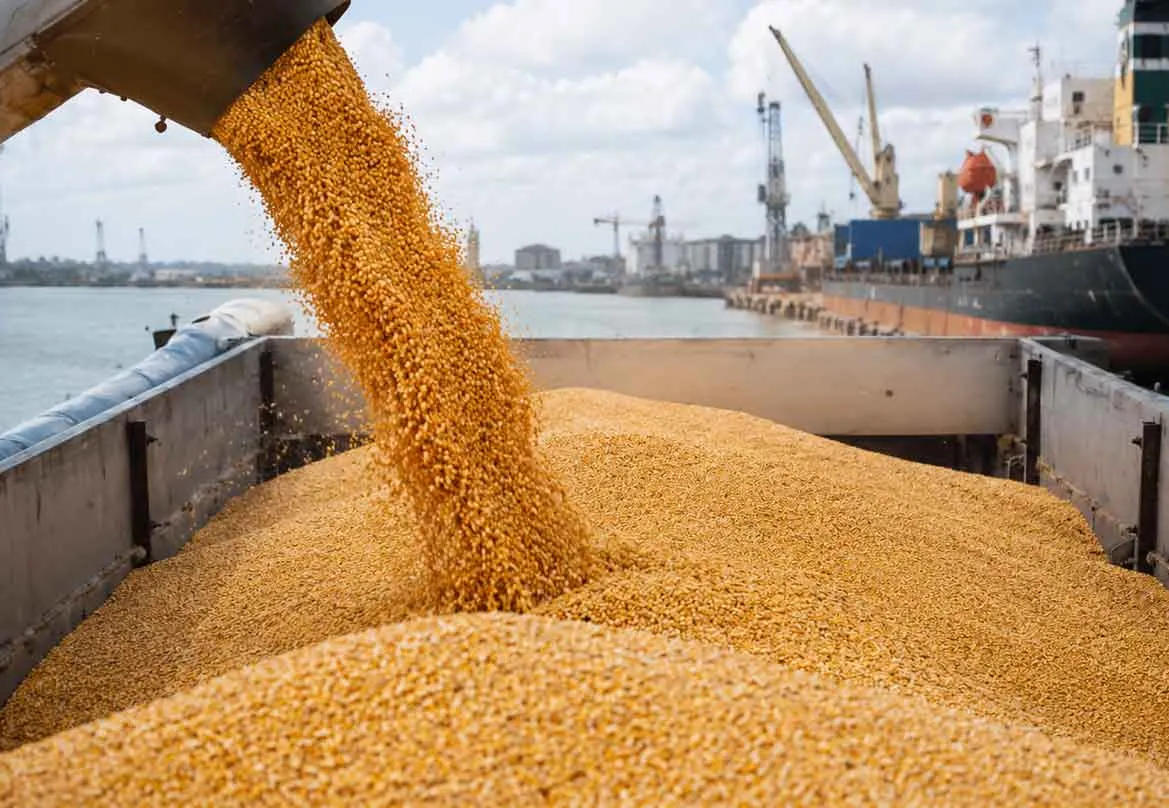
The Port of Beira has once again taken a central role in Mozambique's food supply, in an operation that could mark a significant change in how the country manages grain imports. A new mechanism coordinated by the Mozambique Grain Institute (ICM) allowed the simultaneous unloading of around 32,000 tonnes of rice and wheat, reducing operational delays and avoiding logistics costs that previously exceeded 750,000 dollars in ship demurrage.
The operation was monitored on the ground by the ICM's Directorate-General during a monitoring visit to the Port of Beira, in Sofala province. The initiative is part of the implementation of Ministerial Diploma No. 31/2026 of 24 April, an instrument that sets out new coordination rules for the import of rice and wheat intended for the domestic market.
At the time of the visit, operations were under way at different points of the port infrastructure. At the BGT Terminal, located at Quay 10, the vessel Lale S was unloading 15,000 tonnes of wheat belonging to MEREC. At the same time, at Quay 6, the vessel Grampus was unloading approximately 17,000 tonnes of rice imported by the companies Olam, MOI Foods, Care Trading, Nova Trading, Futur Comercial and Aditya Birla Global Trading.
In total, the roughly 32,000 tonnes of grain brought in through the Port of Beira are intended to bolster the food supply of the central region and the national market, at a time when the stability of the supply of staple products continues to be considered strategic for the country.
According to the ICM, all the operators involved have duly regularised import processes, an essential condition for benefiting from the new berthing priority regime now being implemented.
The new import mechanism arises precisely as a response to the logistics constraints that for years affected the unloading of grain at national ports. The new approach sets coordination criteria aimed at reducing waiting times, increasing operational predictability and improving the management of port infrastructure.
According to data released by the Mozambique Grain Institute, demurrage costs — known internationally as demurrage — often exceeded 750,000 dollars when ships remained at anchor for more than 30 days waiting for space to unload. The berthing priority granted to regularised operators has now made it possible to significantly reduce these financial risks.
Alongside the unloading operations, the ICM held a coordination meeting with Cornelder de Moçambique and the Beira Grain Terminal (BGT), aimed at harmonising procedures relating to the new model for managing grain imports. Among the central points was precisely the application of the berthing priority regime for ships carrying products intended for domestic consumption.
The Director-General of the Mozambique Grain Institute, Luís José Jobe Fazenda, argued at the end of the visit for the need to strengthen coordination between the State, importers, logistics operators and port authorities, stressing that food security depends more and more on the efficiency of supply chains.
In an international landscape marked by volatility in food prices, climate pressures and global logistics disruptions, the performance of transport corridors has become a decisive element in ensuring stability in the domestic market. The experience now recorded at the Port of Beira shows that operational gains and better institutional coordination can translate directly into lower costs, greater predictability and stronger national food security.


