
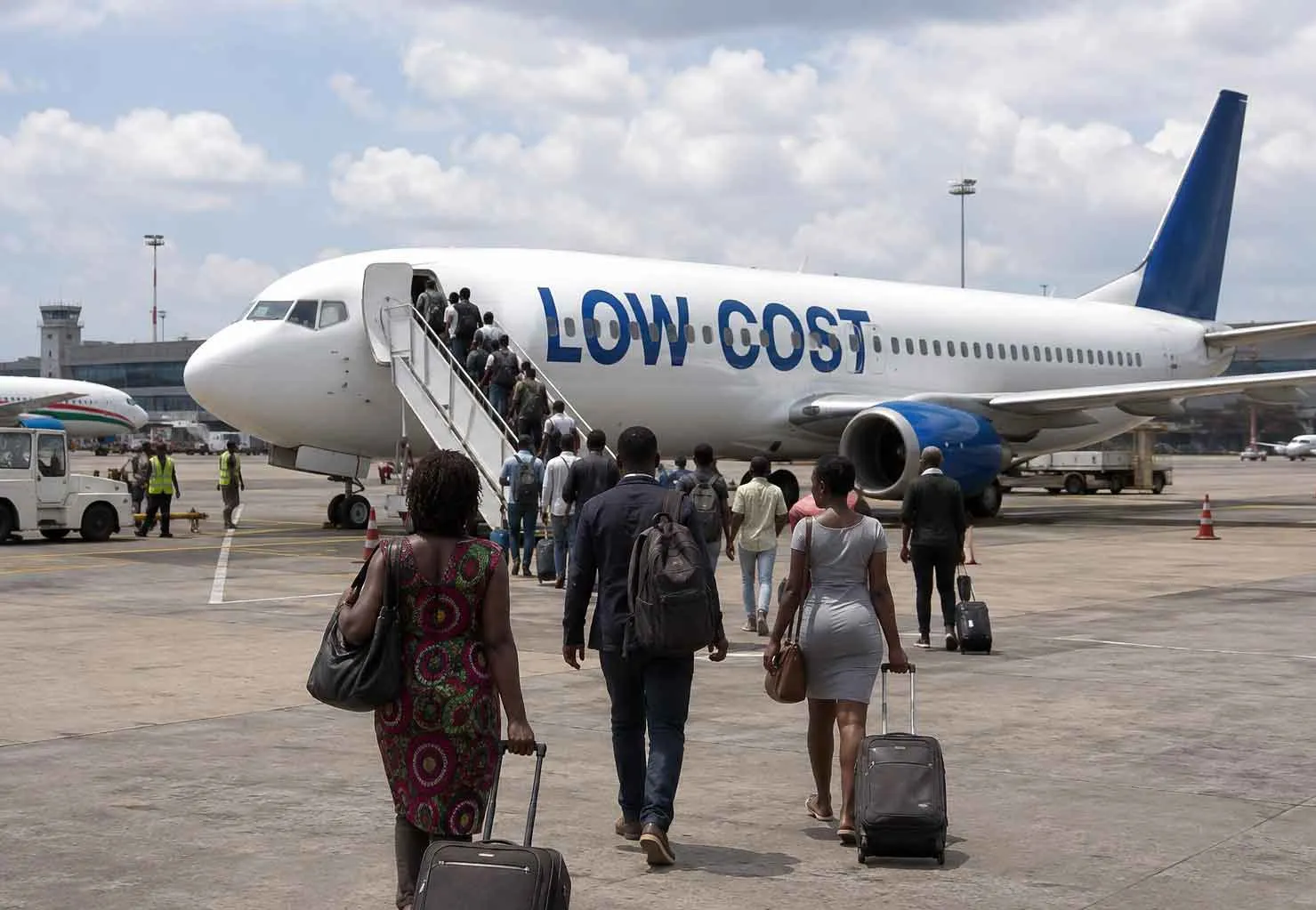
It is a seemingly simple question. If low-cost airlines revolutionised the way people travel in Europe, taking millions of people across borders for a few dozen euros, why has the same not happened in Africa?
The continent seems, at first sight, made for aeroplanes. Distances are enormous, many capitals are separated by thousands of kilometres, and the alternatives by road or rail are not always quick or simple. Even so, flying within Africa remains expensive and, in many cases, surprisingly complicated.
That does not mean there are no budget airlines on the continent. There are, and some have managed to establish significant operations in their markets. What Africa has yet to produce is a truly continental low-cost giant, able to build an extensive network between countries and do for African air transport what companies such as Ryanair, easyJet or Wizz Air have done in Europe.
The explanation begins with costs.
Flying in Africa costs more
African airlines operate in particularly difficult conditions. According to the International Air Transport Association (IATA), they have the highest unit costs in the world. In 2024, the average cost per available tonne-kilometre was around 140 US cents, roughly double that recorded in the rest of the world.
Fuel is an important part of the equation. In Africa, its price is around 17% above the world average. Maintenance, insurance and access to capital are also more expensive. On top of all this comes a fleet that, on average, is about five years older than the global average. Older aircraft burn more fuel and require more frequent and costly maintenance.
For a traditional airline, these are significant difficulties. For a low-cost carrier, they can determine whether the business is viable.
The secret of this model lies not just in dropping free meals or charging for baggage. It lies in cutting costs at practically every point of the operation. Aircraft spend little time on the ground, the fleet tends to be standardised, processes are simplified and each aircraft flies as many hours a day as possible.
When the structure surrounding the airline is already expensive, selling very cheaply becomes considerably harder.
The invisible weight in the ticket
There is another component that passengers rarely consider when they buy a ticket: taxes and charges.
According to IATA, taxes and charges associated with aviation in Africa are around 12% to 15% above the world average. Air navigation charges are also roughly 10% higher.
And there are costs that an airline simply cannot cut.
It can reduce administrative staff, sell directly over the Internet, simplify on-board services or negotiate better deals on its aircraft. It cannot, however, eliminate an airport charge or a tax set by the State.
This is where one of Africa's great problems begins. The larger the fixed component of a ticket's price, the smaller the margin an airline has to lower the fare.
One continent, many markets
But perhaps the biggest obstacle lies outside the aircraft.
Europe managed to create a largely liberalised airspace, allowing airlines to build networks that cross borders with relative ease. It was this transformation that helped create the ground on which Europe's major low-cost carriers grew.
Africa is still far from that scenario.
For decades, several countries restricted access to their air markets, partly to protect their national airlines. A World Bank study on the liberalisation of African aviation identified precisely this protection as one of the reasons for high fares and slower growth in air traffic.
The problem is not new.
In 1999, African countries adopted the Yamoussoukro Decision, designed to liberalise air transport on the continent. Among its principles were open access to markets, liberalised fares and greater freedom in setting capacity and flight frequency.
Almost two decades later, in January 2018, the African Union launched the Single African Air Transport Market, known by the acronym SAATM. The goal is ambitious: to progressively turn Africa into a single aviation market, allowing greater freedom of operation among participating States.
The project exists. Full liberalisation, however, does not yet.
And that difference is decisive.
An airline wishing to create an extensive African network still finds a market fragmented by different rules, bilateral agreements, traffic rights and national policies. What in Europe works as an enormous integrated market remains, in Africa, divided by numerous regulatory borders.
Few flights feed high prices
The result can be seen on route maps.
Only around 19% of intra-African connections have direct flights, according to IATA.
This means that two relatively close African cities may be poorly connected by air. On certain routes, travelling between two countries on the continent means changing in a third country or even leaving Africa.
A vicious circle is thus created that is hard to break.
There are few direct connections because demand is limited. With little demand, airlines offer fewer flights. With fewer flights and high costs, fares remain high. And high prices keep away precisely the passengers who could make the market grow.
Disposable income also weighs on the picture. IATA itself points to the low GDP per capita of much of the continent as one of the factors limiting demand and making African passengers particularly price-sensitive.
It is an important contradiction. Africa needs cheap tickets to get more people onto aircraft, but airlines need lots of passengers to be able to sell cheap tickets.
What would happen if the skies were truly opened?
Here, the numbers become interesting.
A World Bank study analysed air transport agreements between African countries and concluded that liberalisation lowers fares, increases demand and allows flight frequency to rise.
When all these effects are taken into account, the benefit to consumers is equivalent to a reduction of between 40% and 42% in average air fares in the markets studied.
This does not mean that every African ticket would automatically fall by 40%. It means that opening up markets can produce an economic effect of that size through a combination of lower prices, higher frequency and growth in demand.
That is precisely the mechanism a major low-cost airline needs.
Lower prices can bring in passengers who do not fly today. More passengers make it possible to increase frequencies. More frequencies make the service more attractive. And fuller aircraft help to reduce the cost per passenger.
The opportunity lies in the size of the problem
Despite all these difficulties, there is a reason to believe that African aviation could change profoundly.
IATA forecasts that the African market will grow, on average, by 4.1% a year over the next two decades, reaching around 411 million passengers. It will be one of the fastest-growing regions in world aviation.
The potential passenger exists. The challenge is to make it economically possible to carry them.
For that, it is not enough to create an airline and paint the aircraft in the colours of a new brand. A genuine African low-cost revolution will require more open markets, competitive airport costs, lighter taxes, easier movement between countries, better access to financing and effective enforcement of the liberalisation agreements Africa has already approved.
Only then could an airline emerge with dozens of similar aircraft, high daily utilisation, simplified operations and a network large enough to link African cities at prices that today seem improbable.
Perhaps, then, the question is badly framed.
It is not hard to see why Africa needs an African Ryanair. On a continent of this size, with hundreds of millions of potential passengers and air links that are still scarce, the reasons are obvious.
The truly interesting question is another.
What still needs to change for it to finally take off?


