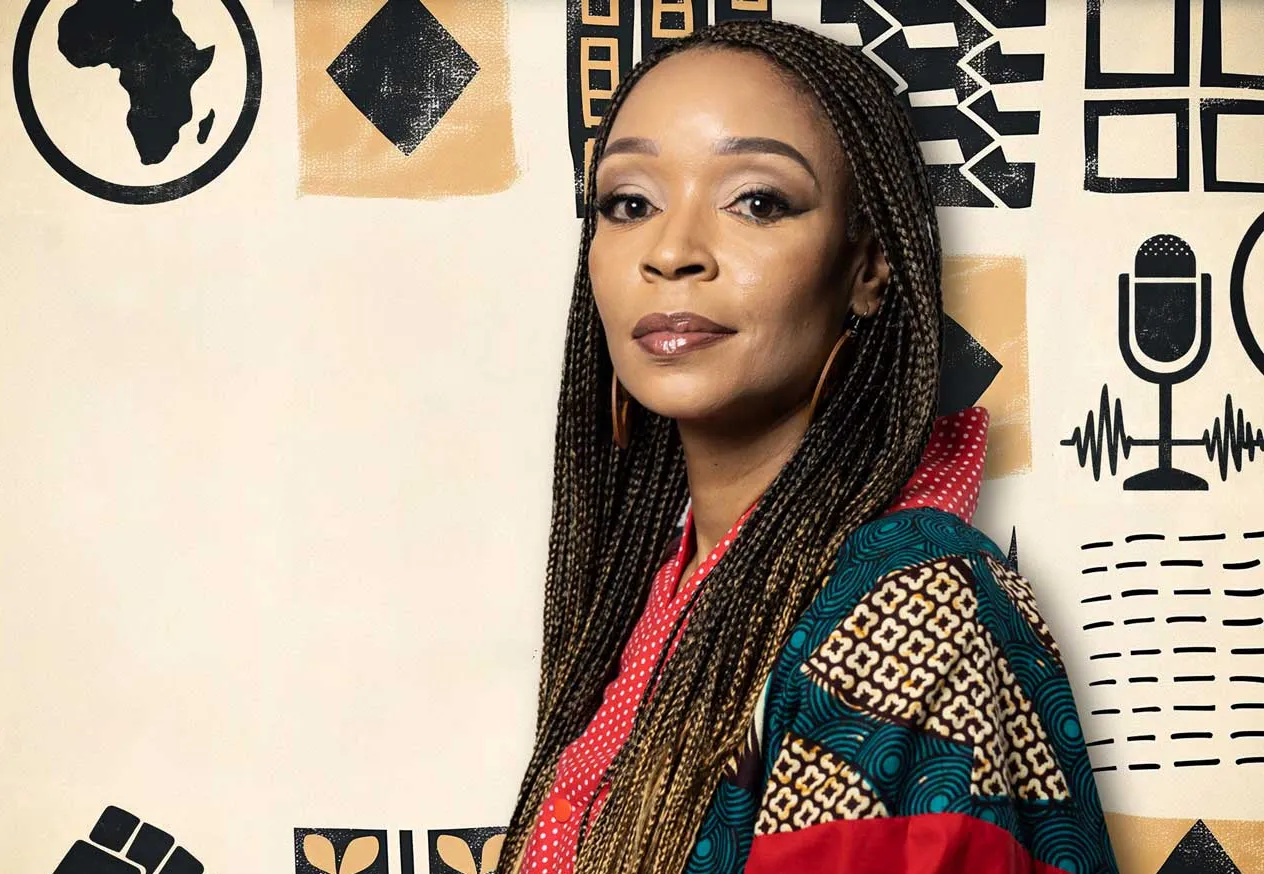
She left Mozambique as a child, but took the country with her. Belonging was not fixed only in the memory of a place; it was built up in the family, in gestures, in language, in food, in aesthetics and in the ties that were never broken. In journalism, she found a craft that taught her to observe the world with attention, rigour and an awareness of power relations, between the written press and her television experience at RTP África. Later, with Afrolink, she turned that path into public intervention. In this conversation, Paula Cardoso speaks about identity, diaspora, racism, exhaustion and responsibility, not from nostalgia or victimhood, but from a place that is embraced, conscious and chosen.
There are absences that are not remembered, only felt. Did growing up far from the land where you were born leave you with the kind of belonging that cannot be learned or inherited, only felt?
I would say there is an inheritance. Regardless of the feeling, this belonging that I feel is also something I inherited. It is inseparable because I was born in Mozambique. Although I came to Portugal very young, I was not yet 3, though I was almost there. My father and my mother were also born in Mozambique. My family is Mozambican on both my maternal and paternal sides, the closest family. This Mozambican setting ended up giving me an upbringing and an exposure to Mozambican culture, or to the cultures of Mozambique, from the very beginning. There was never any distance. That presence could be seen not only in the food, and my favourite dishes are still the ones that are part of Mozambican cuisine, but also in the aesthetics, in the capulanas, in the bracelets, in the distinctive sound of those bracelets. It is a memory which, although I feel it was constructed, reminds me of Mozambique. My father spoke national languages and there was always this recognition of my Mozambican identity, this living of that identity, even from a distance. I remember the Mozambicans' festival, which took place every year in the summer and which gave me that connection to the country, through meeting aunts, uncles and cousins. I remember perfectly the barbecued chicken, the roasted corn, so many particular details that make it impossible to say it was merely a matter of feeling. Mozambique was always present in my experiences, in very concrete ones.
The idea of living “between places” is often associated with a difficulty in belonging, but Paula Cardoso never read her story in those terms. Her identity was always clear. She is Mozambican and insists on saying so, rejecting formulations that dilute that belonging. She has lived in Portugal since a very young age, by her parents' choice, but she has never romanticised that journey. It was a path of self-affirmation and of concrete struggles for recognition and rights. She never felt the need to dilute who she is. The adaptations that did exist, especially in adolescence, involved her hair, not as a rejection, but as an attempt to make everyday life easier in a context dominated by white normativity. Today she reads that journey with distance and clarity. There were adjustments, not ruptures. Her identity remained whole. Mozambican, living in Portugal, without romanticisation and without fragmentation.
When you entered journalism, what illusions did you have about the profession that time went on to dispel?
In reality, I did not have many illusions, or perhaps none. I had no idea what I was going to find, because I had no reference points. I was not doing television, so that was not how I came in. I have always been a print journalist and, being a print journalist with no reference points in the written press itself, other than the newspapers I read, my expectation was simply to work. That was it. I did not think about anything beyond that. And I realised there was no room. There was an idea of a white Portugal and of the subjects having to be aligned with what was assumed to be the wishes of that audience. Stories involving Black people, when they were covered, were almost always associated with situations of excellence or situations of exclusion. Stories like these had space, as did those of the athlete or the musician, the spaces of entertainment, where a Black presence was tolerated, never accepted. All of this is to say that I did not enter journalism with illusions about the profession, but it became clear that there were things I could not do. It was understood that they had no audience, that they were not as valid as other proposals. As I advanced in the field, I also gave up on a prospect of career progression, which I ended up having in Angola, not in Portugal. Even working more and better, I saw no chance of promotion. Incompetent people got ahead of me. That happened. In Portugal, that correspondence between work and recognition never existed for me. Even today, if I had not created my own project, we would probably not be here talking. That is what I felt: that there would be no place for me, whatever I did.
Journalism gave Paula Cardoso, first and foremost, an awareness of the word. She always had a facility for writing, but it was in daily practice that she learned to listen to herself, to lead conversations and to recognise the vices of language. Interviewing and transcribing became an exercise in constant fine-tuning. It also gave her a broader view of the world. Current affairs force you to move between different subjects, geographies and contexts, and that movement widened her interests and her readings of reality. At the same time, it stripped the romanticism from the profession. The idea of journalism as a counterpower runs up against economic groups, editorial lines and the construction of the very notion of news. It also changed her relationship with time. Deadlines compress everything, the past loses relevance and the pressure becomes structural. Weekends and public holidays cease to be a point of reference. Journalism remained a formative craft, demanding, but without illusions.
At what point did you feel that your work began to disturb more than it was celebrated?
Very honestly, I never felt that my work, leaving aside this new stage of my life, was ever celebrated. I celebrated it myself, to the extent of my awareness, at each moment. I celebrated my achievements and some pieces I published, which I liked and with which I was satisfied. I made that journey for myself, not least because I was always the only Black person in the professional settings I was in in Portugal. I was the only Black journalist and, from that perspective, I knew I had to celebrate. It did not disturb because I was not working on these subjects. When I say these subjects, I mean the subjects I work on today at Afrolink. When I begin to have a public presence in Portugal, through Afrolink, the project I created to build my own space, that is when I realise that discomfort arises, directly related to the themes I am working on. That discomfort exists. What I feel is that, with Afrolink, my work is celebrated far more than anything else. At least that is the energy I am in, the energy of celebration. For me, the discomfort simply means that the work is being done. It has more to do with the subject itself than with my work in particular. Anyone who works in this area will cause discomfort in Portugal.
For Paula Cardoso, everything begins with awareness. It is what defines boundaries, between representing and being used, between occupying a place and being instrumentalised. Every invitation comes with an agenda, but the decision always comes down to a simple question: does it serve the place she chose to occupy, or not? When it does, there is no discomfort. Awareness protects. That same awareness also prevents the easy separation between external confrontation and inner exhaustion. For her, one feeds the other. There is no exhaustion that does not have its root in the outside world, and no confrontation that does not leave marks within. We are beings in relation, she reminds us, and it is from this friction with the world that the restlessness, the anguish and the inner plunges that have always accompanied her are born. That is why occupying spaces demands more than presence. It demands clarity about the lineages we carry, about whom we represent and, above all, about who comes after. Representation is not proclaimed; it happens when someone sees themselves in it. And when it happens, it ceases to be a symbol and becomes a path.
Have you ever felt like stepping back, no longer speaking, leaving the stage? What made you stay?
No. I never felt that. I am talking about the Afrolink phase, because there is clearly a before and an after in my story. In the media, in journalism, if you like, there is a before and an after Afrolink. Before, I worked for others, which obviously limited what I could do. My last professional position was in Angola, a different reality, which allowed me to develop a series of works that I would not have been able to do in Portugal, but which never put this dilemma to me of stepping back, of no longer speaking or of leaving the stage. With Afrolink, I begin to work on themes that directly confront the system we have in Portugal. I also realise that there are many people in this fight against racism, xenophobia and all forms of discrimination who receive hateful messages and constant attacks. I am aware that hate speech exists and is out there. I am not immune to it, but I do not feel afraid. It is precisely these setbacks we are witnessing that make me even more eager to move forward and to recognise the importance of continuing to do what I do, together with other people. This work is not individual; it is a collective commitment. I have no desire to step back, nor to stop speaking, nor to leave the stage. On the contrary, I will keep doing it for as long as I feel that this work is necessary.
Switching off does not mean giving up. The fight against racism and inequality is part of Paula Cardoso's daily life, but it does not take up everything. There is joy, there is love, there is life beyond work and public intervention. There are dinners with friends, laughter, a glass of wine, football and the simple pleasure of following Sport Lisboa e Benfica. This parallel existence does not erase awareness. Even in moments of leisure, she remains alert to what is happening around her. She does not ignore situations of discrimination just because she is outside the professional context. If it is necessary to intervene, she intervenes, without feeling it as a burden, but as a civic responsibility. Balance is built at that midpoint. Switching off when possible, looking after herself, observing limits and staying alert to any imbalances is part of how she stays whole in a confrontation that she knows to be permanent.
Was there a specific episode, a conversation or a silence that acted as a trigger for Afrolink to exist?
Yes. But it had nothing to do with any situation of violence or animosity. Before creating Afrolink, I wrote a children's and young people's book, A Força Africana, titled “O Sol desapareceu, será que foi roubado?”. It is a proposal that I want to continue in other books. A Força Africana is the group of superheroes and superheroines that I created, and the idea is to have them unravel mysteries over a number of stories. The first book was published in 2020. Afrolink was born from A Força Africana. Why? Because I needed a Black illustrator, someone who shared my sense of belonging and who understood the importance of bringing a story like this to the children's and young people's literary market. I grew up without those literary references and I did not find characters like me in books. When I had difficulty finding someone to illustrate the book, it occurred to me that it would be important to create a project that would make it easier to identify the profiles of Black professionals and that would allow us to deconstruct the idea of a white Portugal. Afrolink was born from this identification of profiles, from this making visible of our trajectories and of the projects we are developing, disproving the idea of inferiority that continues to be associated with our trajectories, often out of prejudice.
Paula Cardoso does not identify parts of her story that are difficult for her to tell. Not because she sees everything as public, but because she distinguishes clearly between what should be shared and what belongs to the private sphere. What she chooses to share is linked to growth. The anguish, frustrations and misalignments of life, when shared with trusted people, can generate awareness and lightness. If there is a void, it lies in what she does not know, not in what she does not want to tell. Her curiosity is directed at her ancestry, marked by silences and historical uprooting that make it hard to access her family origins. She shares when it makes sense, with those for whom it makes sense, and she believes that many pains persist precisely because we do not allow ourselves to be vulnerable.
What are you no longer willing to sacrifice today, even in the name of greater causes?
Sacrifice. I do not know whether I identify with that word. As I made my choices throughout life, until I got here, and I am 46 now, I did not feel I was sacrificing things. I made decisions, and decisions always mean including some things and excluding others. In life, balance is everything. With the awareness I have today, I seek that balance. And, in that search, rest is fundamental. In short, I do not sacrifice my rest. I do not give up my rest. That does not mean that, in one circumstance or another, I would not be willing to give it up, but, as a rule, I do not want that for my life. As for greater causes, the defence of democracy is fundamental. For me, it is a greater cause, because all the other causes I defend depend on the existence of a system that allows us to take part, to be a part, to put our voice into the world. Then, the fight for human rights is central, a greater cause for which it is worth sacrificing everything. There were people in the past who died so that Mozambique could have freedom, and it is important that we continue to defend that freedom and to fight for a better country for all people, whatever that country may be. A cause is not a job, it is a mission. It is a collective aspiration.
Interviews
Paula Cardoso
When the craft becomes intervention
Omar Diogo25 February 202611 min readTime well invested.
Time well invested.


