
Chiveve River Urban Park
The lung of the city of Beira
Written by: Precidónio Silvério
In the centre of the city of Beira, on the Chiveve River, a piece of infrastructure with 4 basins has been born, covering 47 hectares. It is enormous, not only in its extent, but also in the grandeur it carries. It is called the Chiveve River Urban Park.
On the Chiveve River there are mangroves, a marine ecosystem which, like many others across the country, was being destroyed by human action. Men and women tore out the plants and shrubs for various purposes. The place is known as “the lung of Beira”, since the biological richness that springs up there earns it that name. When Man acts against this kind of biodiversity, it is not only the mangrove that suffers; the various animal species that have their habitat in this ecosystem also die.
Construction of the Chiveve River Urban Park began in 2017. Roughly five years passed before its completion. This infrastructure was designed not only to protect and preserve the mangrove, but also to create leisure spaces for the people of Beira. Maria Pinto de Sá, coordinator of art and crafts at the Park, was the one who showed us the complexity of this heritage: “Before thinking about preserving, it was necessary to replant the mangrove and bring a great deal of life back to this lung of the city,” she confided to us.
A place full of delights
It is not only the mangrove that gives life to the park. The place offers its visitors many delights. There is an enormous botanical garden, play areas for children, restaurants, small snack bars, including ice-cream parlours where children revel in their frozen sweets. There are multi-purpose pitches for various sports, open-air gyms, an events hall, a pavilion of shops and offices, a market and an exhibition centre. The list also includes some 7 km of wooden walkways and a cycle path. All this diversity of delights is found in this park situated in the heart of Beira. Inaugurated in December 2020 by President Filipe Nyusi, the Chiveve River Urban Park is the largest urban park in Africa. It occupies an area of 45,000 square metres.
Art is also part of the Park's calling card
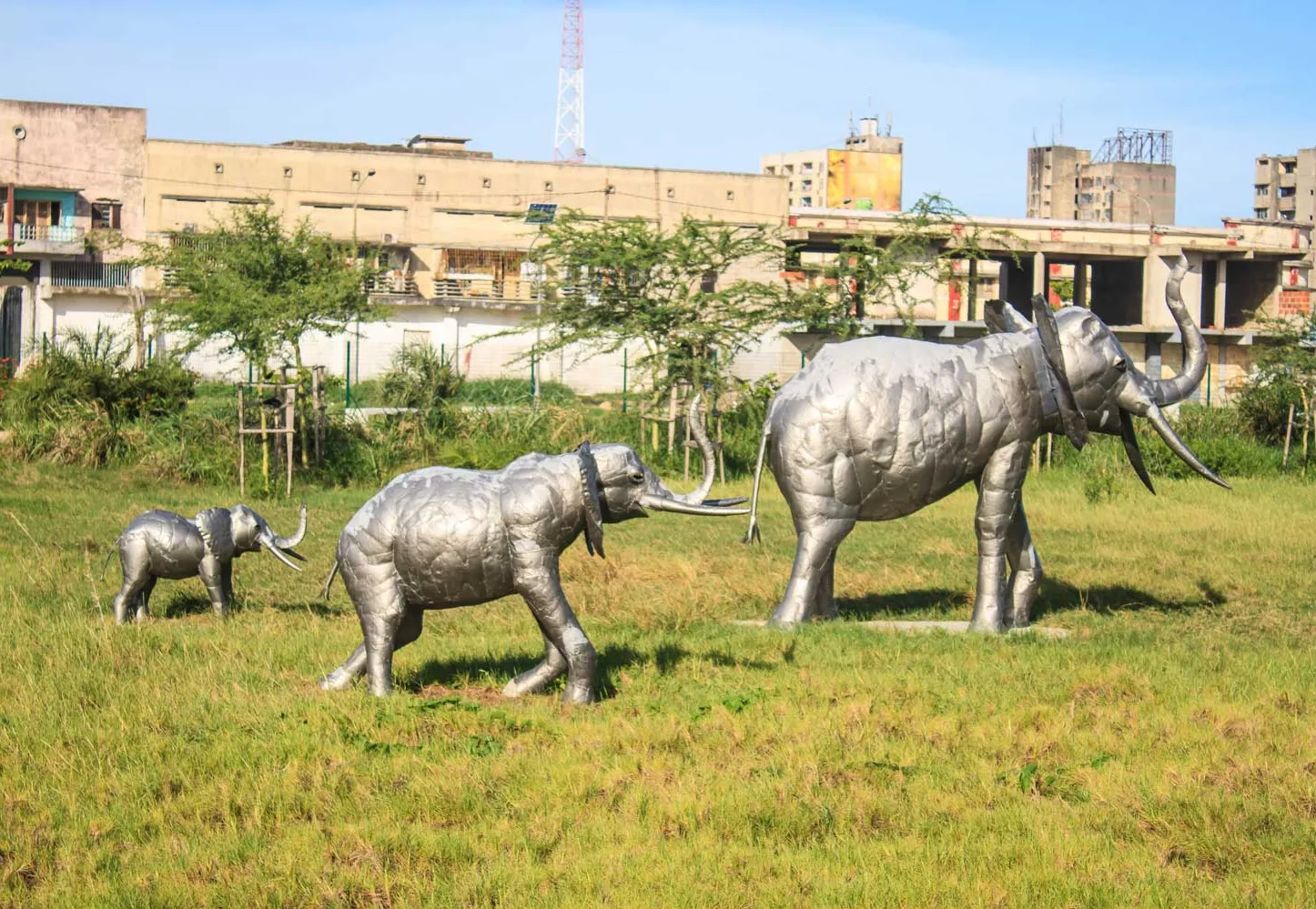
Maria Pinto de Sá was entrusted with this purpose. It was she who rolled up her sleeves and coordinated the acquisition and installation of all the works of art and craft in the park. According to Maria, there are around 50 works of art and craft there, and she herself made the selection of the different types of work, as well as contacting and inviting the artists. “My great concern, when I invited the various artists, was for the park to have a wide variety of works and of national artists representative of our culture. We have, for example, a large mural by the renowned artist Sitoe, and painted murals by Alex Dunduro, from Beira, and by younger artists such as Hotélio, Afro Ivan and Kassiano. A marble bas-relief by the master Idasse, and several ceramic panels by João Donato. Steel sculptures by Djerry. Given our city's link, mainly through its port, with neighbouring Zimbabwe, we also did not forget to invite artists from that country, and so in the park we can see stone sculptures and many animals in iron (elephants, giraffes, rhinoceroses and others).”
The Chiveve River Urban Park was built with funding from the World Bank and the German Government (KfW), each contributing 50 per cent. The body that oversees it is the Municipality of Beira.


