
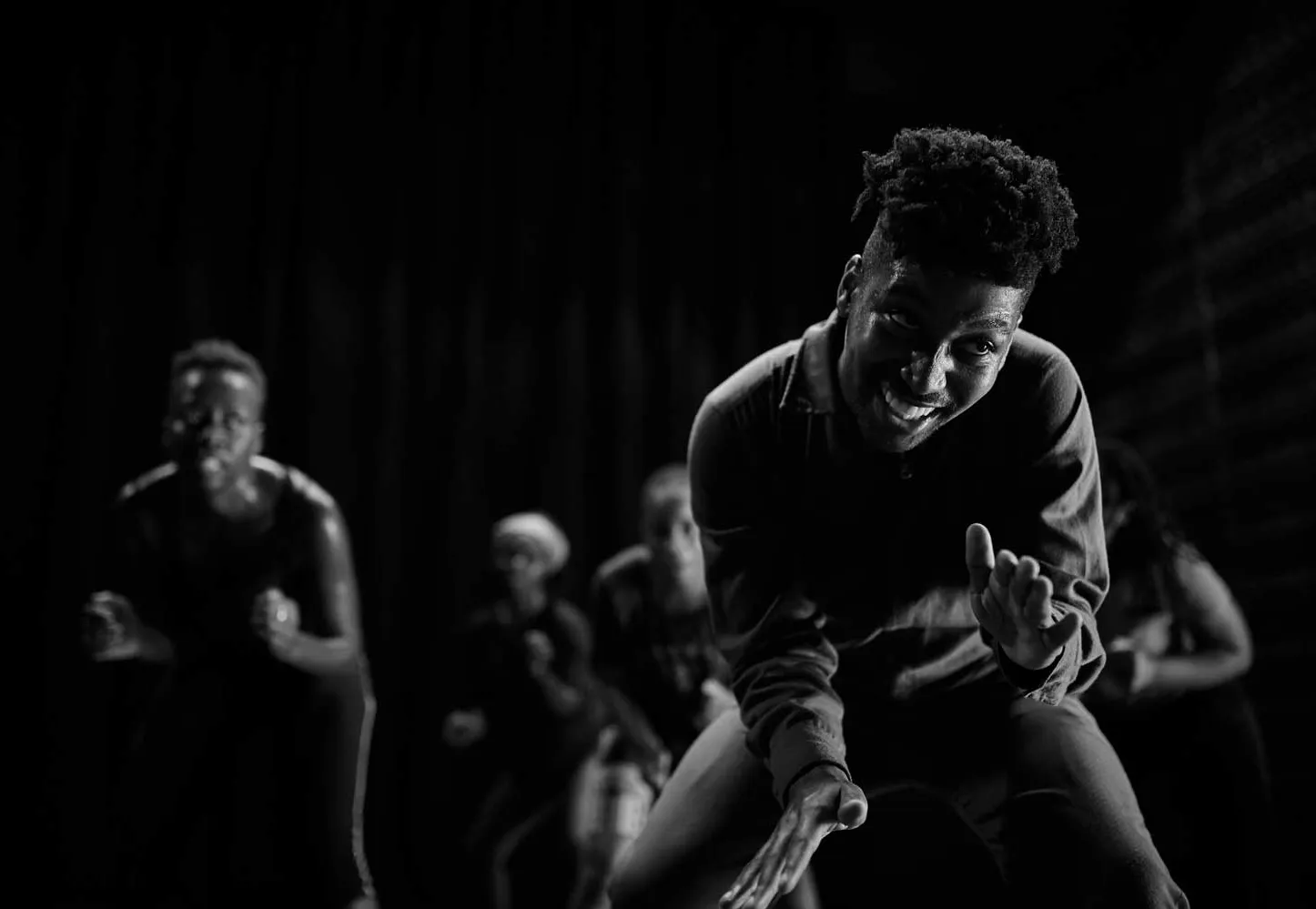
Yuck Miranda
and the fight for the rights of the “Unidentified”
Written by: Jaime Álvaro
The fight to defend human rights, and those of the LGBT community (Lesbian, Gay, Bisexual, Transgender) in particular, is what defines the life of the experienced Mozambican actor and dance performer Yuck Miranda, born in Maputo. This multidisciplinary artist, who considers himself an activist at every moment of his life, whether on stage or off it, spoke to Xonguila Magazine and shared his artistic experience, intrinsically linked to his humanist cause.
Raised by his grandparents, Yuck Miranda, aged 28, grew up in an environment of artists, with his mother and an aunt, both dancers, as his references. Yuck, an openly gay man and recognised defender of the cause of the rights of members of the LGBT community, has always had access to the arts, with which he ended up falling in love and with which he maintains a lasting romance. He studied performing arts at the SOS Hermann Gmeiner Primary and Secondary School in Maputo and, besides these arts (music, theatre and dance), he learned ceramics, basketry and cutting and sewing, which fuelled his passion and enthusiasm for acting and dramatisation, turning him into the versatile artist he is today. "For as long as I have known myself as a person, I have understood myself to be an artist. I started getting involved with theatre at the age of four. I began studying theatre in childhood and putting on plays at school at the age of seven," he shared. "By then I was already certain of what I wanted to do. I took all those artistic subjects from first to seventh grade. When I left SOS, I went into the state school system, where there were not many artistic subjects. So I decided to found cultural groups at school to pass on my cultural baggage and to continue my learning in the arts." In 2010, Yuck began working with prominent Maputo companies, thus starting his process of professionalisation. He was a professional actor with the Luarte Theatre Company, where he developed, before joining the already historic and renowned Mutumbela Gogo company. Now a graduate of Eduardo Mondlane University, he says this about himself: "I am not necessarily a dance artist. Dance is something very recent in my artistic path. I am more a theatre artist who dares to work with dance shows."
Zita: a (sur)real story
'Zita', first presented in 2019 at the Kinani Festival, is a piece that results from the research work of the Unidentified Identities Project, work that aims to reveal, through performances, the narratives and dilemmas of members of the LGBTIQ+ community (an evolution of the acronym 'LGBT' to encompass the various sexual and gender minorities) and which is still in the research phase. In it, Yuck addresses unheard narratives of people who suffered attempted murder in (so-called) safe spaces, of people who suffered homophobic attacks, and discusses the inaccessible policies in countries described as safe for that community. "This is one of my life projects, and it arises from a very personal experience that I lived in Mozambique as an LGBT person," he revealed. The Project involves interviews with a group of people who have been systematically discriminated against, marginalised and excluded when it comes to exercising their human rights, owing to the lack of recognition of their identity.
"I decided to collect stories in countries considered safe for LGBT people. I did my first study in Mozambique, specifically in Nampula, where I interviewed several LGBT people. One of the stories inspired the Project’s first theatre piece, Zita."
Mozambique is one of three countries on the African continent "most tolerant of homosexuality", according to data from an Afrobarometer report that analysed 33 African countries. Yuck questions the so-called tolerance in Mozambique (and elsewhere) with regard to homosexuality or LGBT people and considers it "ambiguous". "I try to reflect that place within 'Unidentified Identities'. Is there anywhere in the world that is safe for the LGBT community? What do we mean when we say there is a safe space?" he asks. "If I am attacked for being an LGBT person, does anyone protect me? I have lived through that experience myself and felt that I received no assistance, and I have also heard many stories of people who did not have access to basic social structures – hospitals, the police, the justice system – in the middle of such an attack," he complained. As part of the Project, Yuck has gathered more than 100 stories, in our country and abroad as well, portraying the dilemmas that the LGBT community faces around the world.
A ‘Cause’ that is known and acknowledged, but...
"The lack of recognition of the identity of LGBTIQ+ people makes them non-identities and therefore not subjects of rights, which contributes to the lack of measures that need to be put in place to ensure the identification of such identities and the guarantee of their respective rights," Yuck Miranda explained of the Project’s scope.
Yuck was recently in Paris, France, carrying out the research phase for his life project, Unidentified Identities, centred on narratives of LGBTIQ+ members from different countries around the world, before the outbreak of the pandemic in Mozambique. "I am an activist at every moment and every day, whether on stage or off it. Activism is not a coat that you put on and, when you get home, hang on some kind of coat rack. Activism is my daily life," he stressed. "Art is a place of freedom; if art does not have freedom, it is not art. So it is about freedoms, about silences, about what social silences say, that my work operates. I want to give voice to these silences because art is a free place," he said.
Besides Mozambique, Yuck Miranda has performed in and directed various collective and/or individual works in several countries, namely France, Portugal, Norway, Sweden, Rwanda, Zimbabwe and South Africa. In October 2021, he was awarded the 'Prince Claus Award', in the Seed category, for the committed work he carries out in defence of human rights. "Being recognised by a foundation like Prince Claus, which has been funding culture all over the world, gives me immense joy," he said proudly. “Winning this award is not only a win for me, it is a win for other artists. I believe that, with this award, many doors will open for the new generation of Mozambican artists in particular, and African artists in general," he concluded. The Award provides a fund, through which the laureate can develop a project in the arts and culture sector.


