
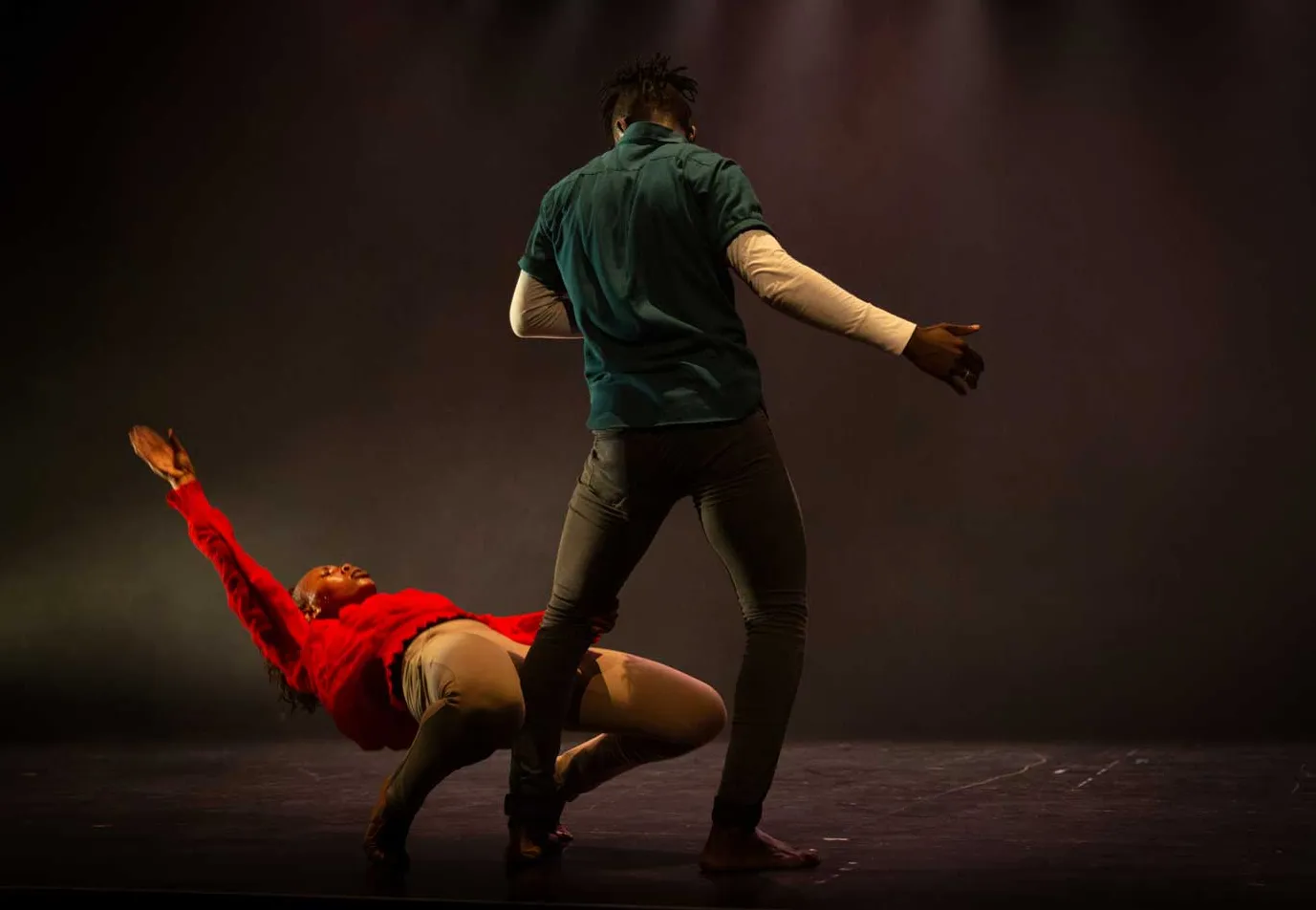
There are artists who create to entertain. Others, to question. Osvaldo Passirivo dances as one who digs up memories and raises ancient dust, with gestures that defy time and noise. Choreographer, performer and teacher, Passirivo has taken Mozambique to stages around the world — but he has never let his body come loose from the land that formed him. From the streets of Maputo to the theatres of Brussels and Lisbon, his artistic path is made of restlessness: about what we are, about what we carry, about what we hide. In this conversation with Xonguila, he reveals himself not only as an artist, but as a guardian of ancestral gestures, a conductor of affections and a translator of silences.
Dance has taken you from Maputo to international stages, but it has also brought you back to your roots. If I asked you to describe the invisible starting point of each new creation of yours — the moment before the first step — what would I find?
Before the first step, there is always a whirlwind of silence — echoes of my artistic journey. It is not emptiness; it is a place full of ghosts, memories, the voices of my ancestors, the drumming in the distance, the body waking to an ancient pain or joy. That is where everything begins. Invisible, yes, but present.
When you create a choreography, do you seek to tell a story, put a question to the audience, or provoke an emotion? Do you prefer the audience to understand or to feel what is happening on stage?
I create in order to ask, but I have also choreographed or done movement direction for productions that tell stories, since every collaboration is unique. Each of my gestures carries a doubt, a restlessness, but sometimes I wonder whether everything has to be asked and/or answered. I am "not" interested in offering answers — I prefer to open cracks and leave ellipses. If someone leaves the performance without certainties, but with the body stirred up inside, then we have danced together.
I prefer that they feel. Understanding is a luxury and subjective; feeling is urgency. If the other person's body vibrates with mine, we are already in dialogue — near or far.
What silences of Mozambique do you seek to translate into movement?
My country's silences speak loudly, very loudly. The silence of those who left without saying goodbye, because they leave an empty silence for those who stay; that of the women who have always carried the world without complaint; that of the streets that dance even without music — because the streets, avenues and so on of my Mozambique dance the stories lived in them. I try to translate them without betraying them.
And if the city of Maputo were a body in motion, what would its dance be like?
Maputo dances with loose hips but a tight chest. It is a warm, pulsing body, but also one tired of carrying promises. Its dance is made of improvisation, of having to adapt to the situations at hand, because dance (art) is made mediocre by those who ought to support it. But, as we are resilient, we make history (pandzamos). Just to reflect: dance, from nursery school to adulthood and professional life, even so, sees recognition slow to arrive.
Has there been a moment on stage that made you rethink your relationship with dance?
Yes, there was a moment. I was on a creative residency for the show SMILE IF YOU CAN, by Horácio Macuácua, in Maputo. Suddenly, I felt that I was dancing while standing still in the same space, with a bouquet of roses, and I realised that dance does not consist only of moving — being static in a performance space already takes us to a place that begins static and ends dynamic, or in other ways. From then on, dance became something more open... But it is important to say that, with each creation, I allow the body, the mind and my spirituality to place themselves in question within this global body...
Which of your gestures on stage do you think comes closest to a prayer?
My body is my sacred temple for sharing and receiving this faith — ancestral, traditional, classical, modern and futuristic. When I kneel, lie down, roll, walk on a performance floor — it is to the floor that the body speaks, to something greater than itself. That gesture is prayer, it is surrender, it is gratitude, it is blessing and it is faith.
What was the rawest and most honest moment of your artistic career?
It was when I was doing urban dance, in the Makinistas Group. At primary school — that is where the first contracts came from, but, at the same time, it was the "raw" phase of Osvaldo Passirivo. Then came the transition to contemporary dance, coming from traditional dances. There was no trick or filter there. Only truth.
How do you handle tradition and innovation without one erasing the other?
Tradition is not a museum — it is a current. That is, it has high and low seasons, but it is always there: my essence. I innovate with my feet inside the terreiro, with respect but without fear, because there is no future without roots, and there is no root that does not want to grow.
What has your body not yet managed to say, yet keeps trying to?
Pains that the body does not yet know how to say through movement, but I end up sharing that reflection with other bodies — and it becomes a way of seeing those pains of mine in other bodies that may be alike and different. Perhaps also because they hurt too much. But I keep trying — at every rehearsal, at every spasm, I try. The body is insistent, like the outward expression of that pain.
Tell us about your current project. What does it represent for you, both artistically and personally?
I am working on a solo called WHY. It is a contemporary dance performance that explores the complexities and nuances of human existential questions. The piece plunges into the depths of the mind, questioning the purpose of life, the nature of choice, the search for identity and the struggle against uncertainty. But it is also the search for some personal answers — I am a father and I have a champion: a special son. At the same time, I try to understand who is really special: me, for knowing how to deal with him, or him, for accepting me and trusting me (family)? Each individual may have a unique interpretation of what gives meaning to their life — and that search may evolve over time. The important thing is that each person finds what resonates with their own experiences and values.
Do you keep any image from your childhood that still moves you on stage today?
The image of my mother, my father and my sister always dancing at home — my father shirtless, as he liked to be, which ended up becoming a trademark in all of us. Now, with my son, we are the same. And, as it is something cultural or traditional, in traditional dances we are always shirtless and always with a contagious smile... My family — by blood and through the arts — is, in itself, very happy, despite life's adversities.
What moves you more: an audience in absolute silence or one that reacts intensely?
Absolute silence gives me goosebumps — it is mutual connection, that is, it is when the audience breathes with me. But I confess I also love the other side, when someone shouts "eish!" in the middle of the dance, depending on the context we are in. And, particularly, when it is Mozambique responding — because dancing at home is a gift, it is the fulfilment of a dream every time I step onto a stage in Mozambique.
If you had to imagine the Mozambican body of the future — the one who will dance fifty years from now — and left a final movement as a legacy, what would we see in that dance?
I imagine a hybrid body: ancestral and electronic, because Mozambicans adapt easily — not only in dance, but in other areas too. I see a body that dances with algorithms, but still knows the smell of wet earth. A body that has not forgotten the xitsuketa... And if I had to leave the stage today, the final movement would be simple: an outstretched hand, slowly opening and closing. As if to say: there is more, but now it is up to you — it is the passing of the baton.


