
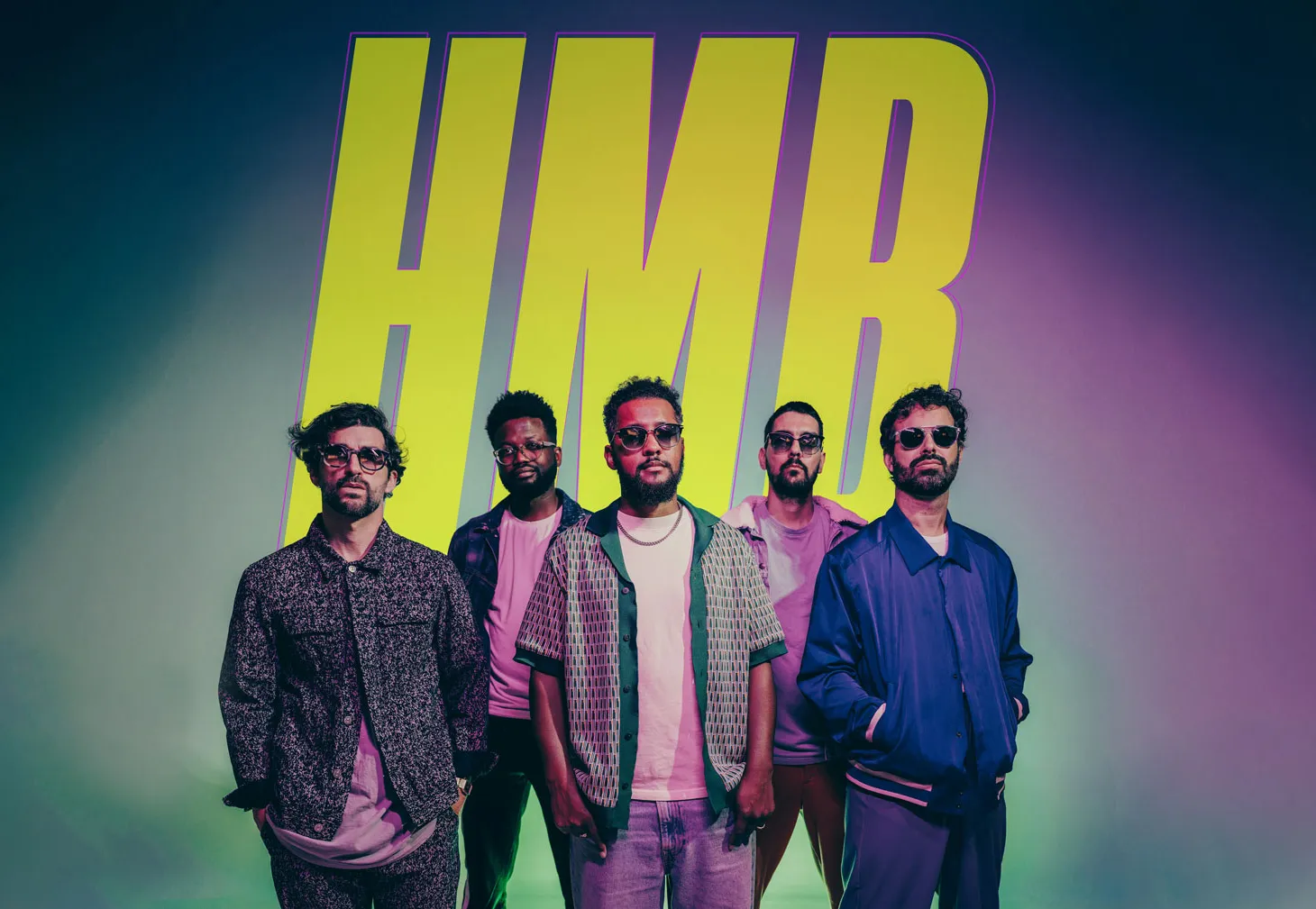
“Neste Deserto Nascem Flores” is a highly evocative title. Could you tell us more about the moment or the specific situation that inspired this name and the concept of the album? Also, what are your expectations regarding how it will be received by the public and the critics?
The name of the record came after the songs had already been chosen, after we had already put together a collective, a bit like someone writing a book. When we pick up an instrument or something that has inspired us, we don't know exactly what it is going to become, nor what consequences or what impact it is going to have. The name of the record came when we looked at the work with fresh eyes and realised that the name “Neste Deserto Nascem Flores” was very strong and also ended up summing up the spirit of the record quite well. It seemed to us a name that was almost too obvious for us not to have noticed it until then. As for how the market will receive it, that is always unpredictable. So I prefer not to have great expectations. Naturally, being a human being who spends time and gets emotionally involved with the things he creates, I always hope that people will take something positive from it and that, in some way, they will be touched by the work. But from a commercial point of view, I try not to set my expectations too high.
This album marks a new phase in your career. In what ways do you feel your music has evolved or matured in this latest work?
I am a little afraid of the word “evolution”, because evolution does not always mean that something changes for the better, but I want to believe that, as we have made records, they have always changed for the better. The thing is, we have actually been together for 16 years; at the end of this year it will be 17 years together. That is a long time sharing the road, a long time sharing music. This is our fifth record. I want to believe that, yes, as we went along, we improved. In terms of sound, HMB is always very hard to describe. I even believe that HMB happens live and that studio records find it very hard to capture the spirit of the band. But that's it. Still, I think that yes, we have evolved and matured. The songs have naturally more mature themes, laden with experience, and that is what we want to convey. We are beginning to enter a cycle in which we start sharing our experiences.
“If an invitation comes, we will accept and go to Mozambique to make music for the Mozambican people. All you have to do is call us!” - Héber Marques
The singles “Sol e Lua” and “Já Não Sou Bom a Mentir” present emotional and musical contrasts. Could you talk about why you chose these songs as singles and what they represent in the context of the album? How do the personal experiences of each member intertwine in the lyrics and melodies of this album?
The singles are indeed opposites in several respects. For example, the first single, “Sol e Lua”, was chosen because it was the most “easy listening” song, and the one with the “gimmicks” that were easiest to digest, understand and enjoy. We are talking about a platonic love, which, of course, becomes deeper on closer analysis, but those were the reasons we chose “Sol e Lua”. As for “Já Não Sou Bom a Mentir”, it reflects very much a condition that, as we grow up, we often find ourselves in, and we realise: “Gosh, this version of me that I have shown until today is not the most authentic version, it is not the most faithful version.” So it is natural to want to break some crystallised images, and “Já Não Sou Bom a Mentir” speaks of exactly that. Personal experiences always have, obviously, a great impact on the lyrics of the songs. Being the one who writes most of the songs, I can't escape that, can I? That is, at least as far as I am concerned, the songs will always carry a very large share of me, and the melodies and arrangements will carry a share of the others.
The collaborations with artists such as Tatanka, EU.CLIDES and Joana Silva bring sonic diversity to the album. How did these partnerships come about, and what impact did they have on the final result of the album?
Whenever we have done collaborations on a record, we have always respected what the song was asking for. From the beginning, from the very first HMB record, it has always been like that. If we felt: “Look, the song is asking for... I don't know, a harp”, and none of us plays the harp, we would invite someone, because the song really called for a harp. That is just an example. So, in this case, the guests, in my view, always have a very big impact on the song, and I think it is always a good impact. In the case of Tatanka, on the song “Money”, when the line “O pedigree é especial e ninguém leva a mal” came to me, I always heard Tatanka in my head singing it. And since he is a personal friend and I have his phone number, asking whether he would be up for it was easy. And, being the generous person that he is, he said “of course, let's do it”. We set a date, and he made it happen. I even filmed it, and it was very special for me. I have a little clip of him doing that acting bit in the middle of the song, which I think he does like nobody else. I think he shone even more there. In the case of Eu.Clides, the song... I always thought it was a duet; I never thought it was a song for just one performer, I always thought the song would have two. But Eu.Clides was not obvious at first. In the end, though, he turned out to be the best option. It was Joel, HMB's drummer, who thought of Eu.Clides and proposed him. I have known Eu.Clides for a long time, since he was about 13 or 14... And yes, when he said it, it was indeed obvious. So I called Eu.Clides and, besides being an artist with a very unique voice and a very unique way of making his music, he is a first-rate guitarist. I sent him the song and he liked it a lot; he felt it had a lot to do with him. He came here to the studio to meet me and recorded the guitar because I asked him to as well, and just by putting his guitar on it, he took the song to another level. And then, when he put his voice on it and brought his way of interpreting the song, I think the song became very special, to the point of being, to this day, my favourite song on the record.
After a 15-year career and with a solid fan base, how do you see your relationship with the public? Are there specific expectations about how this work will be received by your fans, especially in Mozambique?
I think that, depending on the period in history in which an artist emerges, they have different notions of their audience. We emerged at a time when YouTube was just appearing, for example, and later, about two years after we started, Facebook and social media appeared. The idea of social networks begins to take hold. I think that artists who are starting out today have a clearer notion of the audience they want to reach. And that is not necessarily better or worse. It is neither better nor worse for an artist to have a clear idea of who their audience might be, as opposed to having no idea what might happen. To speak specifically about us, we emerged at that stage when we began to have more direct contact with the public. I think that, at the beginning, we even made good use of YouTube and communicated well with our audience with plenty of content. Then there was a phase in which we stopped doing that, and that is my great regret. I think that HMB, being the band we are, with the history we have always had and the quality we have today and have always had, should have kept up uninterrupted communication with their audience. But I want to believe that the impact of our music is always a positive one. I want to believe that we are leaving a good musical legacy, and that the public, at least as far as quality is concerned, will never feel let down. That is my expectation when I release music with HMB; it has always been my expectation. I believe that anyone who wants to stop and listen to music (not just put the music on, as most people do nowadays, switching on the radio and using music as background sound, and I have nothing against that…), anyone who sits down to listen will truly draw out the essence of the record. And I would like that to be how our audience behaves. Not least because we did exactly that with a number of our closest friends, inviting them to sit with us and listen to the record from beginning to end.
What message would you like to send to your Mozambican fans? Are there plans for concerts in Mozambique?
Well, as for plans, what we really have is a great desire, at this stage more than ever, to do what comes from the soul. We very much want to play music, to make the most honest music we can. We want to be in the most special places we can be. If an opportunity to return to Mozambique arose, we would very much like it to happen. We would certainly get even more out of the experience than we did in 2016, when we went to Mozambique. I think we would get even more out of it. So, if an invitation comes, we will accept and go to Mozambique to make music for the Mozambican people. All you have to do is call us!
Throughout your journey, you have certainly faced many challenges. How did these challenges influence the creation of “Neste Deserto Nascem Flores”, and what does this album represent in your journey as a band?
It is a journey, it is already a life. A person of 17 is no longer a child, nor is he an experienced adult, but he already has a life, already has a lot of history, already has a lot to tell. In the world of music and an artistic career, 16 going on 17 years is a long time, and it is natural that with it there are also things that don't go so well, disappointments, whatever life throws at us, which are difficulties, and with that also come disenchantment and disconnection. All of that is natural in a band. What is not natural is that, after so long and with everything I am describing, there is still unity, there is still a desire to keep making music. That is in the realm of the miraculous. So I think we end up being a small miracle in this industry, alongside other bands that have also had journeys as long as ours. And this record, “Neste Deserto Nascem Flores”, really could not be more fitting because, after all this time and after everything I have just described, we can see the little flowers springing up from the desert. And nothing brings more joy than that.
This album introduces new sounds to your characteristic Soul and R&B. Could you explain how these new influences show up on the album and the impact they have had on your sonic evolution?
We will always have a mother tongue as our foundation. Just as I express myself best in Portuguese because it is my mother tongue, whenever I want to say something that comes from the heart, it will be easier for me to do so in my mother tongue, the language of my heart. But that does not mean I don't know how to explain and express myself in other languages. Life and experience will equip me with other tools and other languages, and I will probably learn to express myself in other tongues. With music it is the same: we came from Soul and R&B but, as music lovers, we don't confine ourselves to that sound, and it is very natural for us to travel through other colours and other aesthetics. This record is just one more manifestation of that. From early on, we have always liked to be a bit of everything; we have always had an irreverence in sound that is very characteristic of rock. We have always had more inspirational themes and lyrics, which come very much from Gospel, but we like to express ourselves in many ways, and this record is just one more representation of that.
Following the interview given to Xonguila by EU.CLIDES, in which he emphasised the profound influence that the church and religion have on his lyrics, reflecting an intense spiritual connection with his music, we would like to know: given the importance of faith and spirituality in your own lives, how does that spiritual dimension intertwine with the narrative and the message you wish to convey with the songs of “Neste Deserto Nascem Flores”? How has this aspect of your identity shaped the lyrical content and artistic vision of this new album?
Look, it is not an easy answer to give, even though it might seem obvious given the band's history, and even my own history as someone who is at the front of the band, and the fact that I was born into a Christian home. I cannot escape this message, and it is something I realise today, at 40. I realise that I cannot escape it, just as nobody can escape spirituality. Everything begins and ends in the spiritual. But for me, it was something very unconscious. That spirituality that was impregnated in HMB's songs was something very unconscious; today it is something very conscious, I am aware of it. So, besides being unable to escape it as someone who lives and breathes in this world, I also feel even more acutely the responsibility that the work I put out there should be not only a sonic experience, but also an emotional one. And “Neste Deserto Nascem Flores” is steeped in that in its songs. For example, “Força Motriz” is a song in which I sing “Tu és minha força motriz, minha terra, a minha raiz”. The lyric is exactly that: an appeal to spirituality, to the spiritual, a plea that the spiritual may not forsake us, may not disappear. Here, the spiritual has a very specific name for me: I am talking about God, I am talking about Jesus, I am talking about the Holy Spirit. I cannot escape it, to such an extent that, when I go to write, the images I use are often biblical images. In the verse itself I say “Eu já tentei desatar o nó, olha só, mas nada, nada se passa, nada. Mais de sete voltas a Jericó, olha só, mas nada se passa”. For anyone who has some familiarity with the lyrics, with the biblical content, they will understand that Jericho is a city that still exists today. It is a land that points to the East and is one of the settings of the Old Testament. It has a very curious story that anyone who is curious can go and read. So, all this is to answer that, indeed, spirituality and religious and church life inevitably influence HMB's songs.
In an increasingly digital and sometimes distant world, also marked by conflicts such as wars, music has the unique power to connect people and awaken deep emotions. With ‘Neste Deserto Nascem Flores’, which aspects of the human condition do you hope to explore or illuminate, especially in relation to hope, resilience and the search for peace in times of conflict?
Peace is not necessarily the absence of conflict. And very often we embrace a false peace because we don't want to be in conflict. Being in conflict is not necessarily bad. That is just a parenthesis I wanted to make. But yes, in a more digital world, people really are more distant, and human interaction, which makes all the difference, has been growing scarcer. “Neste Deserto Nascem Flores” is a human reaction, a human expression. We expressed ourselves in the best way we could during the period in which we were recording this record. We always hope that it will have, above all else, a real impact, going beyond being a simple manual for change in someone's life or for someone's soul. We want people, when they listen to HMB's record, to realise that it was made by a human being. Above all, that is the great mission of our music. Everything beyond that is a bonus. If people manage to take something from it that lights up some dark area of their lives, all the better, because then we stop merely making music and enter the realm of life's purpose. I truly believe that all of us have a purpose in life, and my purpose is to be a kind of prophet, the one who reminds us of God's truths. I think that, even without mentioning the name of God, it is possible to convey that message, to remind people of God's ideas, His laws and customs. And I think HMB ends up being a vehicle for that, often being a prophet for myself too. Whoever says something is first of all voicing an opinion to themselves; a person is their own first audience. It is complex, and the question does not allow for a very short and succinct answer, as you can tell. But yes, I would like to pass on a message of hope, resilience and the pursuit of dialogue, above all dialogue, and not the absence of conflict. I want to be aware that people are really listening and understanding what side A is saying to side B.


