
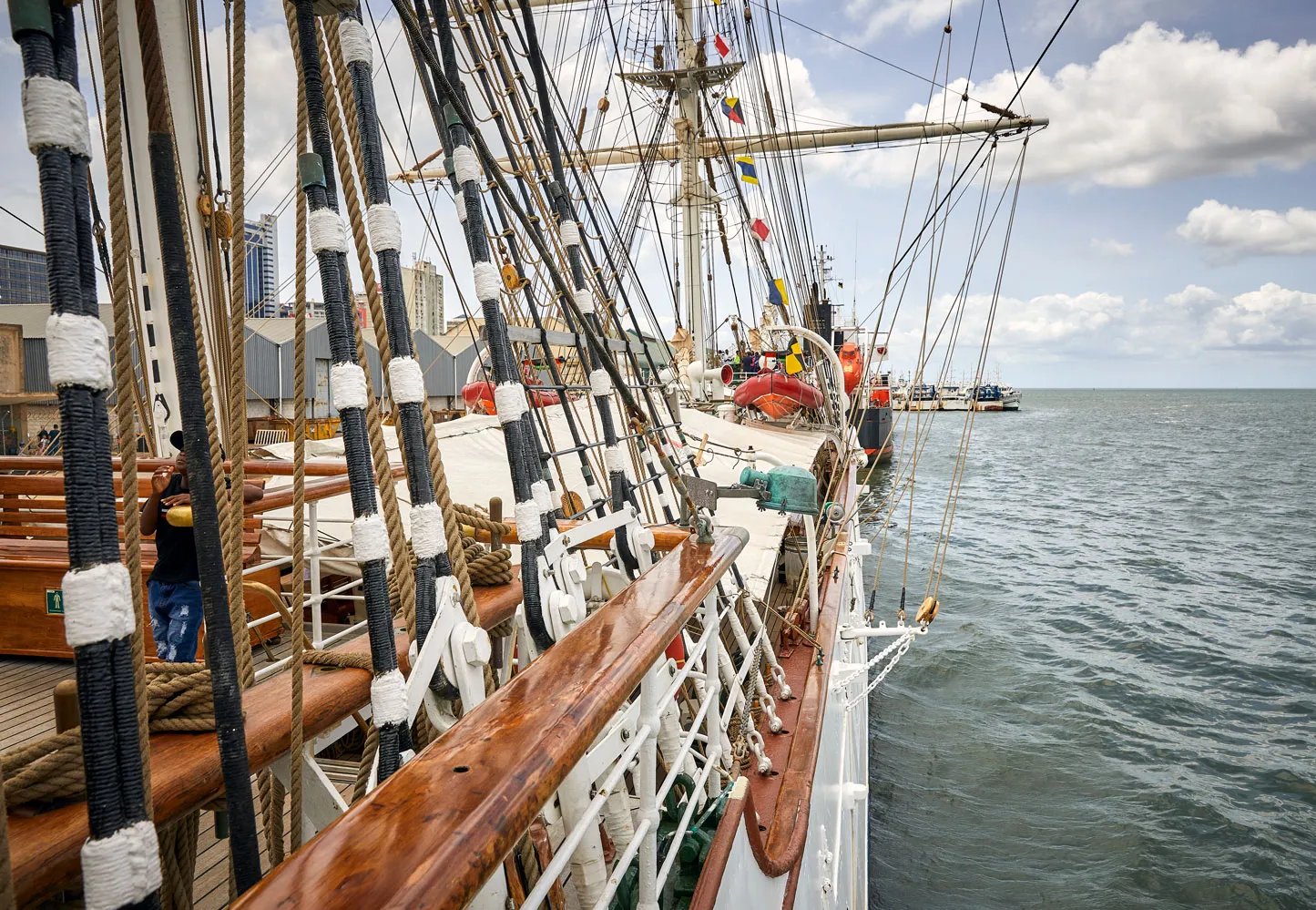
Until 3 January, the Norwegian sailing ship Statsraad Lehmkuhl, one of the largest and most beautiful sailing ships in the world, will be moored in the Port of Maputo. She left the coast of Norway in August 2021 on a 20-month circumnavigation called the One Ocean Expedition, which will take her a total of 55,000 nautical miles, calling at 37 ports. It is a global ocean expedition that aims to raise awareness and share knowledge about the crucial role of the oceans in a sustainable future from a global perspective, since we face common challenges, in particular climate change and ocean acidification. In Maputo, besides a reception on board, which took place on the day of arrival, 17 December, seminars are being held for academia and the private sector, as well as visits to the ship, mainly by children and young students. From Maputo, the ship will sail for Cape Town, in South Africa.
A floating university
The 108-year-old Statsraad Lehmkuhl was built in Germany in 1914 for merchant purposes, but has sailed under the Norwegian flag for more than a century. She has been converted into a state-of-the-art research vessel that allows high-quality data to be collected continuously throughout the voyage. Equipped with modern instruments, she carries researchers and students from different parts of the world, who gather information on the water (carbon dioxide levels, acidification and temperature) and carry out studies on marine litter. She is therefore a powerful tool for outreach, inspiration and connection with the oceans, and the expedition is recognised by the United Nations. This sailing ship, 98 metres long and with its tallest mast rising 48 metres above the deck, carries 22 sails and a crew of 25, and can take a further 140 trainees on a voyage. She can reach a top speed of 17 knots, that is, 31.5 km/h.
On the occasion of the One Ocean Expedition's call in Mozambique, the exhibition Oceans that Unite Us is on show at the Museus do Mar (Fisheries Museum) in Maputo, also until 3 January. Through a range of informative images, it shows us the challenges of conserving marine ecosystems. Organised on the initiative of the Embassy of Norway in coordination with the Foundation for the Conservation of Biodiversity (BIOFUND) and the Mozambique Oceanographic Institute (InOM), the exhibition was opened by Lídia Cardoso, Mozambique's Minister of the Sea, Inland Waters and Fisheries, who called it “a true lesson about the ocean that evokes sustainability in the use of marine resources”. The exhibition aims to highlight Mozambique's marine biodiversity, its importance and the need for its conservation, prompting reflection on the United Nations Decade of Ocean Science for Sustainable Development (2021-2030).
Norway and Mozambique in the field of oceanographic research
Norway's cooperation with Mozambique in oceanographic research goes back several years. Fridtjof Nansen, another Norwegian research vessel, has already visited Mozambique on different occasions, involving local researchers, which has created strong ties between the two countries. According to the Ambassador of the Kingdom of Norway in Maputo, Haakon Gram-Johannessen, the Fridtjof Nansen is expected to return to Mozambican waters in 2023 to continue its research activities.
It should be recalled that the premises where the exhibition was held, inaugurated in November 2014 under the name Fisheries Museum, are also the fruit of Norway's cooperation with Mozambique.


