
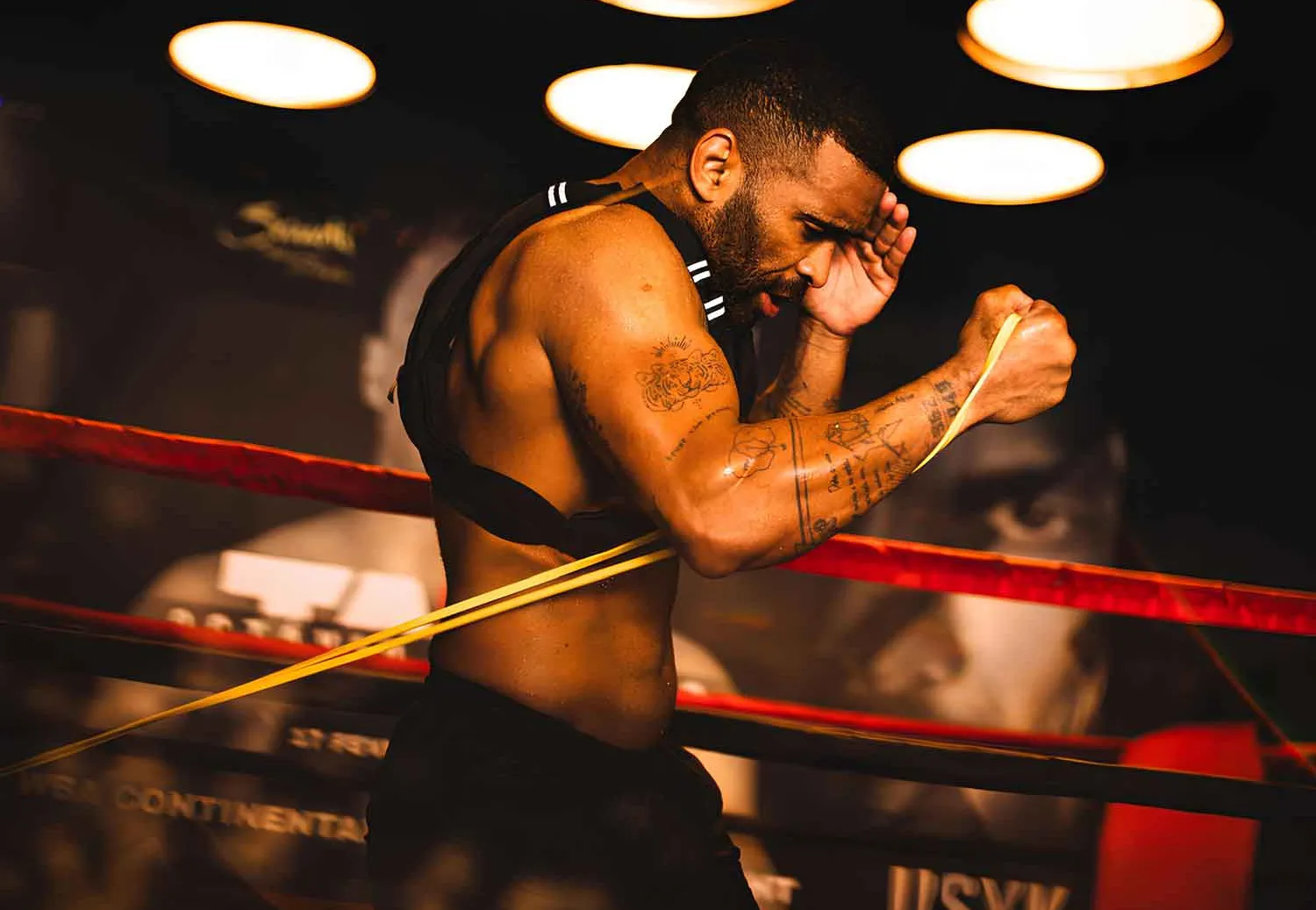
Octávio learned to fight before he ever stepped into the ring. He grew up in Maputo, amid freedom and movement, and left while still a child, leaving behind far more than a place. Life saw to it that he met his first battles early, some without an audience, others hard to name. Boxing came later. Not as an immediate destiny, but as an answer. It was there that he found a way to channel what he carried inside him: the pain, the discipline, the resilience, the will to keep going. Today, every fight carries that journey. It is not merely a confrontation, it is memory. It is the point where the athlete and the man meet. In this conversation with Xonguila, he talks about his childhood, his departure, the loneliness of the ring and what, in the end, truly remains.
Before the first bell rings, when you are still alone in the changing room, who is the man preparing to step into the ring?
A man full of dreams. Regardless of any achievements I may have, regardless of age, I always feel that hunger, that desire to win more. He is a man who steps into the ring as a dreamer, always ready to achieve more and more.
What kind of boy was the Octávio who grew up on the streets of Maputo? Which memories of your childhood still stay with you today, even after everything you have lived through?
Ah, I have fond memories of my country, I have fond memories of Mozambique. I was an extremely restless kid, but I always loved fighting. We had a very strong culture in Mozambique of staging karate fights and fighting in the street after watching films. As I have said, I spent a large part of my childhood in Chamanculo, surrounded by games. We liked playing with spinning tops, riding ball-bearing go-karts, among other things. I was a child who grew up with a great deal of freedom, something you no longer see today. Always full of energy. To this day I carry very fond memories of Mozambique and of my childhood. It was a very pleasant period. I lived moments that still mark me and that always leave me missing the country.
For Octávio, Maputo lives in the senses. The smell of the sea, the smell of fruit, the taste that lingers, the warmth on the skin, the freedom of walking barefoot. That is where memory remains. He remembers leaving while still a child. At Maputo airport, amid farewells and familiar faces, the dream began to take on weight. He was chasing a future linked to Sporting, but he was leaving behind everything close to him, and it was there, at that moment, that emotion took over; he cried a great deal, unable to hold back what he felt. It was the first real separation. He learned to live with the distance, but that moment never left him.
Along your path there must certainly have been dreams left behind. What was the hardest price you had to pay to get where you are?
The great dream I had as a boy was to be a footballer. I always wanted to play for Sporting or to be a great footballer at a great club anywhere in the world. But that dream never came true, because I didn’t have that quality. But what I had to give up most, to reach the level where I am today, was the distance I had to keep from my family, from my own children. Because I always had to give far more of myself than I should have, you know? I started in sport very late, so I felt I had to work twice, three times as hard as the others to achieve my goals. Meanwhile, I often had to give up being with my children, with my family, in order to make my dreams come true. For me, that was the hardest thing, the toughest thing I had to do to reach the level where I am today and from where I want to climb even higher.
Boxing was born in one of the hardest moments of Octávio Pudivitr’s life. It was not an immediate choice, nor an old dream. It was a necessity. When his youngest son was diagnosed with cancer, everything around him lost its balance. Routine stopped making sense. He sought to change, to leave that place, to find some way of dealing with a pain he could not contain. It was in this context that boxing came in. Not as a passion, but as an escape. A space where he could let it all out, where he could, in his own way, face what he was going through. He trained more than usual. Three, four, five hours a day. The intensity shaped body and mind. In time, signs of something more began to appear: progress, opportunities, a real connection to the sport. Today, he recognises that moment as a turning point. What began as flight ended up opening a path. Boxing stopped being a refuge and became a destination.
Some see boxing only as violence. For you, what is this sport really?
Truly, that is part of the way people see boxing, as if it were only aggression. There is also a lot of influence from athletes we have had in the past, have now and will continue to have in the future, who think boxing is a form of personal assertion. I firmly believe that boxing is a sport that, just as it saved my life, has saved the lives of many other people. It is a sport like any other. But I understand that there are still many people who are a bad influence, who incite violence and hatred. That is why, when I set up my club, I always tried to do something different, outside that mould, a distinct reality. We wanted to help the kids understand that boxing also has values, has discipline, and gives us much more than the sport itself. Loyalty, companionship, discipline, among other things. That is what we try to instil in the youngest, because, as I have said, this idea that boxing breeds delinquents and people of little character is still very present in people’s minds. So we try to prove that this is not the case, and there is nothing better than leading by example.
Your body has become a tool of combat. When you look at the scars it carries, do you see pain or memory?
This sentence will sound a bit of a cliché, but it isn’t. I believe that everything makes us stronger. I think that everything that has happened to me, the scars on my body, the physical pain, the injuries, have made me far more resilient and the person I am today. I am increasingly proud, because I try to be better than I was yesterday. I am not a perfect person, nor am I heading that way, nor do I want to be, but I have to be better every day and set an example to everyone who looks up to me and who believes in my process and in everything I have been through. I truly believe that everything I have been through, the pain, the marks, the hurt, has made me the person I am today. And I also believe that today I can share much of my experience because of those mistakes and that process of growth, that transition into maturity. I believe all of these are positive experiences that I can now share with friends, with family and with my children. I owe my resilience and my will to win largely to that hurt, to those scars. I think it comes a lot from there, from never having given up.
For Octávio, the greatest challenge in boxing is not in the body, it is in the head. In controlling the ego and in knowing that victory is fleeting and defeat can come at any moment. Then there is the loneliness. When the bell rings, everything else disappears. Only the confrontation remains. And, for him, life is not very different. He learned not to depend on anyone. To be prepared, to sustain himself. Because, in the end, one certainty remained: nobody fights for us. Help may come. And it makes a difference when it does. But before that, one certainty remained: nobody fights for us.
Is there any fight in your life, inside or outside the ring, that you feel you are still fighting within yourself?
As I said, I always try to be better every day, to correct my mistakes from the past and some mistakes I have in the present, which I have already identified. My greatest fight is that: trying to be better every day, better and better, a better person, a better father, a better friend. That is my greatest fight, my greatest war. Every day I wake up to be a better citizen. That is my greatest battle, the battle that matters most, so that my children look at me with great pride in the father they have.
There is a force that accompanies Octávio and cannot be seen. It comes from the roots, from his connection to Mozambique, to his African heritage and to faith in God. Before entering the ring, he returns to his ancestors. To those who fought before him, to those who opened the way. That is where he draws his energy. An ancient, almost tribal strength, which reminds him where he comes from and pushes him forward.
What has changed in you since you became a father? And do your children know exactly what kind of man it is who steps into the ring?
A lot has changed. My children brought more sensitivity, they brought a different outlook from the one I had. Now I am much more understanding, much more patient. My way of loving is different because of my children. I believe my children have added a great deal. They are hard work, because there are several of them, but it is work that I take immense pleasure in, being present as they grow, in their education and development. I feel very proud because, thank God, all my children are healthy today and are good kids, good pupils. I feel like a very lucky man. And they feel it too, because they often say: ‘Dad, there’s a boy at school who is a fan of yours,’ or things like that. These days they have phones, they go on Google, they search. I think they already have a sense of the scale of what their father has done and of the importance he has in sport, and beyond.
In the end, when everything stops and he looks back, Octávio Pudivitr wants to know that it made sense. That the resilience, the effort and everything he gave along the way was worth it. He believes there is no right time and no right age. There is willpower. There is the decision to carry on, even when nobody believes. Let that be what remains. The proof that he did not give up. And that the journey, with everything it held, was genuine.


