
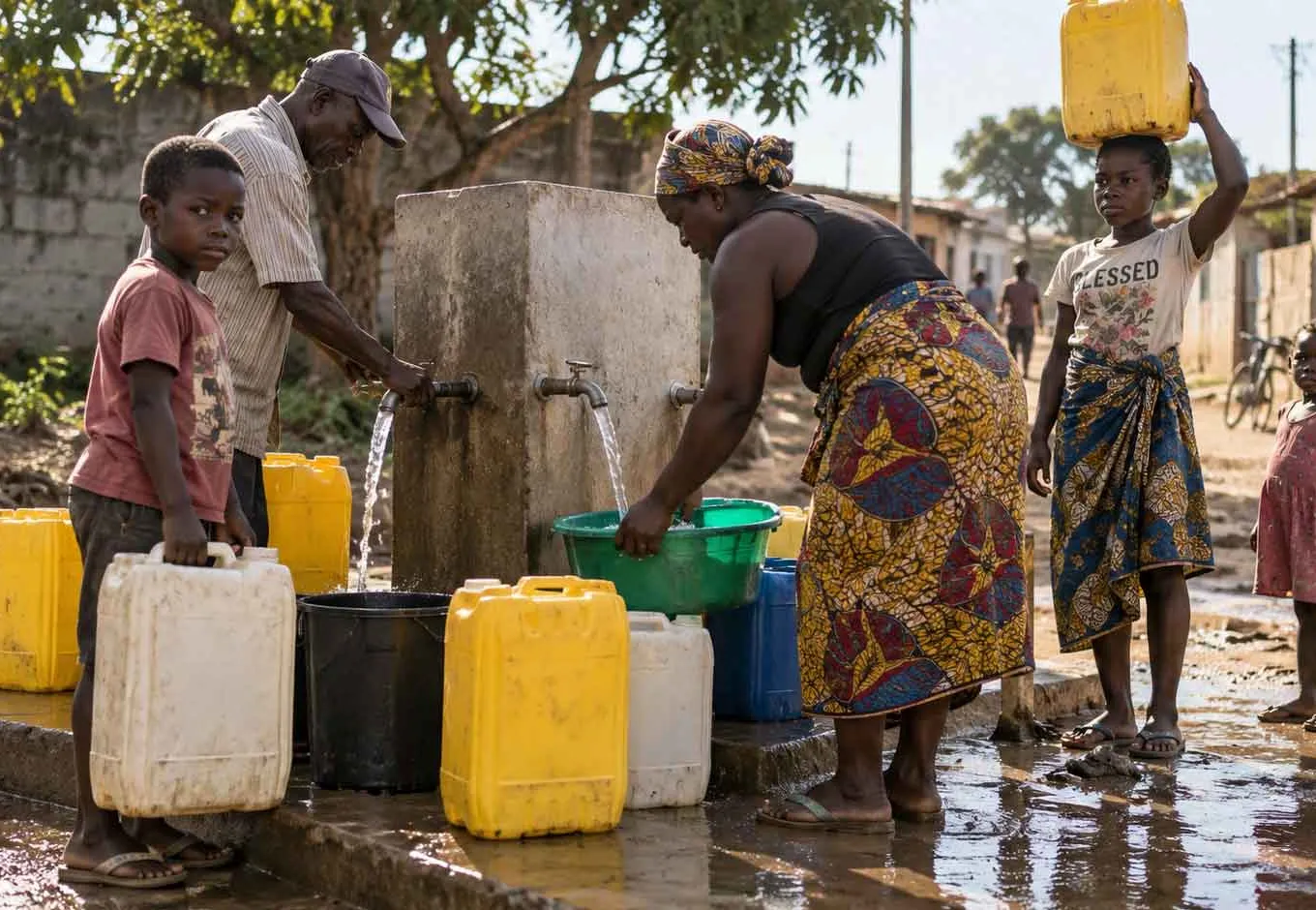
It is in northern Mozambique that the challenge becomes most evident when the year enters its most critical months. Between September and December, difficulties in water supply worsen and expose the vulnerabilities of communities, especially in rural areas. Faced with this situation, the Government has decided to place the region among the priorities of the new national strategy for the sector.
The plan involves installing new supply systems, drilling boreholes and providing equipment such as hand pumps, in an attempt to increase the amount of drinking water available to rural populations.
The directive was announced in Maputo by the Minister of Public Works, Housing and Water Resources, Fernando Rafael, on the sidelines of the opening of the National Institutional Alignment Meeting on the New Framework for the Water Supply and Sanitation Sector.
“Concern about water coverage is nationwide, but we have found that the northern region has presented the greatest supply challenges, mainly between September and December,” said the minister.
Organised by the Water Supply and Sanitation Regulatory Authority (AURA), the meeting brought different stakeholders to the same table to discuss the reforms under way in the sector and clarify how institutions should act under the new framework for water and sanitation management.
The priority given to the north is also set out in ProÁguas, the National Water Security Compact 2026-2036, through which the Executive intends to significantly expand access to water in the country over the next decade.
“This ProÁguas strategy also intends to prioritise these regions, where we will create the conditions to have more supply systems, more boreholes and more means, such as hand pumps, so that the rural population can benefit from more drinking water for consumption,” explained Fernando Rafael.
Beyond infrastructure, the Government intends to correct coordination problems between the institutions responsible for managing water resources. The meeting therefore served to frame the reforms under way and harmonise positions on the exercise of institutional mandates, from the central level to the decentralised structures.
The aim is to turn this coordination into concrete action, strengthening the capacity of provincial governments to coordinate and monitor the delivery of water supply and sanitation services.
Fernando Rafael also challenged the sector's institutions to improve the flow of information and coordination in the management of water resources, especially in processes involving the transfer of systems and assets.
“In the area of assets, we must ensure clarity for everyone in the transfer of systems, providing information on the assets, existing contracts, liabilities, rehabilitation needs and transitional responsibilities,” he declared.
According to the minister, it is not enough for information to circulate. Clear rules must be established on who is responsible for each matter, how often data should be shared and which institutions or bodies should receive it.
The minister also addressed a message to the Water Supply and Sanitation Regulatory Authority, arguing that the institution should exercise its powers with “independence and rigour”.
In the Executive's view, strong regulation will be decisive in ensuring adequate standards of service quality, increasing transparency and protecting consumers.
Responsibilities extend to the sector's other institutions. The Water Supply Investment and Asset Fund (FIPAG) is responsible for ensuring the sustainability of investments, while Águas de Moçambique (AdeM) must guarantee clear and responsible asset management.
Fernando Rafael also argued for coordinated action between provincial governments, directorates and companies. Although each structure has its own powers, the minister considers that the efficiency of the system will depend on the ability of all of them to work in a coordinated way.
The strategy comes at a time when Mozambique is preparing a considerable expansion of the national supply network.
In July, Fernando Rafael announced that the country expects to establish 876,335 new household connections for drinking water by 2036, as well as building more than 25,000 public supply points, as part of efforts to increase national coverage.
In parallel, the Government is implementing a strategy aimed at strengthening supply and improving the quality of the services provided by Águas de Moçambique.
The financial scale of the ambition was presented in May by the President of the Republic, Daniel Chapo. The Head of State announced the mobilisation of almost 3.95 billion euros by 2036 for investment in the water and sanitation sectors, under ProÁguas.
The programme sets a target of raising national water supply coverage to 75% of the population by 2036. In rural areas, where some of the greatest challenges persist, coverage is expected to reach 65%, while in urban centres the target was set at 92%.
To achieve these figures, ProÁguas provides not only for new systems and boreholes. It also includes the construction of dams and sanitation infrastructure, as well as thousands of new household connections in different parts of the country.
In the north, where scarcity becomes particularly severe at certain times of the year, the priority set by the Government now seeks to translate these national targets into concrete change: getting more drinking water to the communities that continue to face the greatest difficulties of access.


