
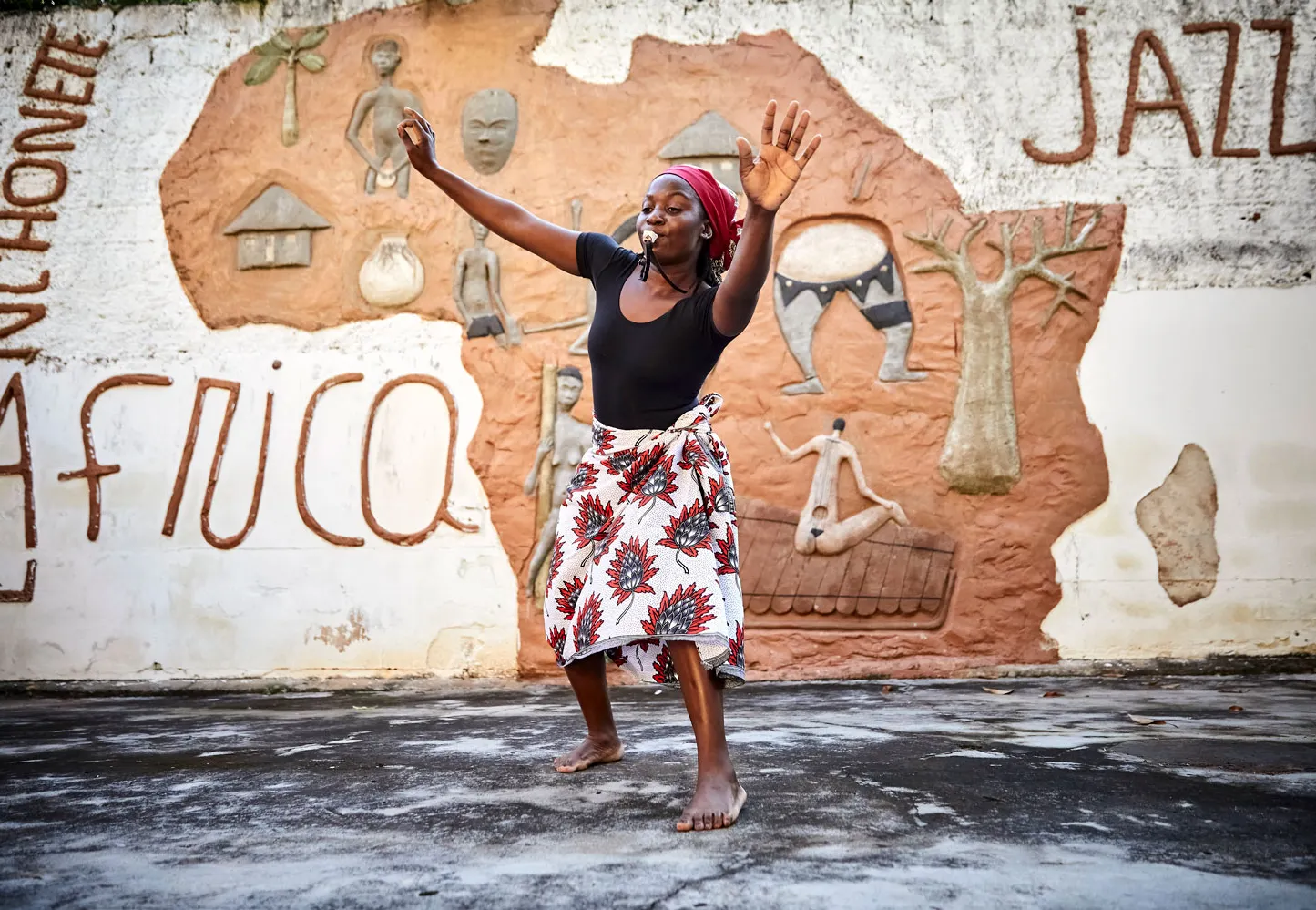
The sound of the drum that once announced pain is today a translator of joys that, through movements accompanied by songs, decode the speech of souls by means of dance. Colourful capulanas on bodies ready to vibrate introduce the group of men and women who, arranged in a circle, enter it in pairs, in back-and-forth movements, and, as if it were a competition, show, each in their own way, their steps, to the rhythm of drums and the sound of clapping. This is how the nhambarro takes shape, a dance characteristic of Zambezia province originally part of the ceremonies devoted to the initiation of girls. Its origins go back to local history and tradition, in an attempt to respond to women's health problems. According to some oral and written sources, nhambarro is the traditional name of a women's illness characterised by vaginal discharge.
“At the time, when a woman had discharge problems that caused her pain, a healer was called. In the course of treatment, a dance was performed, danced only by women who had already been through the initiation rites. The healer brought her drums and, in an attempt to cure that illness, they danced,” said Júlia Asdrúbal Sede, dancer with the Companhia Nacional de Canto e Dança (CNCD). The swaying combined with the various movements of the pelvic area pointed to the area of pain and to the purpose that had dictated the dance's emergence. “When the dance is performed, the pelvic girdle moves a lot. You can even move the arms, but the pelvic girdle is used a great deal, perhaps because that is where women felt the most pain,” the dancer went on.
The sound of the drum that once announced pain is today a translator of joys that, through movements accompanied by songs, decode the speech of
souls by means of dance
An ancient dance that is always new
With the passing of time, the nhambarro developed, covering more aspects of social life, no longer limited only to women's pain. Nowadays, men and women perform this dance which, through the joy and liveliness that characterise it, accompanies the population at various moments in life.
The nhambarro has often been used as a symbol of joy at moments such as harvest celebrations, graduations and weddings, or even as a warm way of receiving a leader or important figure, by way of welcome. “The songs that accompany the nhambarro have a lot of social meaning. They are created in response to various situations in the lives of communities, to draw attention, to reprove, to praise some behaviour or simply to celebrate joy,” said the CNCD dancer.
This dance, with profound content and meanings, is practised across a vast area of Zambezia province that takes in the districts of Quelimane, Namacurra, Inhassunge, Mopeia, Morrumbala, Chinde and part of the district of Mocuba. Dressed in colourful capulanas and T-shirts, the dancers are normally accompanied by three musicians, each with a different drum (gogo, mussosso and namirrebele, the latter being tall, cylindrical and hollow. In each hand a board can be noticed, traditionally known as madha, a word from the Chuabo language (echuwabo) meaning hand. The boards are used to amplify the sound of the hands. They turn the touch of the hands into something more audible. A whistle signals the dancers' entrance and exit and helps to motivate them, giving them more strength for the dance. “When we dance nhambarro, the intention is really to go forwards. At certain moments, this dance can be confused with the utsi dance from Sofala province, but there is something that sets them apart: in the nhambarro the intention of the steps is to lead the performer forwards, whereas in the utsi the steps take the dancer backwards,” explains our interviewee.
In Júlia Sede's eyes, the nhambarro is one of the most beautiful cultural manifestations of the Mozambican people and, despite the transformations it has undergone over time, it has never ceased to symbolise Zambezian joy. “I always invite people to get to know this dance, particularly Zambezians, so that they can know their culture better. The nhambarro is part of us and should be part of our lives,” concluded the dancer.


