
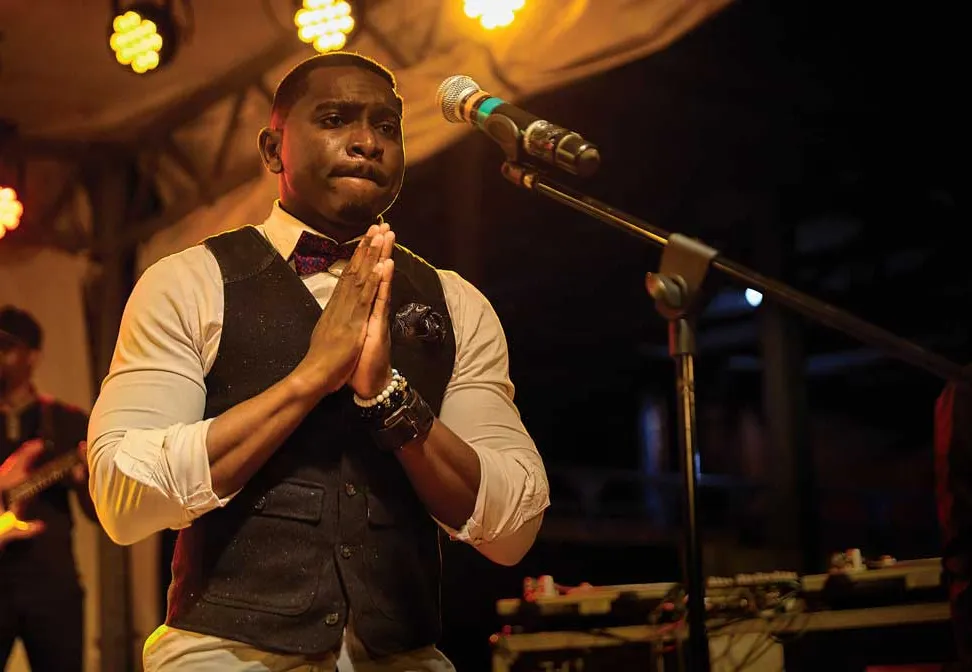
What was the moment that sparked your desire to become a singer, and what inspired you to follow this path?
That desire arose when, in sixth grade, a classmate (Impro – Bruno Sebastião Cuna) shared with our group of friends (Bagas – Bruno Abreu Bata and Fábio Matsinhe) the album “99% de Amor” by the Angolan group SSP. At the time, we were already imitating, at class parties, songs by Gémeos Parruque (a Mozambican duo from the 1990s) and Black Company. From then on, we wanted to be rappers and began writing our own songs.
Tell us about your journey in the music industry. What were the most significant challenges?
I started out at the Maxaquene Second-Level Primary School, where Universidade São Tomás now operates, with the group OPR – Organização dos Putos Rappers (Organisation of Young Rappers). Later, in 1999, I began going to the studio of Uncle Ernest, keyboardist of African Trio, who had previously been part of K10. My passion for music made me fail eighth grade. In 2004, I joined Track Records, where I was nicknamed Ace Nells by Kloro and D-lon. There, I joined the group ELEX, where I made my first recordings. In 2005, I took part in Fama Show, a stage of my career well known to the Mozambican public. In 2010, I released my first album, published by Vidisco, and I am currently preparing the second.
How do you define your musical style, and how has it evolved over the course of your career?
I consider myself a versatile musician, predominantly oriented towards R&B, but also exploring Afro Jazz and Afro Beatz, among other styles. This versatility is perhaps the fruit of my experience on Fama Show, where we had to adapt to whatever song we were assigned. My evolution is largely down to the curiosity of being on stage. I took part in many live concerts, often unpaid, at venues such as Gil Vicente and others that hosted events like “Clave de Soul”, organised by Felling Kappela. There, I had the opportunity to meet brilliant musicians who helped me refine my sensitivity to live music.
Many artists have a work they regard as a milestone in their career. What is yours, and why?
“Histórias de 918” is, so far, my only released album, and it marked me deeply, as it came five years after my rise on Fama Show. It was a landmark moment, like giving birth to a first child. In terms of singles, I highlight “Será”, which featured Anselmo Ralph, and “A Ma Fofinha”, featuring Ziqo. The latter, in particular, was a great success, winning an award at the Mozambique Music Awards.
Do your personal experiences show in your music or lyrics?
Yes, many of my lyrics are inspired by my own experiences and also by those of the people around me. I learn from other people's experiences, without needing to go through the same situations.
What were the biggest difficulties you encountered, and how did you overcome them?
I faced various difficulties, some greater than others. My advice is to keep patience, thoughtfulness, determination and calm in order to overcome any obstacle that presents itself.
Besides singing, are you involved in other artistic or social projects you would like to share with us? What are you doing at the moment?
Yes, besides being a musician, I am a lawyer and I am building a promising career as a digital influencer. At present, I am working on developing my law firm, CAN Advogados & Associados, and a communications company that I created together with my wife and children, Neyson's Empire. These are projects that are very dear to me and in which I am investing all my energy.
How do you maintain originality and authenticity amid current trends?
Although current trends can be useful for keeping us up to date, it is crucial not to lose our essence in the process. We can adapt, but without losing our true identity.
Is there an artist you dream of collaborating with in the near future?
Without a doubt, Ne-Yo! As for the others, I feel I could make a collaboration happen at any time.
How do you see the evolution of Mozambican music on the international music scene?
I believe we are on the right track. However, it is clear that not everyone is doing a good job. Moreover, there are artists who, like me, could be contributing much more to Mozambican music. We have plenty of talent; we just need proper guidance and encouragement. The music industry should provide a comfortable life for all musicians, instead of spending large sums solely on foreign musicians who come to perform in Mozambique. It is essential to support local musicians, by attending their shows and buying their albums, in order to guarantee the sustainability and growth of the national music industry.
What are your plans for the future?
I have various plans on a personal level but, in short, I intend to release my new album, “Quarto Escuro”, consolidate my law firm together with my partners, and make a difference in communications in Mozambique, together with my family, through Neyson's Empire. These are the projects that occupy me at present and on which I am focused.


