
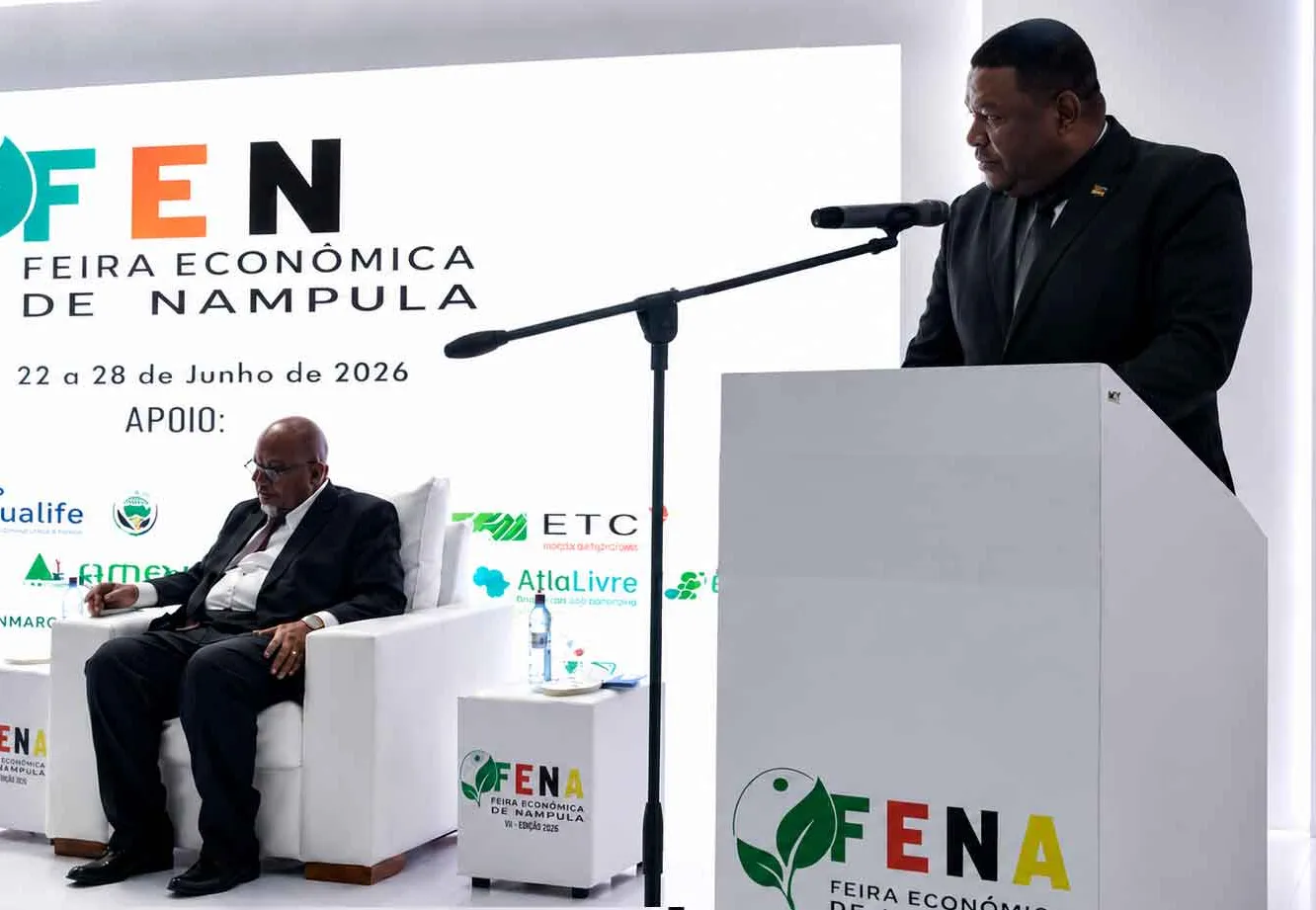
For decades, resources left Nampula for other markets as raw materials. Now, the ambition is different: to transform, process and generate wealth within the province itself. This was the central message delivered by the Minister of Economy, Basílio Zefanias Muhate, at the opening of the 7th edition of the Nampula Economic Fair (FENA), an event that brings together more than 300 national and foreign exhibitors and aims to consolidate the province as one of Mozambique's main economic engines.
Held under the motto “Nampula: Open Door to the Future”, the fair is much more than a space for exhibiting products and services. For the Government, it is a strategic piece in a national agenda geared towards strengthening domestic production, industrialisation, market expansion and the competitiveness of the Mozambican economy.
Before business people, investors, institutional representatives and producers, Basílio Muhate argued that FENA should function as a platform linking opportunities, investment and innovation, creating conditions for strengthening the private sector and for more effective integration between production and markets.
The scale reached by the event confirms this progress. With participants from the districts of Nampula, from various provinces of the country and from partner nations, the fair has become a prime venue for making business contacts, forging partnerships and identifying new business opportunities.
The strategy presented by the Executive falls within the Trade Policy and Strategy of Mozambique 2023–2032, a document that provides for increasing national production, diversifying the supply of goods and services, strengthening exports and promoting investment. The initiative is also aligned with the National Industrialisation Programme (PRONAI) and the National Development Strategy.
At the heart of this vision is a clear objective: to ensure that an ever-larger share of the wealth generated by agricultural, mineral, energy and tourism resources is processed and put to use within the province itself.
For Nampula, this means creating conditions so that products are no longer exported mostly in raw form and instead feed processing, packaging, preservation, storage, transport and local marketing activities. The processing of resources thus comes to be seen as a fundamental condition for increasing the added value of the provincial economy.
It was precisely in this context that the Minister of Economy called for the development of value chains spread across the different districts. The proposal involves creating small industrial units and processing initiatives tailored to the productive characteristics of each region.
In agricultural areas, the priority should be on processing and preserving production. In areas with specific resources, the challenge will be to create economic activities linked to the processing, logistics and integration of those products into larger markets.
According to the vision presented, this approach will allow a more significant share of the wealth to remain in communities, creating new opportunities for small producers, cooperatives, micro, small and medium-sized enterprises, as well as for young entrepreneurs and women in business.
But economic transformation also demands a change in market behaviour. Boosting the consumption of local products was highlighted as an essential element for ensuring productive scale, strengthening companies and attracting new investment in processing sectors.
Basílio Muhate also highlighted the factors that place Nampula in a privileged position to take on a leading economic role in the country. These include the youthfulness of its population, the entrepreneurial capacity of its inhabitants, the diversity of the resources available and a geographical location considered strategic.
The importance of the logistics corridors and the Port of Nacala was likewise stressed as one of the province's greatest competitive advantages. These infrastructures allow more efficient links to national, regional and international markets, creating opportunities for sectors such as commercial agriculture, agro-processing, industry, trade, logistics and exports.
However, the minister warned that natural resources and infrastructure alone do not guarantee sustainable economic development. Realising this potential will depend on the ability to attract investment, train the workforce, widen access to financing and create a business environment capable of meeting the demands of modern markets.
It is precisely in this context that FENA takes on an important role. By bringing business people, investors, financial institutions, public bodies and entrepreneurs together in one place, the fair seeks to close the gap between projects and real business opportunities.
This edition's motto seeks to reflect that ambition. “Nampula: Open Door to the Future” presents a province that intends to establish itself as an investment destination, a centre of innovation and a platform for economic cooperation.
More than a showcase of local potential, FENA aims to turn contacts into partnerships, ideas into investments and resources into products with greater added value. The event's true impact will be measured by its ability to generate business, create jobs and convert the province's economic potential into income and prosperity for families.


