
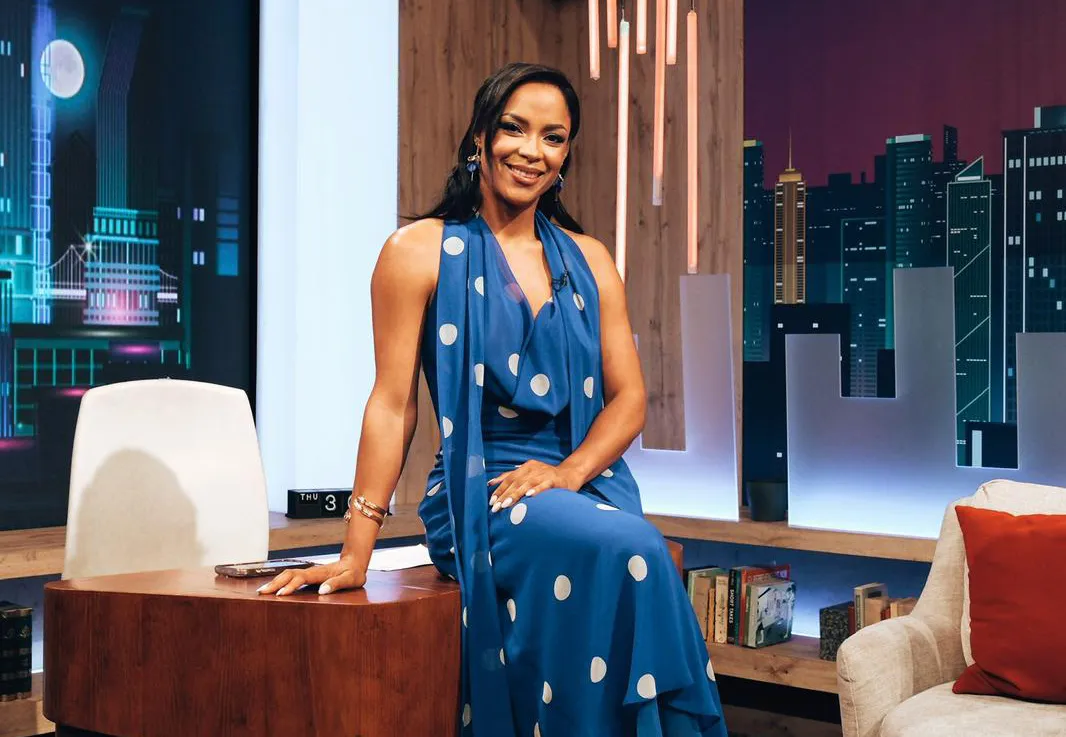
Some faces are born for the light, but do not always seek it. Nádia Silva is one of them. Coming from Cabinda, she grew up amid catwalks, pageants and cameras, learning early that beauty can be both a shield and a wound. She has been a beauty queen, an actress, a presenter, a mother. Above all, she is a woman who has remade herself at every stage, with a serenity that disarms and a strength that does not show off. Between Lisbon and Luanda, she lives in the space between borders, between worlds that she shares with rare naturalness. On Miradouro da Lua, the programme she hosts on RTP África, she speaks to the world, but it is within that she listens most. The first Black Angolan woman to present a late-night show on the channel, she has turned visibility into an act of resistance and affection. In her there is the heritage of the women who came before — the grandmother who healed with her hands, the mother who believed in the power of study, the daughter who today gives her back a mirror and a future. There is also the restlessness of someone who lives between countries, accents and silences, without ever ceasing to seek a meaning for her own voice. There are conversations that are not held in order to answer; they are held in order to listen to what silence reveals. This is one of them.
You have lived between cameras and silences. How does one learn to stand in front of the lights without losing oneself in them?
I look inward before I look at the lens. The camera shows what I do, but only silence reminds me of who I am. It is not about never losing myself, because we are all subject to that; it is about always finding myself again so as not to lose my bearings.
How many times has your beauty spoken for you when you would have preferred it to be your voice?
Countless times. Beauty often arrived before I did, and I had to push it aside a little to get it out of the way. Today I know that my voice is the most beautiful part of me. I learnt to make myself heard with subtlety and courtesy. Beauty can open doors — and it does, in fact, for many people — but it is the word that builds paths. Beauty has a short shelf life; what really remains are our values.
They say that television is a house made of reflections. When the studio lights go out, who is the woman left alone in front of the mirror?
When the lights go out, what is left is a woman who takes a deep breath, who is sometimes tired and at other times proud, but always whole. In the silence, I am neither image nor character. I am flesh, faith, doubts and a very stubborn will to carry on.
You have spoken of harassment and of pressures within the industry. What made you decide to turn pain into speech rather than silence?
Silence was making me ill. Pain, when kept inside, takes root where it should not and brings problems that are often irreversible. Speaking openly about harassment and pressure in the artistic world set me free and may set other women free too. I turn wounds into words and words into strength. That is how I heal and move forward. I also understood that this transformation changes not only my own path but that of many other women who are inspired by my story, courage and voice.
You are the first Black Angolan woman to host a late-night show on RTP África. What weight does that achievement carry: is it a personal victory or a collective responsibility?
It is both. It is my victory, yes, but it is also the echo of women who dreamt of arriving earlier and the impetus of those who will come after. When I walk into the studio, I walk in with Africa, with Angola, with Cabinda, with our stories and with the hope that I will not be the last. The place I occupy today increases my responsibility with every episode of Miradouro da Lua, precisely because I am the first, the one opening the way, breaking down barriers and beliefs. I try not to fail myself, and above all all those who believe in the revolution we are making.
On programmes like Miradouro da Lua, the conversation seems simple, but there is always a subtext. What drives you when you interview someone: curiosity, empathy or a mirror?
It is a triangle, really. Curiosity opens the door, empathy invites them in, and the mirror makes the conversation not only about the other person but about all of us. For me, conversing is always about finding shared humanity and, whether I like it or not, I always end up feeling a connection to my interviewee. It is truly a process of mutual sharing. I like the guest to feel genuinely at home.
Motherhood changes the body, time and the voice. What did your daughter give back to you of yourself? Was there a moment when you felt vulnerable as a mother and realised that you did not need to be perfect?
Motherhood is one of the most contradictory processes in a woman's life; we experience a mixture of feelings, sensations and transformations, we are reborn — indeed, I always say that every mother is born twice. Changes to the body are an inevitable process when we decide to create life within our womb, but postnatal care is essential if we are to return in some way to our normal state; the body has a great deal to do with the emotions. My daughter gave me back my tenderness. She taught me that vulnerability is also strength. There was a moment when I realised that I did not need to be a perfect mother, only a present one. She does not want a heroine, but rather a cuddle, honesty and love. With her I learn every day to make the most of small moments, because everything passes so quickly.
Your mother and your grandmother did not leave you a fortune; they left you direction and knowledge. What part of them still guides you when life demands more?
My grandmother's faith and my mother's courage. Two humble women, full of strength. They taught me to walk with my heart held high, even when the world tries to make it smaller. I carry their values as a compass, and it is impossible to lose myself when I know where I come from. They taught me the value and power of education, and that, wherever I go, I should never forget where I am from.
"If you think about the upbringing you had, is there any advice from your parents, any belief or even fear that still shapes who you are?"
In truth, I have two: “Do not forget who you are and where you come from” and “Study, my daughter, knowledge is the most powerful weapon.” I grew up with those mantras inside me. Being true to myself has always been my greatest strength.
And was there a moment when you realised that your path was veering off course, and that you would never again be the same?
Yes. It was when I realised that my place was not given but earned. When I stopped asking for permission and began to exist with authority. From then on, I was never again small enough to fit into cramped spaces. I know my worth and I demand respect for it.
What would the girl you once were still demand of the woman you have become?
That I stay bold. That I do not get complacent. She dreamt without fear and told truths that I, at times, wanted to soften. Today I honour her courage and let her guide me when the world asks for silence.
When the mirror does not recognise you, what do you still hide from others, and from yourself?
I hide the fear of failing and the temptation to doubt myself. But I have learnt that acknowledging my shadows gives me more light. I am not strong despite my frailties; I am strong with them.
Coming from Cabinda, you bring with you an almost mythical land, so often forgotten. What part of that origin still speaks loudest when you are in Lisbon, among accents and distances?
The root. The ground. Cabinda reminds me that I belong to a land that resists and that keeps memories as if they were treasures. I carry the scent of the sea, the stubbornness of the earth and the certainty that I am not a stranger within myself. I miss our strong, unique accent, the warmth of the people, my grandmother's cooking and the endless green that clothes the province from one end to the other. We are a particularly hospitable people and, above all, survivors.
Between Portugal and the countries it once touched, there is an old pain, but also a language that unites us. Do you believe that one day we will truly be one country of intertwined voices?
I believe in language as a bridge, but I also acknowledge the wounds. I do not know whether we will be one country, but I believe we can be several nations that listen to one another, respect one another and finally treat memory and pain with dignity.
What place does Angola hold in your plans for tomorrow: is it a return, a bridge or a memory? And, in that same light, between what is said and what is left unsaid, what still needs to be said out loud about identity and the culture shock you experienced?
Angola is always home, even when it is distance. It is a return, it is a bridge, it is a root. We still need to speak louder about identity, about the non-place that we so often inhabit between worlds. I exist in the middle, but that middle is also territory. I have had the opportunity to go to Angola often and I manage, in a way, to ease the longing. Even though I live abroad, I remain connected to the country. Miradouro da Lua has given me that connection every year.
And when the cameras and microphones are switched off, what will you do in that silence?
I will breathe. I will write. I will be simply a woman, a mother, a daughter, a friend. In the silence, I return to myself. And that is where my next lights are born. I have countless projects in the pipeline, but I do not like to put the cart before the horse. I work calmly and respect the process of each stage of my life, but I know that I will not be standing still.


