
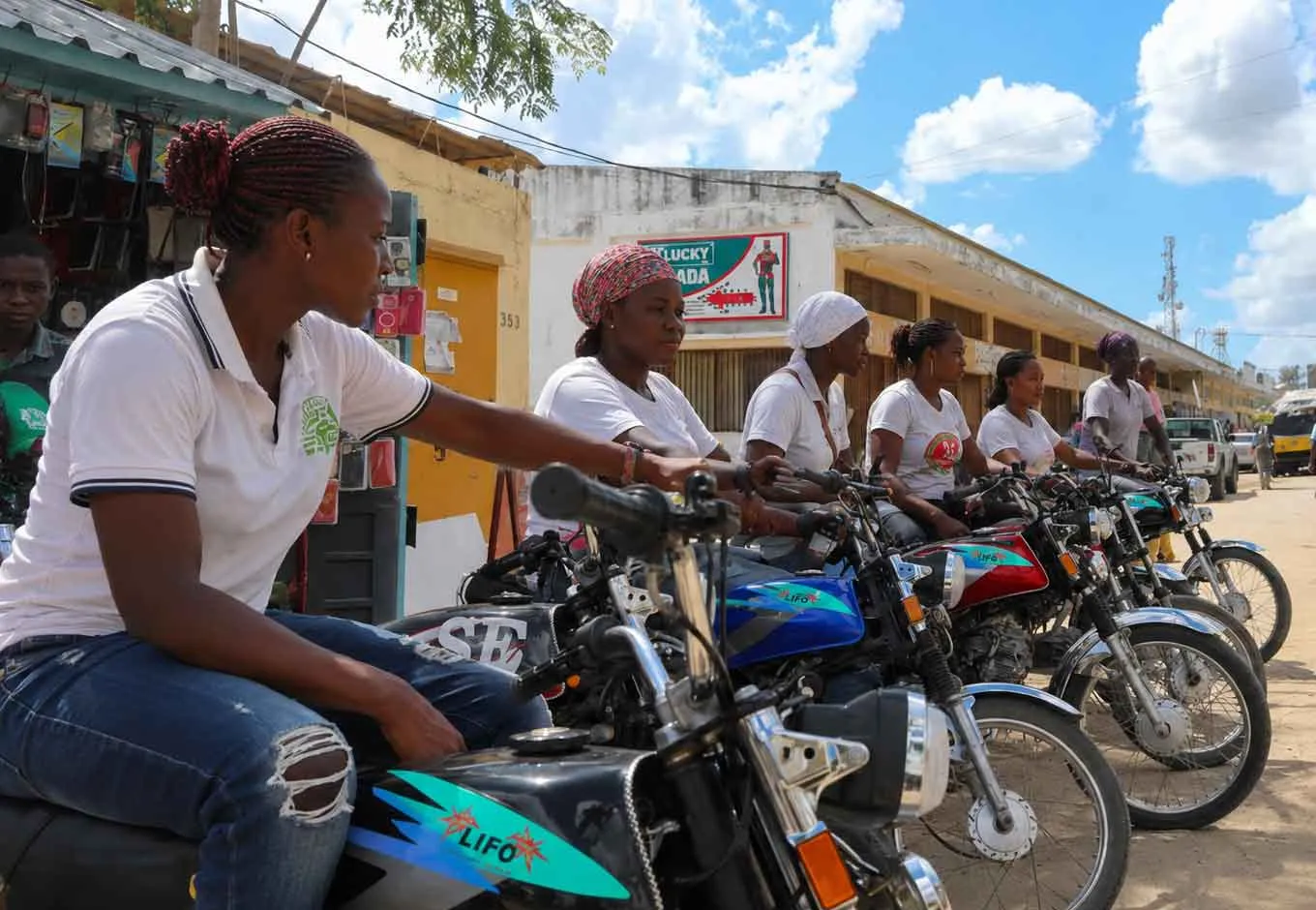
More and more women are finding in motorbike taxis a way to provide for their families in the city of Beira, defying prejudice in a sector traditionally dominated by men. According to a report by Lusa, the rising cost of living and the scarcity of job opportunities have led a growing number of women to take up this activity as a way of securing an income.
Among them is Augusta Munguela, 48, a widow and mother of five, who has worked as a motorbike taxi driver for seven years, after a series of events that changed her life completely.
In 2008 she lost her husband and, later, saw Cyclone Idai destroy the 12 stalls she owned at the Goto market, leaving her without her main source of income.
"Everything piled up on me. I lost my husband, then I lost my business. I was left with nothing to stand on", she told Lusa.
With no alternatives, she decided to invest in riding a motorbike to carry passengers. At first, she accepted only female customers, believing it would be a safer option, but she ended up abandoning that decision when she realised it was limiting her earnings.
"I thought I would be safer that way, that I would avoid trouble. But I began to see that I was losing money. Sometimes two men needing a lift would turn up and I would turn them down. I ended up realising that I had to break that prejudice myself", she explained.
The covid-19 pandemic further reinforced the importance of the work, at a time when household expenses rose and her children entered higher education.
Today, Augusta says it is through the motorbike taxi that she is able to support her children's studies at Licungo University and Zambeze University, including a daughter who is studying Medicine.
"What seemed impossible for a mother with no education, the motorbike gave me", she said.
Despite the financial stability she has achieved, she admits she still faces risks on the road and discriminatory remarks.
"I've heard it said: 'Women can't drive.' But when I arrive first, nobody says anything", she said.
Another of the women interviewed by Lusa is Balbina Sílvio, 47, a teacher, who has been using a motorbike for more than a decade to supplement the family income and support her businesses.
"You can't live on a salary alone. The cost of living is high and I have five children to raise, as well as other family members. I ended up thinking about doing other things so I could help at home", she explained.
According to Balbina, using the motorbike allowed her to transport goods, develop her business and gradually expand her commercial activities.
"I'm prospering bit by bit. I don't think I started out like this, but I'm already reaching a high level", she said.
The president of the Beira Municipal Assembly, Jacinta dos Remédios, considers that the growing female presence in the sector shows the search for solutions in the face of unemployment and represents progress in promoting equality of opportunity.
For his part, the president of the Beira Motorbike Taxi Drivers' Association, Jacob Pereira, believes that the arrival of more women strengthens economic activity and encourages others to follow the same path. He added that the association works with the National Road Transport Institute (INATRO) and a driving school to train professionals, arguing that certification is essential to improving road safety.
According to Lusa, the women who do this work report days of more than 12 hours and face risks such as road accidents, robberies and harassment, especially at night. Even so, for many, motorbike taxis now represent an opportunity to achieve financial independence and secure better living conditions for their families.


