
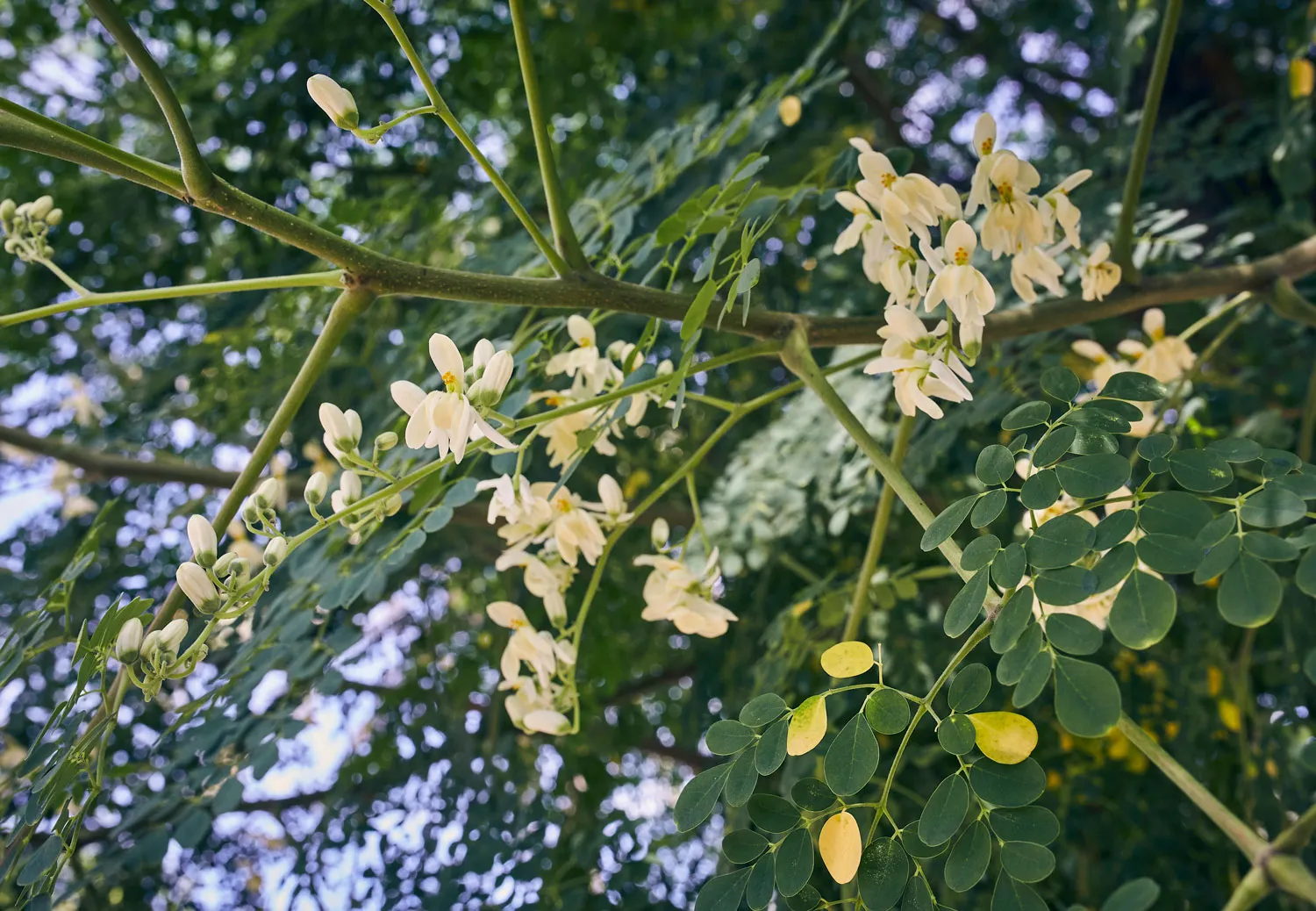
Moringa
A boon for health and for sustainable energy
Written by Precidónio Silvério
Mozambique has forest cover of around 61.8 million hectares, corresponding to 78 per cent of the country’s surface area, making it a territory rich in organic resources for generating environmentally sustainable electricity and allowing more people to have access to it. Among the riches of the flora that the country possesses is moringa, a plant frequently cultivated and used to produce derivatives to treat certain illnesses. Products for personal hygiene, beauty care and more are also obtained from it. The leaves, for example, can be turned into oil for culinary use or to relieve certain skin irritations and, when ground, can be consumed as a supplement, added to tea or other foods. Parts and products of this plant have also been recommended for people suffering from conditions such as diabetes, HIV/AIDS and anaemia, among others, although there are some scientific objections and recommendations for caution in its consumption.
Carlota Sitoe, in her fifties, is a retired teacher living on the outskirts of the city of Maputo. At her age, it is common to go through some health complications. She tells us about the good experiences she has had using some moringa derivatives: “I consume the moringa leaf, even without it being processed. Sometimes, when I feel some discomfort in my body, such as joint pain and weakness, I boil the leaves, drink the water and within a few days I am well. In fact, I have had other good results. The leaves also soothe eye irritations. I often recommend to close relatives and acquaintances that they take advantage of the benefits the plant offers.”
Manuel Peniel, who also lives in one of the neighbourhoods of the Mozambican capital, swears by the “magic” the plant offers. He is not only a consumer of moringa; for more than five years he has devoted himself, as an entrepreneur, to processing and selling its derivatives. As he told us, he has even created a brand to produce and supply moringa to his customers, who are also passionate about the plant. Manuel has taken part in several fairs, at which he promoted his products and his brand: “It always pleases me to satisfy my customers when, even from afar, they request certain supplements. I do all of this at home. Some derivatives are very quick to process, but others take me several days. At the end of the work, the result is positive.”
Among the riches of the flora that the country possesses is moringa, a plant with diverse uses, such as treating illnesses and making food, hygiene and beauty products, among others.
Investing in bioenergy technology
Moringa can indeed offer derivatives and supplements, but it has much more to offer humankind. According to experts, it is a viable organic resource for generating environmentally sustainable energy. Some studies indicate that between 700 and 1,100 moringa trees can be planted on one hectare of land. Its cultivation can generate 1,478 litres of oil per hectare, which can be converted into biodiesel.
Research indicates that the exact origin of this species is somewhat obscure, owing to its widespread cultivation since ancient times. Scientifically named Moringa Oleifera Lamarck, it belongs to the Moringaceae family, and seems to originate from Agra and Oudh, in the north-west of India, south of the Himalayas. The plant, the studies suggest, was used by the ancient Romans, Greeks and Egyptians (the oil extracted was used for food and cosmetics) and is now widely cultivated in all the tropical and subtropical regions of the world. Mozambique is an excellent habitat for it, and it can be found in homes as well as cultivated over large areas of land, for industrial and other purposes. This and other resources can, according to Hamida Mazive, a master’s student in renewable energy science and technology, generate sustainable energy capable of reaching most of the population. However, in her view, to reach that stage the country needs to invest in technologies capable of turning the organic wealth it possesses into energy. For Hamida, in Mozambique biomass is widely used in the form of heat, when it could be turned into electricity, and using the organic resources the country has to generate electricity and biogas can reduce the chances of negative effects of climate change: “We are at a time when one of the major concerns is to reduce fossil fuels, which, as we know, have enormous disadvantages for the environment. Transforming organic resources will not completely change this picture, but they can very well reduce the chances of pollution, as they are cleaner and more sustainable.” Our interviewee stresses, however, that only by adopting new technologies geared to transforming organic materials will we achieve what we want. She mentions firewood and charcoal as an example of the use of biomass to generate energy in the form of heat, but, she insists, “charcoal, firewood and other organic resources, with suitable technologies, can be turned into clean, renewable electricity.”
From the experiences of others to our country
According to our interviewee, there are countries that have technologies that Mozambique can use for bioenergy. Such is the case of Brazil, which for some years now has used moringa, for example, as a resource for producing energy. Hamida Mazive believes it is possible to bring these technologies here. “Of course, these are necessary investments, but investing in them brings good results,” she adds: “Looking at the amount of organic resources our country has, a plant would, for example, be needed with which all organic matter could be reused. Like moringa, peanut shells, banana skins and others (often considered rubbish) can be reused for bioenergy.”
Hamida, who is also a rural engineer, does not rule out the need for the country to strengthen its bioenergy generation policies, as they can promote investment and raise awareness of the reuse of organic materials for clean and renewable energy. On this subject, Mazive states that, besides allowing more people to have access to energy, the bioenergy industry can contribute to the self-sufficiency of many.
“With technological means, we can all grow in the use of these resources and improve environmental sanitation, and more people will be able to be employed. For example, if we have a bioenergy plant, it may need solid waste in large quantities to process. By using plants for that purpose, more people will be able to grow them to feed the industry.” But, cautious, our interviewee leaves an important warning: “In using organic resources, plants for example, to produce energy, we must make sure that we replace what has been taken, because it is not enough to think about clean energy if there is no replenishment and sustainability.”


