
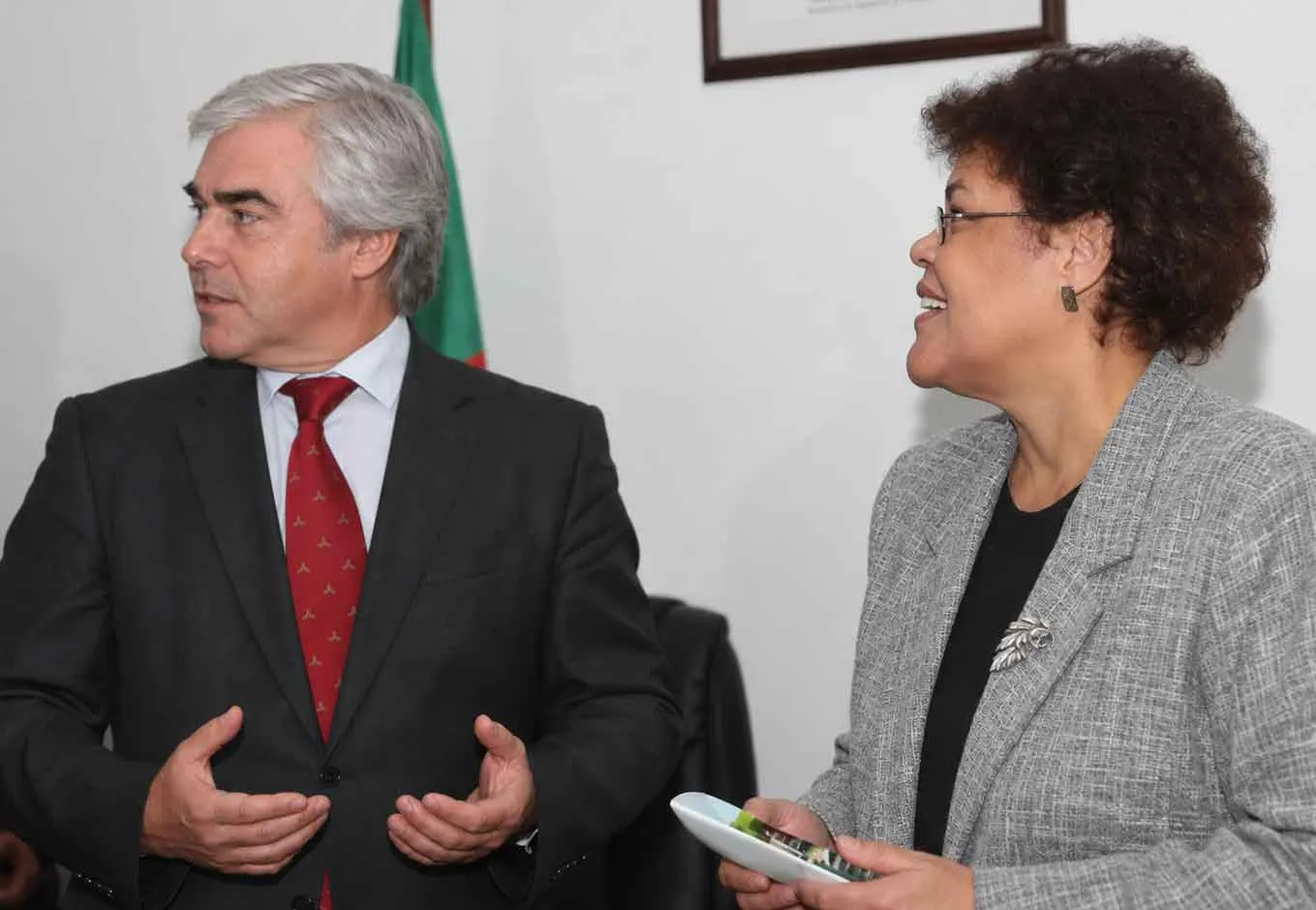
More than half a century ago, Portuguese and Mozambicans sat down at the same table, in Lusaka, to put an end to a war. On Monday, in Maputo, the two countries met again around that past, this time with another purpose: to preserve the documents that hold the memory of the conflict and allow history to be reconstructed from both sides.
The Minister for Combatants, Nyeleti Mondlane, asked for access to the historical military archives held in Portugal, arguing that Portuguese documentation is indispensable for deepening research into the period of Mozambique's national liberation struggle.
"A significant part of the documentation on operations, personnel, places of detention and the political and military decisions of that period is today held in Portuguese archives. Without that access, the history of the national liberation struggle continues to be written from only one of its sources," she said.
The request was made after Nyeleti Mondlane and Portugal's Defence Minister, Nuno Melo, signed, in Maputo, a memorandum of understanding for the recovery, digitisation, conservation, enhancement and study of the military archival heritage held in Mozambique, with technical support from Portugal.
For the Mozambican minister, however, the scope that Maputo seeks goes beyond preserving the documents that remain in the country.
"It is important to specify the scope that the Ministry for Combatants attributes to this instrument. The Portuguese military heritage held in Mozambique is a collection that the Mozambican State keeps with responsibility and that will now benefit from Portuguese technical support in its recovery, processing and digitisation," she explained.
Nyeleti Mondlane, daughter of Eduardo Mondlane, first president of the Mozambique Liberation Front (Frelimo), made clear that the Mozambican ambition is "broader": to guarantee "Mozambican researchers' access to the historical military archives held in Portugal", making it possible to move towards "a joint historiographical investigation of the period of the national liberation struggle".
This work, she maintained, could help "to complete records, confirm the identities of combatants, locate graves and return to families a memory that belongs to them".
On the Portuguese side, Nuno Melo framed the opening of the archives in terms of historical rigour and reconciliation between the two countries.
In a speech made during his visit to Mozambique, the Portuguese defence minister said that writing history requires researchers to have access to the documents needed to cross-check and confirm the facts.
"When history is written," he said, it is necessary to allow "researchers access to the archives, so that they write it truthfully".
"You cannot write history truthfully if we cannot verify it factually. And that factual verification happens through documents and with a purpose that is good, which is this purpose of reconciliation, of those who concluded agreements, shook hands and looked to the future with hope, focused on the development of the two peoples," declared Nuno Melo.
The Portuguese minister also recalled the human dimension that remains tied to that past. Portugal currently has about 130,000 surviving former combatants, while Mozambique has approximately 120,000.
For Nuno Melo, the preservation and consultation of the archives is therefore also an act of "reconciliation", as well as a necessary condition for guaranteeing rights that depend on the existence and preservation of these historical records.
"I regard the signing of this agreement as one of the most important parts of this visit by the Portuguese delegation to Mozambique. Because we are honouring those to whom we owe everything. Truly. And in doing so we are building something. We are preserving memory," he said.
During the visit, Nuno Melo also met Mozambique's Minister of National Defence, Cristóvão Chume, and paid tribute to the Portuguese combatants of the First World War.
The visit also allowed the Portuguese minister to reaffirm the depth of the historical relations between the two countries, arguing that they cannot be reduced to the period of armed conflict.
"Portugal and Mozambique are united for ever and ever. Our history is shared and I must say that it is not measured by a conflict alone. What unites us is far more than what separates us," he emphasised.
Nyeleti Mondlane, for her part, stressed that a substantial part of that shared history depends precisely on the documents kept in the military archives.
According to the minister, it is in these collections that there remain recorded facts, names, places and dates that can no longer depend exclusively on oral transmission.
"A large part of this" shared history, she recalled, is reconstructed "from military archives, where are recorded the facts, names, places and dates that oral memory, on its own, no longer retains, and that the younger generations on both sides have the right to know".
The minister then went back 52 years, to Lusaka, where Mozambican and Portuguese representatives negotiated the end of the war and laid the foundations for a new relationship between the two peoples.
Fifty-two years ago, she said, Mozambicans and Portuguese "sat down at the table to put an end to a war and to open a new page in relations between the two peoples".
More than half a century later, Maputo has again become the setting for a meeting between the two countries around that same history — now not to end the conflict, but to ensure that its documentary traces survive the passage of time.
"Today, in Maputo, the two countries sit down again to ensure that this page and all those that preceded it are preserved and fully known. The history that separated the two peoples is today the same one that unites us."
For Nyeleti Mondlane, the memorandum thus represents more than a technical commitment to archive conservation. It is also a statement about the relationship that Mozambique and Portugal have built since the war.
"By signing this memorandum, Mozambique and Portugal reaffirm that their bond rests on the language they share, on the memory they preserve in common and on the mutual respect that the two peoples have managed to earn. It is a bond of brotherhood that time has consolidated and that no time can undo," she concluded.


