
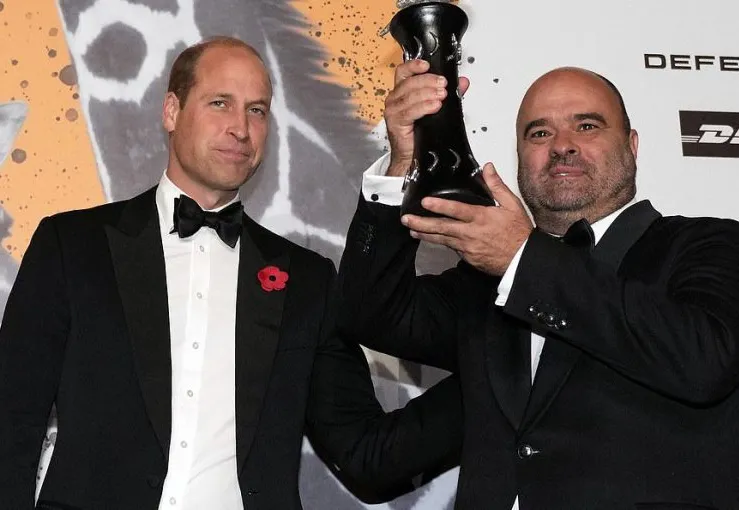
This is Miguel Gonçalves, administrator of Maputo National Park, aged 49, married and the father of two children. A native of Maputo, in southern Mozambique, Miguel Gonçalves competed for the award against administrators from Kenya and Tanzania. The prize was presented to him in the first half of November, in London, by His Royal Highness William, Prince of Wales, during the tenth gala.
Miguel is the winner of the “Tusk Conservation Awards 2022” prize, a distinction that recognises the profile of conservation leaders and their significant impact on wildlife and communities across Africa.
In conversation with Xonguila magazine, Miguel Gonçalves began by explaining that, when he took on the challenge of leading one of the country's most important conservation areas, in 2008, he was not an administrator. “We had two conservation areas in the district of Matutuíne, in Maputo Province, which were the Maputo Special Reserve and the Ponta de Ouro Partial Marine Reserve. I was called in to provide technical advice to what was then the National Directorate of Conservation Areas (DINAC), today the National Administration of Conservation Areas (ANAC), on the creation of the Ponta de Ouro Partial Marine Reserve. It was a process that was already at a fairly advanced stage, but even so, I contributed, in some way, to completing its creation, which was established in 2009. In the same year, I was appointed administrator by Fernando Sumbana, then Minister of Tourism”.
In 2017, Miguel Gonçalves took on the dual role of administrator of the Maputo Special Reserve and the Ponta de Ouro Partial Marine Reserve. “At that point I began the process of unifying the two conservation areas into what would become what is today Maputo National Park”, he said, adding that one of the main challenges on the marine side was the limited resources available, above all human resources: “When the reserve was declared, there were only two staff, me and one ranger. Then we gradually improved, hiring and receiving more colleagues. Another challenge, no less important, was linked to this: turning a reserve on paper into an effective reserve. There was a lot of lawlessness at the time; people did not understand that there was a new authority in the area and that it had a strong presence. The local communities did not understand what our role was and the importance we could have for their lives, so we gradually built relationships. So it was an entire process of research and monitoring for the creation of a conservation area”.
As for the Maputo Special Reserve, the situation was different, as the process was already under way; it was a matter of restoring a reserve that dated from 1960 and that, for various reasons, with the civil war in Mozambique, had been severely affected. “We had to start the process of reintroducing species that had become locally extinct because of the war, with the aim of making the area one of the preferred tourist destinations, which will allow local development to be created”, Miguel Gonçalves stressed.
Bridging past and present, the park has gone from a hunting ground to one of the most important wildlife nurseries, a great achievement that Gonçalves credits to the enforcement team. “We have an enforcement team that is dedicated and committed to what it does, and they are the ones who are the great architects of the result we have today. Winning this prize is a source of pride, and it is an honour to know that our work is recognised nationally and internationally. This is a very important, prestigious prize. It must also be acknowledged that it reflects what we, as Maputo National Park, have been doing.”
It should be remembered that this was not the only prize he has received: “We had already won two other prizes when we were only on the marine side; my colleague and I won a similar prize representing the continent”, said Miguel, whose plans for the future essentially consist of continuing the work that is under way, with the same commitment and dedication. “We are continuing with the reintroduction of terrestrial and marine fauna. We are very committed to supporting communities and are trying to have Maputo Special Park declared a natural World Heritage Site”, he concluded.


