
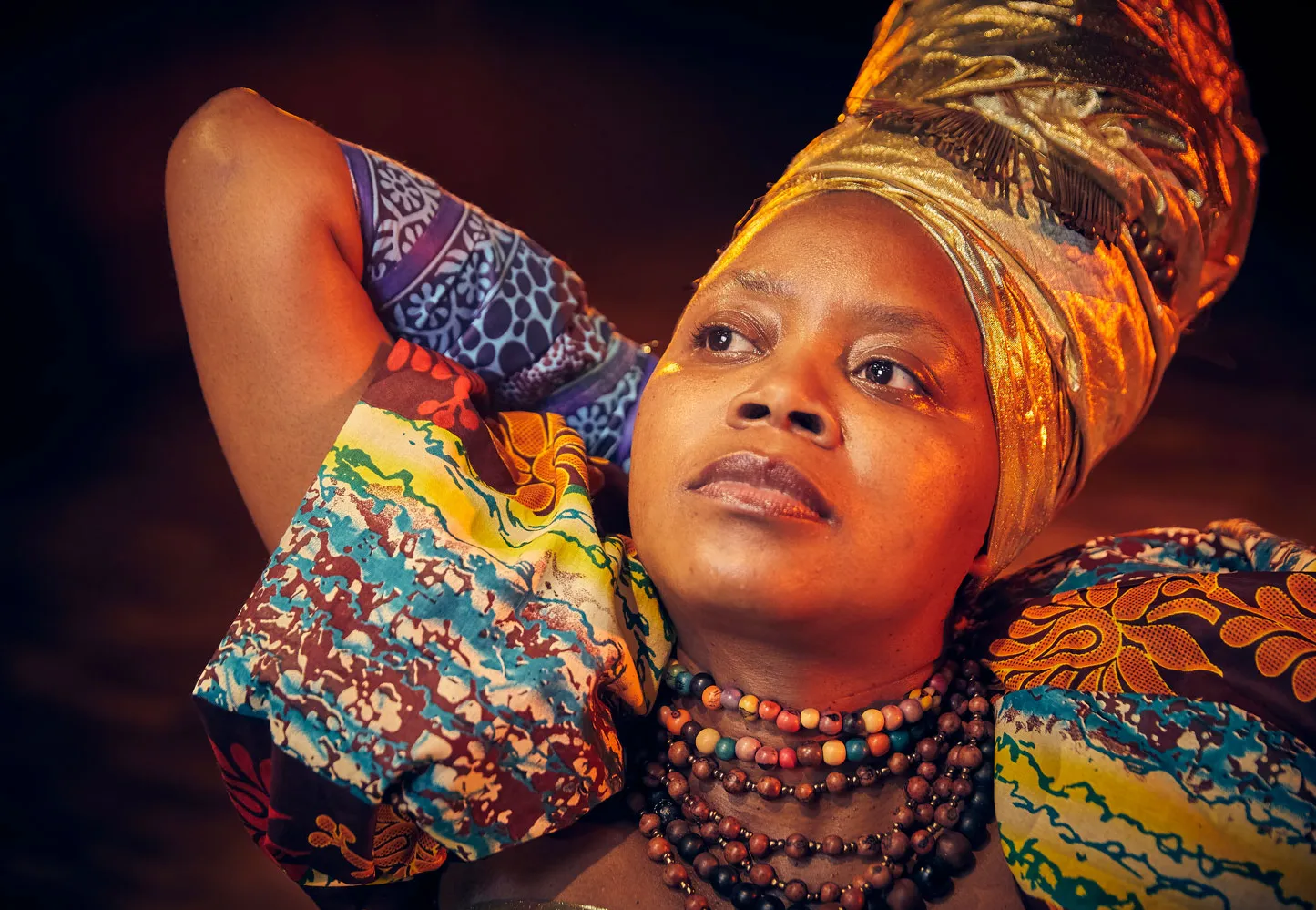
Music has been with her since childhood, ever since she gained access to music school. She was registered as Amélia Maria Matsinhe, but her sweetness and charm led the artistic world to christen her simply Mel Matsinhe, a name that carries art, in a pronounced way, in many forms.
“I was part of the first group to benefit from independence: free school, music school. I had access to a lot of things that the children of my time did not. My parents always let us freely study whatever we wanted, and I chose music, or music chose me,” said Mel Matsinhe. At fifteen, she won a scholarship and went to study music in Cuba. She is qualified in performance, as a pianist and as a music educator, by the National School of Music in Havana. She holds a degree in history from Eduardo Mondlane University, with a pioneering final-year dissertation on urban popular music and identity in the post-colonial period. Mel Matsinhe also holds a master's degree in history and musicology from the University of Oslo, in Norway, where she lived for about ten years. On returning to Mozambique, besides music she began to devote herself to the art of writing in verse: “I discovered that, as human beings, we are creators, and creators do not limit themselves. We are constantly looking for new ways to express ourselves, and that is how literature came into my life. It is as if there were two different people inside me, one who prefers to write and the other to make music, and the two coexist peacefully.”
Mel published her debut book Ignição de Sonhos in 2017, through the Fundação Fernando Leite Couto. Since then, she has published in various national and international anthologies. Her next work, Palavras em Fuga, was published under the imprint of Xiluva Edições. Xiluva - Partidas de uma flor is another of the artist's works, bringing together 51 poems full of musicality.
The “Honey” (Mel) to animate the dreams of the youngest
Besides being a pianist, singer, poet, social activist and entrepreneur, Mel Matsinhe is also passionate about children. From this love of the arts and of “flowers that never wither” came, ten years ago, Xiluva Artes, an arts centre devoted to the artistic training of children and adolescents. Between word and rhythm, the artist finds a space to give a voice to the talents of the young. “I think it is in children that we can plant the seeds of the citizen. I chose, as part of my path, to consciously influence children through the arts,” the artist added.
Njingiritana, the International Children's Festival, is a clear example of the effort the artist has made to bring art to children. The platform developed by Xiluva Artes aims to promote arts education through performances, debates and children's workshops. The initiative began in 2016 and, since then, has focused on promoting the presentation of artistic content suitable for children, thus contributing to their access to artistic products made especially for them. “We realised that we could occupy a different space and bring art and cultural products to more children and more families. Step out of the comfort zone and occupy our own space. In this context, Xiluva Artes, through our teaching programmes and through the festival, takes the opportunity to do this, to expose children to all kinds of art products, so that they have other experiences and develop other sensibilities.”
The 7th edition of Njigiritana recently took place in Maputo, from 12 to 16 October, at the Galeria de Maputo cultural venue and in the district of Marracuene. The festival sought to highlight the importance of creating, and providing access to, suitable children's content in the Mozambican, regional and African context, especially in this post-Covid-19 pandemic period. Access to art products has been one of the concerns on the minds of various artists, and a constant reflection that was present in this edition of Njigiritana.
Between challenges and achievements, the multifaceted artist carries dreams that are not only her own, dreams that reflect the aspirations of many of the country's artists. “There is a collective dream, not an individual one, of a consistent, robust arts sector in which artists, for example, can live from their art, have their rights as creators respected and protected, and benefit from them. Because art endures, and not only artists benefit, but all generations. I believe I am one of those who dream of a more robust arts sector, in which art is in fact accepted for what it is, as an ambassador of Mozambique, a vector of peace, harmony and individual and collective well-being,” Mel concluded.


