
MÁRIO TIQUE: “I could have been anything in life, except an artist”
Written by: Jaime Álvaro
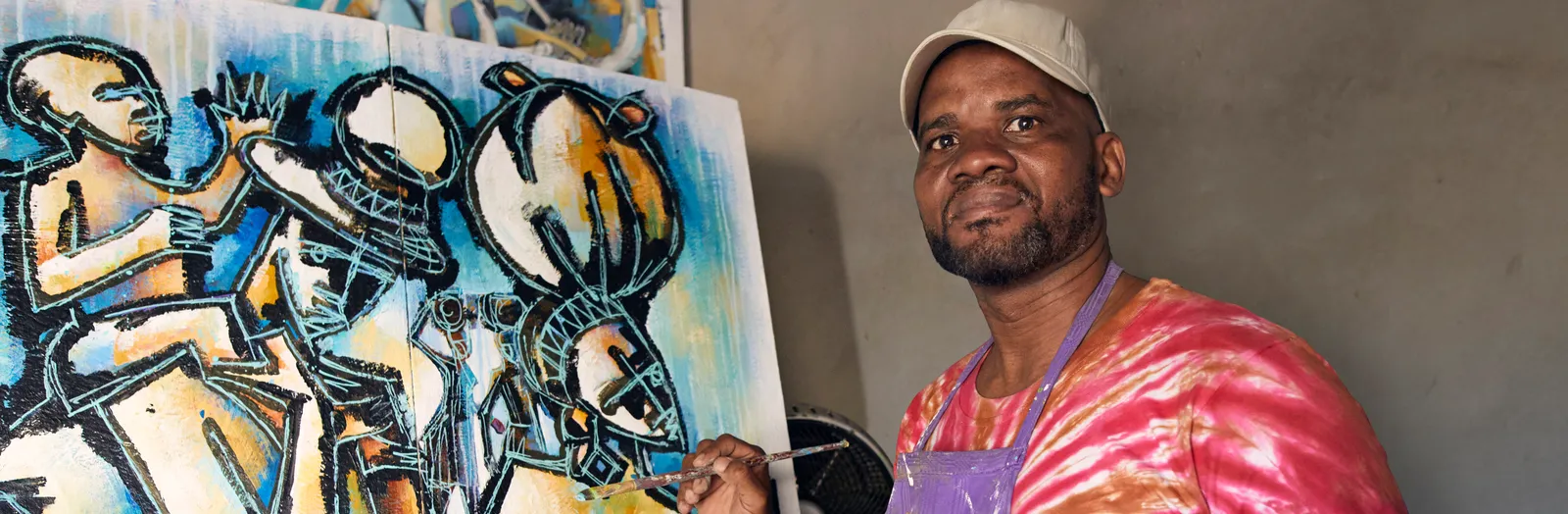
The statement is ironic, but true, from one of the most highly regarded visual artists in Mozambique, who once thought of living off something other than art. Mário Tique wanted to fly planes, back when he was drawing them as a small boy. They were, in truth, the outlines of his destiny, completely different from what his parents dreamed for him. Mário’s parents wanted him to be a lawyer, an economist or a doctor. Indeed, he could be anything he wanted to be, except what his time made of him: a fortunate visual artist and graphic designer who, although not a pilot, has the gift of taking people on the journeys that their emotions, memories, experiences and imagination invent and that his magic hands paint onto canvas.
“My parents began to accept me as an artist when I started winning prizes,” says Mário, proud of all the prizes and honourable mentions in recognition of his work. “It took time to perfect the technique, even though I was born with a natural gift. Besides, the artistic bug runs in the family,” boasted the artist, whose brothers and sisters are also involved in the arts, before taking us aboard his latest “journey”, Debaixo do Sol (Under the Sun), the name he gave to his recent solo exhibition, curated by Yolanda Couto.
Mário Tique has taken part in painting exhibitions in Mozambique and abroad, notably shows in Porto and Lisbon (Portugal), and in Marseille, Lyon and Paris (France), where he studied graphic design
Debaixo do Sol exhibits and also denounces social inequalities, wars, hunger and the crises of humanity (past and present) from different perspectives and in geometric lines, which the artist also used to show the work ethic, the resilience and the unity of the Mozambican people, despite the social differences that increasingly multiply like the intensity of the sun’s light, beneath everyone, rich and wretched alike.
The show, held at the Fundação Fernando Leite Couto gallery in the city of Maputo in May, took about a year to prepare and marked the reopening of cultural spaces, namely galleries, museums, theatres, cinemas and others, which had been forced to close their doors because of the state of emergency declared by the President of the Republic, Filipe Nyusi, as a result of the covid-19 pandemic.
By coincidence, Nyusi was one of the first visitors to the exhibition and the buyer of one of the works. “I was pleased with the President of the Republic’s interest in my work. We often think that politicians are not interested in the arts, and that this is why art is so often left aside in government programmes. We can see that they attend other areas more, and art is always left until last. But the President buying a work from my exhibition already shows that, after all, we may be mistaken; after all, they too are paying attention to this kind of event.”
The arts need to be decentralised
For Mário Tique, the visual arts have become elitist in the country. People on the outskirts do not have access to them, and “the lack of an audience educated about the importance of the arts ends up harming the artist,” he argued. “There is an urgent need to decentralise exhibitions away from urban areas and take them to the outlying neighbourhoods, and to teach people the meaning of the arts. Because they are the ones who will appreciate our works and then buy them. Some people keep saying that works of art are expensive, but in truth they do not understand them,” he stressed.
The responsibility does not lie only with gallery curators; “the Government must do its part. As an artist, I sometimes open the door of my gallery and invite friends and children to appreciate my creations. In addition, I have been using social media to promote my work.”
And Mário had more to say: “The price of painting materials is high and, at times, they have to be imported. This leads some artists to use low-quality paints. Some choose to use wall paint to paint canvases. This is reflected in the quality and value of the work, which is bought at a price that makes it unsustainable for the artist to become professional and live from his work,” he concludes.
During his career, Mário has taken part in painting exhibitions, both at home and abroad, notably shows in Porto and Lisbon (Portugal) and in Marseille, Lyon and Paris (France), where he studied graphic design and developed his learning in the visual arts.


