
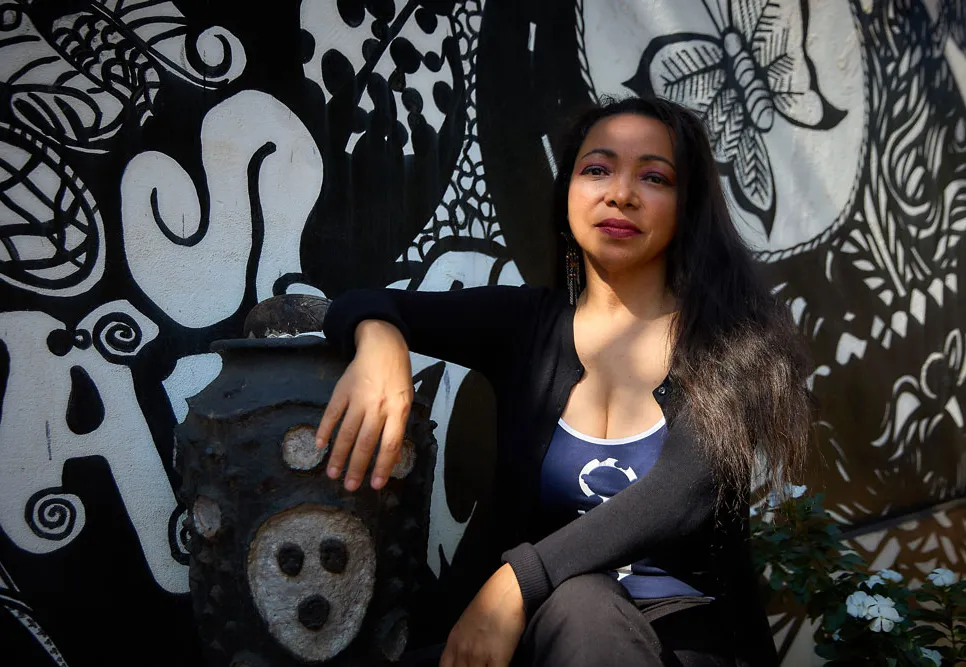
Choreographer, dancer, dance teacher, researcher in contemporary dance, entrepreneur in the arts and culture and maker of dreams, Maria Helena Pinto is 50 years old, 40 of which have been dedicated to the arts. She was born and raised in the city of Maputo, and has been flying around the world since the age of 17. She is a widow and the mother of a 19-year-old boy.
Maria Helena Pinto took her first steps in dance at just 8 years old, and this is how she remembers those distant times: “The first art schools in Mozambique were created at that time, and there was a National School of Dance, which still exists today. I had just seen a show called “As mãos” [The Hands], in which I saw Maria José Sacur dance, and from that moment on I fell in love with dance.” Then, as Maria Helena says, she was “recruited by the State”, revealing that she had not been influenced by her family, although she had an aunt who sang and was part of a renowned musical group of the time.
It is a whole life dedicated to choreography, dance and research. Asked what had been the high point of her career over the four decades of dance she has already travelled, Maria Helena Pinto told us it would be hard to answer, as there have been several moments that left their mark on her, but one ended up being chosen: “It was in 1995, when I came back from Cuba, in the company of Augusto Cuvilas, and created the piece “Amadsofer”, which was seen by more than 24,000 spectators. The piece was shown as part of the 15th anniversary of the Companhia Nacional de Canto e Dança and, thanks to it, there was a great surge of interest in dance and in the profession,” she explained.
Along the same lines, Maria Helena added: “At that time there was great exposure of my life as an artist in the media, and I made the front page of the main newspapers in circulation. I am talking about the newspapers Domingo and Notícias. That was the beginning. People were able to discover my work and, from that moment on, I never stopped. I had started working at just 13, and I was already dancing in nightclubs, creating my own choreographies and giving classes well before 1995. I left the country at the age of 17. Three or four years after my return, I started working with the Companhia Nacional de Canto e Dança.”
A life full of achievements always has obstacles along the way, and Maria Helena Pinto was no different: “Throughout my career, I met several challenges of asserting myself; I fought for a change of consciousness regarding the choreographic artist and the dancer. I also fought for the existence of the profession, for the valuing of the profession and of the figure of the dancer,” she pointed out.
For this researcher in contemporary dance, it is very hard to change people's mindsets and the perception they have of the artistic community. It is a titanic task and takes many years: “In this endeavour, of course, I cannot say that I have achieved nothing, because nowadays the understanding and respect that part of society has for those who make dance has already changed. But, of course! We have to give it value by paying choreographic artists for the services they provide. We often complain that this is expensive, that art itself is expensive,” she said candidly.
In the same vein, Maria Helena Pinto argued that “we have to stop thinking that, because it is art, it has no value. We have to demystify this business of saying that the artist is a fringe figure. We are not on the fringes; we have knowledge, projects, we take part in the development of a society, we make a difference in our country, as well as wherever we go. With our works, we take part in changing mindsets, for the evolution of humanity itself. This is not free; it has its value, it has its reason for existing, so it is necessary to invest in this area, and investing also means that we have to pay for the services that artists provide us.”
Maria Helena Pinto holds a doctorate in Aesthetics, Science and Technology of the Arts, Theatre/Dance option, from the Université de Paris VIII, France, having earned a degree in Performing Arts from Universidade Eduardo Mondlane in Maputo. She has attended dance courses and workshops in several countries, such as France, Portugal, Brazil, South Africa, Senegal and Tanzania, among others. She is a co-founder of the Instituto Superior de Artes e Cultura (ISARC) and founder of the project Primeiro Festival Internacional de Dança Contemporânea (FIDC). She was one of the principal choreographers of the Companhia Nacional de Canto e Dança (CNCD), where she was from 1995 to 2009, becoming artistic director in 2004. She is also the founder and President of the Associação Centro de Pesquisa Coreográfica in Maputo. “Over the 40 years dedicated to the arts, I have been leaving seeds that may be sources of inspiration for young people in their future work. It was a way of leaving evident the marks of my work, my legacy and my body of work.”
Besides this vast background and history, in 2010 Maria Helena Pinto founded Dans’Artes, the project to which she has devoted most of her attention in recent times. “Dans’Artes was conceived as a place that could help decentralise spaces for the manifestation of the arts. Basically, these spaces are concentrated in the capital city; however, I went to the district to create this attraction.” Dans’Artes is located in the district of Boane, in Djonasse, in the Vila Artística Dans’Artes, and, according to its founder, rests on four pillars: artistic and cultural development; development of cultural tourism; community development; social and economic development.
Maria Helena Pinto is the author of more than a dozen choreographies and has taken part in several national and international theatre and dance festivals. She has been awarded several prizes and distinctions throughout her career, two of them received on behalf of Dans’Artes, one of which was this very year: the Cultural and Creative Industries Award, in the Dance category, granted by the Ministry of Culture and Tourism.
In the academic field, Maria Helena Pinto is the driving force behind and creator of the first degree course in Performing Arts at the Universidade Pedagógica de Maputo, and she chaired the creation of the country's first master's degree in Performing Arts and Cultural Studies, which is due to start shortly at the same university. In letters, Maria Helena Pinto has already published one book, “Devir(es) Contemporâneos”, on the emergence and evolution of contemporary dance in Mozambique. She is currently writing her second work, entitled “Minha Vida” [My Life], in which she recounts her artistic journey and her life in general.
To mark her 50th birthday, last June the artist held an exhibition entitled “Maria Helena Pinto: Corpo e mente com histórias universais” [Body and mind with universal stories] and an auction party, with the aim of raising funds to continue the construction of the Teatro do Dans’Artes.


