
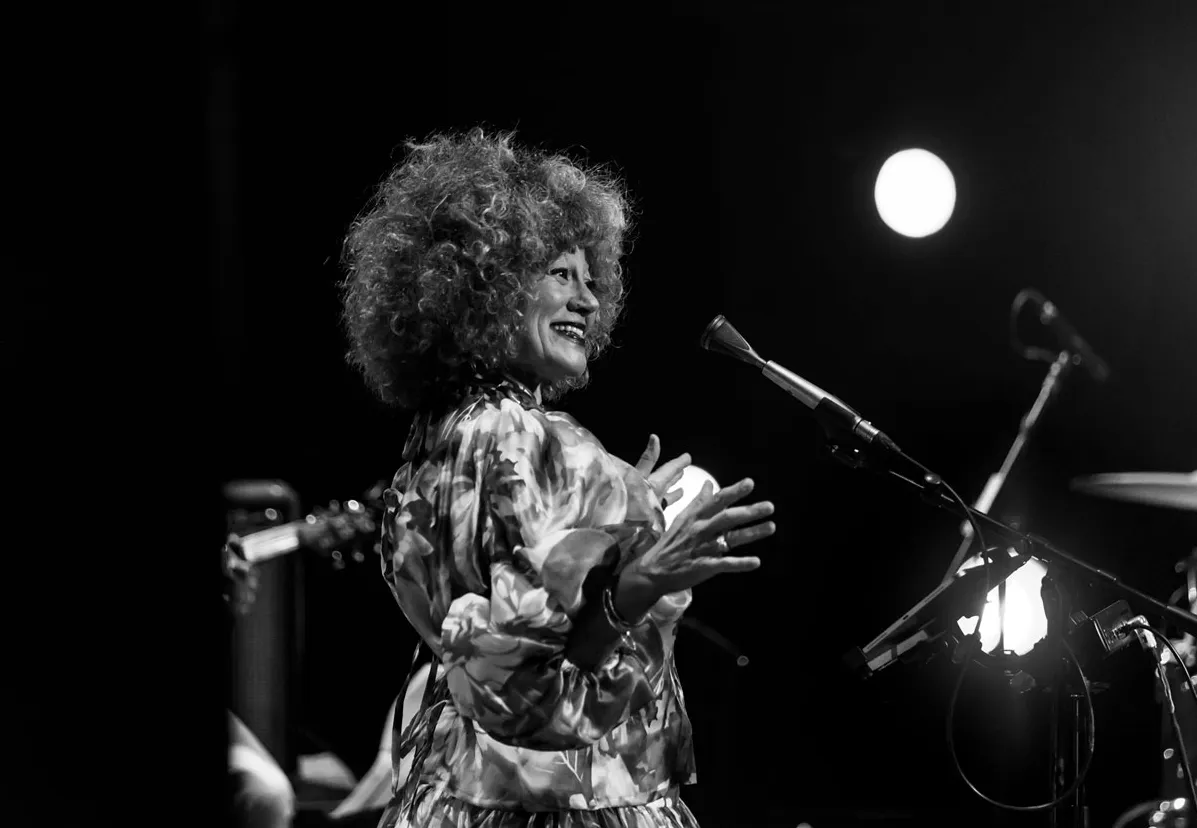
A free-spirited singer with an unmistakable voice, Maria João is one of the boldest and most creative Portuguese artists of her generation. Her connection to Mozambique spans time and blood, and made itself keenly felt at the recent presentation of her new work at the Franco-Mozambican Cultural Centre in Maputo. In this conversation with Xonguila, the artist tells us about that affectionate and creative bridge between Portugal and Mozambique, the maternal roots that shaped her and the way Mozambican culture has become woven into her music and her being.
What is the origin of your connection to Mozambique?
My connection to Mozambique is truly extraordinary. It is, indeed, very strong — it comes through my mother, who was born in Mozambique; she is Mozambican. She was born in Chinde and was brought up there for the first years of her life. She has an incredible life story in those first 10 or 12 years. She was raised on a boat that my grandfather, a veterinary surgeon, owned. That boat sailed up and down the river, carrying goods and animals. She grew up there, in that universe. She used to tell me she had a pet, a little goat... and the story goes on from there.
How was that maternal influence? Do you feel Mozambican in some way?
I feel half Portuguese, half Mozambican. Honestly, with all my heart, that is how I feel. It is a tremendous bond. I was born in Portugal and grew up there, but Mozambique is, in some way, my country too. And I can't even explain properly why or how. The truth is that I began going to Mozambique often from the age of 11. My mother only hadn't taken me earlier for fear that I would catch malaria, as I was still very small. But, since then, we went many times to Maputo, to Beira, and even to South Africa. It was an enormously important influence for me — a Mozambican feeling that I can't explain properly. I lived longer in Portugal, but I think it is the blood that runs in my veins, it is the colour that dwells in my skin, it is my memories. My mother was fundamental in keeping that sense of belonging to Mozambique alive
In what way did Mozambican culture influence your career and your music?
Mozambican culture influenced me profoundly, consciously, and I know exactly when. It was in 2000, on the occasion of the commemorations of the Discoveries. I was invited to create two works about the cultures of the Indian Ocean. Supposedly, it was meant to be about India, but I asked to include Mozambique. And so it was. It was an overwhelming experience. Mário Laginha and I went to give a concert on an island and they gave me two books — Terra Sonâmbula by Mia Couto, which is my bedside book, and Hamina e Outros Contos by José Craveirinha, from the publisher Ndjira. Those books awakened something in me. I felt they belonged to me. Since then, they have always been with me. When I want to write lyrics, poems, that is where I draw my inspiration. Craveirinha's poetry, Mia's prose — they dwell within me. It was from there that the album Cor was born, which was also about India. We played with the Indian musician Trilok Gurtu, and that album was enormously important to me. Not because it was better than the others, but because that was where I found myself as an artist and as a person. It was when I truly embraced my pride in being Mozambican too, in being this mixture that I am. The album Cor marked that moment.
“The album Cor marked the moment when I truly embraced my pride in being Mozambican too, in being this mixture that I am.”
You presented your most recent work a few days ago at the Franco-Mozambican Cultural Centre. What do you feel the Mozambican public gives back to you?
It was a huge celebration to present this album, which celebrates all these years of career, in Mozambique, in Maputo, with Mozambicans, with my dear friends and with musicians I love so much and who influence me profoundly. The Mozambican women singers are wonderful, Texito Langa, who now comes to Portugal a lot, Stewart Sukuma, Cheny, Walter... and António Prista, who is like a brother. I am very grateful to everyone, but especially to Prista, who is a true driving force of culture in Maputo — he moves heaven and earth to make everything happen. It was truly incredible, we managed to do this concert, this album. People always welcome me very warmly; I think they understand this mixture that I am. They fill the concerts, they applaud, they come to hug me. It was total happiness. The next day, at 8 in the morning, I was on a plane to Lisbon, at 10,000 metres altitude, and the day after I had a concert in a salt mine in Loulé, 230 metres underground! This artist's life is madness — so high and then straight after so deep. But I wouldn't choose any other life for myself.
The rapport with the many musicians you performed with was clear to see. Do you plan to be more present in Mozambique or to make an entire album produced here?
That would be incredible — making a whole album recorded entirely in Mozambique! Some things have already been recorded there, but mixed afterwards in Portugal. For that, I only need to bring my musical partner, João Farinha, who is my musical director and without whom I can't do anything. He helps me combine the electronic side with the music, something that interests me more and more. Recording a whole album there would be wonderful. I really want to. At the moment, I am focused on trying to bring some Mozambican musicians to Portugal. We have already managed to bring Texito, and it would be fantastic to be able to bring the girls too. But everything is very expensive — flights, accommodation... We are trying to find support in Mozambique and also to see whether any Mozambican company with a presence in Portugal can help. I got it into my head that I had to do this — record in Mozambique, with these people. We have already managed to do part of it. But if I manage to make a whole album there... yes, please, please, it would be what I would love most.
And that's it. I am Maria João, singer.


