
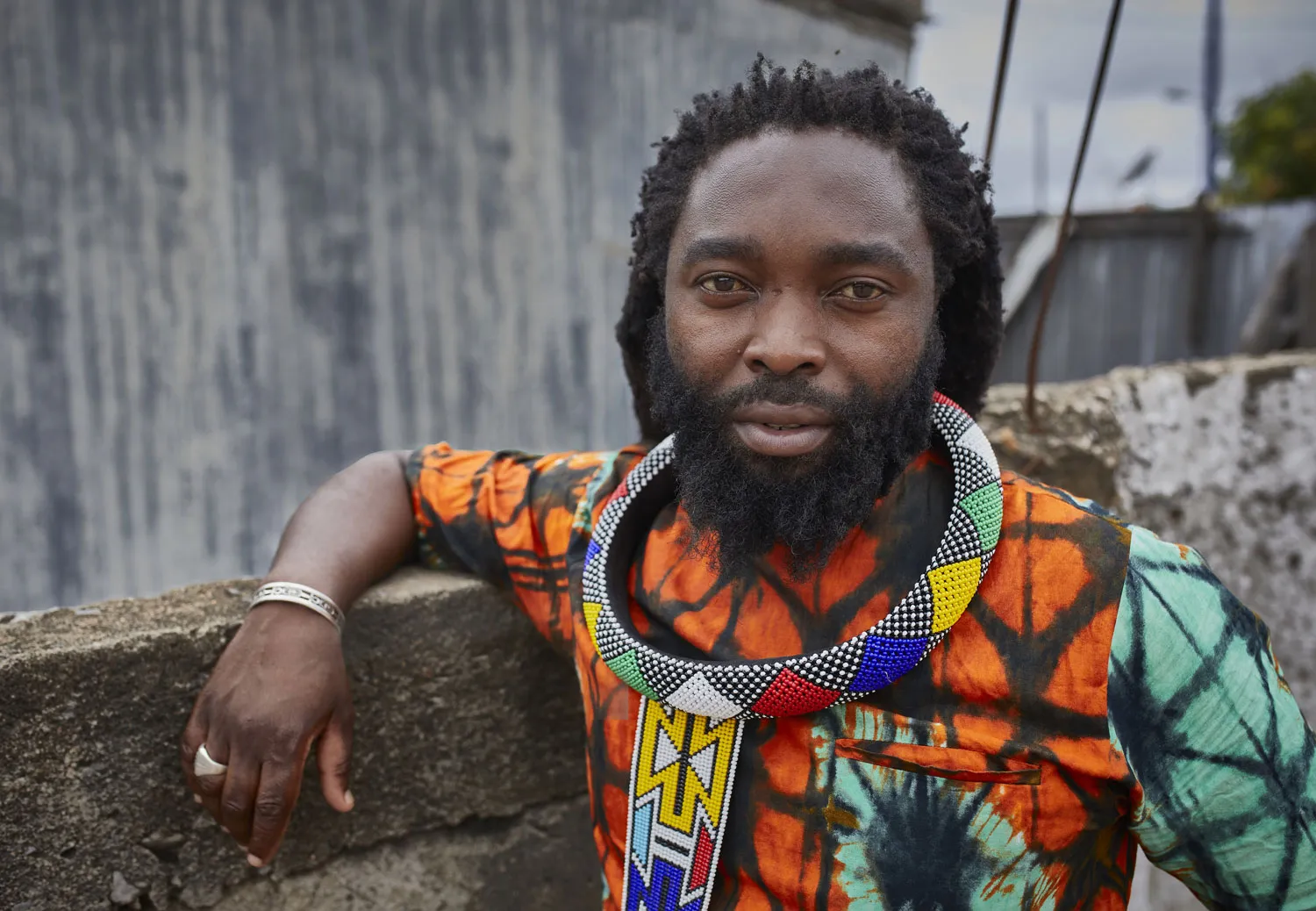
Marcelino Manhula
From street dweller to internationally acclaimed artist
Marcelino Manhula, aged 34, is an “unlikely hero”, the protagonist of a story of persistence, faith and great resilience. An artist who explores contemporary mosaic and makes stones speak, in 2013 he won South Africa's biggest national mosaic prize, in the country to which he ventured, empty-handed and with a heart full of hope, in pursuit of his dream.
But before becoming the internationally recognised mosaicist he is today, Manhula, who was born in Maputo and lives in South Africa, spent almost two years on the streets of Johannesburg and Cape Town, enduring cold and hunger, until he was taken in by a local church.
To understand the story of how this true Master overcame adversity, we must go back to 2005, the year in which, with a speciality in mosaic, he decided to emigrate to the neighbouring country in search of better living conditions, after completing his technical education in Visual Arts at the Maputo School of Visual Arts.
He became interested in art during childhood, while attending primary school. It was not an easy education, but his desire to succeed in life meant that he faced and overcame every difficulty that came his way. “I grew up with my mother; I never knew my father. I sold scrap, second-hand clothes, and worked shifts as a docker at Mozambique Railways, to help my mother put food on the table. In the morning I had to go to school, in the afternoon I had to go to work,” he continues. “Time and again I fell asleep in the middle of class. The teachers always asked why, and I explained that during the night I carried sacks in the holds of Mozambique Railways to pay my school fees and buy teaching materials.”
Manhula has been connected with the arts since childhood and is proud of how they helped him overcome social differences. “I grew up in the suburbs, between the neighbourhoods of Maxaquene, Mafalala and Polana Caniço, in precarious conditions. In my community, few people could afford a car, unlike people who lived in the surrounding neighbourhoods. To make up for this lack, the other boys from the neighbourhood and I made little cars out of clay and recycled iron. When we drove our toys, made with love, it was as if we too belonged to that elite class,” he recalls proudly of a childhood that was as hard as it was happy.
The artist's adventure and his first job opportunity
In 2005, shortly after completing his technical education in the Arts, Marcelino Manhula emigrated to South Africa to specialise in Mosaic, an ancient technique, a decorative art used since Antiquity, from at least 3500 BC to the present day. It is made with small pieces of various materials, such as stone, ceramic, glass and others, set into the walls of buildings (churches, for example) or placed on any surface, forming figures.
“I arrived in South Africa at 19 years of age. I didn't know the language, I didn't know anyone. I slept on the streets and searched them for anything I could find, I ate from the rubbish. Often I would go to the cinema at night to watch films, and sleep hidden under the seats until the next day. I would be woken by the cleaning staff or the security guards. For a long time I went on living like that,” says the mosaicist. “My first job opportunity was with a local private solid waste management company. I swept roads for a living and was paid by the hour. One fine day, I saw an advertisement for places to study mosaic at the Spier Arts Academy in Cape Town, and I travelled there. It was the opportunity I had been looking for.”
Manhula set off from Johannesburg for Cape Town in the same conditions in which he had left his homeland. “I had to leave Johannesburg, to venture once more into an unknown city. I took a train to Cape Town with just a briefcase, a jacket and a pair of trousers. In my pocket I had only 350 rand in coins. I survived a few days. It wasn't easy, Cape Town is a very cold city,” he relates, recounting his painful experience in the land of Madiba.
Without documents, Manhula had to survive on the streets again for a year and a half. He began knocking on the doors of local churches that offered charitable services, to obtain clothing and food. “I was taken in by one of the churches and managed to find a job, the same one I had done in Johannesburg. As I had no documents, I needed to obtain a refugee document in order to remain in that country and have the chance to study what I love most in life, the arts, at the Spier Arts Academy.”
Indeed, in 2012 Manhula graduated from the Spier Arts Academy as one of the best students on the three-year Architectural Mosaic course, and won a scholarship to do a master's degree in Contemporary Mosaic at the Irene Di Spilimbergo school in Italy, between 2012 and 2016, where he also stood out for the excellence of his performance, thereby opening the doors of the world.
“Contemporary Mosaic is a technique little explored in the country and in the world. Few of us practise it. Practically speaking, there are more mosaicists in Italy and in South America, more precisely in Mexico, and in South Africa.”
Marcelino Manhula is one of the few African artists who paint with stones. Since 2015 he has been on the list of the world's 40 best mosaicists.
Before becoming the internationally recognised mosaicist he is today, Manhula lived for almost two years on the street, enduring cold and hunger, until he was taken in by a local church
From the galleries of the world to the community
Marcelino Manhula has held numerous solo exhibitions at many prestigious galleries in African, American, Asian and European countries. Also trained in art therapy, he holds international art exhibitions and workshops.
“I began selling my work all over the world and I still do so today. It is possible to make a living from art, I live from art. We all have a talent, we just have to discover what it is, because that is what we will live from,” he said, stressing that we should love our work.
Recently, in partnership with the Mafalala Museum and the IVERCA Association, the artist led a contemporary mosaic workshop called “Give back to the community” (Devolver à comunidade, in literal translation), which brought together about twenty young people from the Mafalala neighbourhood and beyond, from various segments of society, mainly visual artists and art students.
“Manhula is a young man who grew up in the suburbs of Maputo, between Maxaquene, Mafalala and Polana Caniço, and in one way or another he felt, and still feels, the need to give back to the place that produced him, that made him a man. And for us, as the Mafalala Museum, this was also a unique opportunity, since our focus is precisely social integration, the appreciation of cultural heritage, the democratisation of art and effectively creating broader access for communities such as Mafalala. And that was the icing on the cake,” stressed Ivan Laranjeira, Director of the Mafalala Museum.
“My aim is to return art to where it was born, to the place it belongs, in the community,” summed up the master Manhula, who in 2021 will take part in an art fair in France and another in Italy.
Written by Jaime Álvaro


