
Mangroves
In ecosystem restoration efforts, the example of Incassane
Written by Precidónio Silvério
By the end of 2022, Mozambique is due to replant some 5,000 thousand hectares of mangroves, according to the projections of the National Strategy and Action Plan for Mangrove Management in Mozambique established by the Government. The situation of the country’s mangroves is not among the best. Extensive areas have been destroyed, a major problem that has built up over decades. Climate change is among the causes of the destruction of this biodiversity, but the biggest villain is Man himself.
The National Strategy and Action Plan for Mangrove Management, under way since 2018 and due to end in 2023, rests on five pillars. The first has to do with the management, protection and sustainable use of the ecosystem, ensuring not only that these are participatory, but also the diversification of the livelihoods of the surrounding communities. Another pillar, that of environmental education and awareness, aims to develop students’ interest in the mangrove ecosystem, as well as to promote and carry out public awareness on the subject, given the great repercussions of a devastated mangrove area on marine species and on the lives of the people who depend on such an ecosystem. The other pillars address legislation and enforcement, as well as environmental research.
A long road, but we must make a start
It is Thursday. The day begins cloudy. Clouds cover the sun and a few drizzles stubbornly fall. The clock hands showed 9:30, the time at which Xonguila Magazine set off for the Incassane mangrove, in the municipal district of Katembe, on Maputo Bay. Located south of the city of Maputo, the district is bordered to the north and east by Maputo Bay, to the south by the District of Matutuíne, along Avenida do Metical, and to the west by the District of Boane, along the Tembe River. On arrival, the Xonguila team takes its first steps, just a few. The tide is low. Locals explain that at that time of year this happens in the early hours of the day, but by early afternoon the waters begin to come to life.
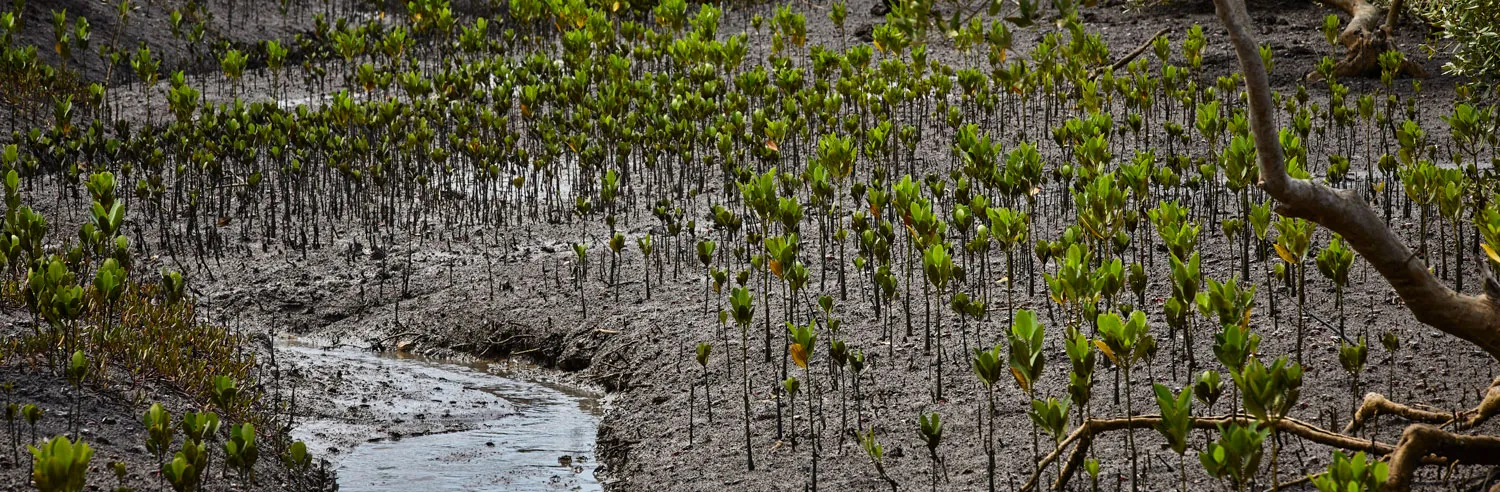
At first glance, and from afar, marks revealing the negative side of human action become evident. It seems there is a football pitch there, but anyone who thinks so is mistaken. These are hundreds of sacrificed mangrove plants. Local communities and outsiders cleared and continue to clear the mangroves for subsistence and other purposes. The scene is repeated in almost all the mangrove areas of Maputo Bay. Such is the case of the areas of Muntanhana, Mapulene and Machangulo (in the district of Matutuíne, Maputo province), for example. But not everything is going badly. If, on the one hand, marks of destruction are evident, on the other, a renewed ecosystem is beginning to emerge. There is a project there dedicated to replanting the mangrove, and the green, increasingly distinct, is proof of that. The project belongs to the Eden Reforestation Association, headquartered in the city of Maputo, and consists of reforesting the areas destroyed since 2019, the year in which the organisation began its activities. Represented by Hermenegildo Cuamba, it carries out its activities in the provinces of Sofala and Maputo, given their critical situation. The association, one of the Government’s partners, has a target to meet: to replant mangroves over some 3,000 hectares by the end of 2022. Of these, it has already delivered 1,000 hectares to the Executive. “The Government shared its targets, and we embraced them. At first, we had promised to replant a certain area, but then they asked us to restore the mangroves over an area of 3,000 hectares,” explained Hermenegildo Cuamba.
The mangrove replanting project carried out by this association focuses essentially on the provinces of Maputo and Sofala. But that is not enough; the association intends to reach other parts of the country and renew the ecosystem. Hermenegildo Cuamba describes the project as being not only environmental but also social. As he said, the project prioritises employment, since more than 300 staff, mostly young people, work on reforesting the mangroves. “Besides replanting the mangroves, we prioritise offering jobs to young people. All of them are paid for the work they do,” he said.
Saving the mangrove means changing communities’ habits
In Mozambique, estimates of mangrove area point to the provinces of Cabo Delgado, Nampula, Zambézia, Sofala, Inhambane, Gaza and Maputo, more specifically to the mouth of the Rovuma River, Nacala Bay, the Zambezi delta, Chiveve, the mouth of the Save River, the Limpopo estuary and Maputo Bay, respectively, points that are only part of the mangrove areas that those same provinces have.
According to the National Strategy and Action Plan for Mangrove Management, more than 60 per cent of the Mozambican population lives in the coastal zone, and is highly dependent on coastal resources and ecosystems. Doing the sums, most of the population lives directly alongside this natural resource and depends on it for survival. Márcia Nrepo, of the National Institute for Fisheries Research, an institution under the Ministry of Fisheries, the Sea and Inland Waters, does not rule out the pressure that these populations place, and have placed for a long time, on the mangroves in the communities where they live. Most of them are poor, and rely heavily on biomass fuel. To cook food, they resort to firewood and charcoal, and the only resource available to turn into this fuel is the mangrove plants. So this member of the team that drew up the Strategy and Action Plan points to some ways of safeguarding the mangroves, among them the transfer of technology to communities: “One of the ways to reduce the chances of the mangroves being destroyed would certainly be to create conditions for communities to have other fuel options for their everyday use, which means considering technological alternatives.” And Márcia Nrepo continues: “For example, if we bring to these communities mechanisms for generating solar energy, as fuel for most of their needs, lighting and cooking, for example, their habits will change and their behaviour towards the mangroves will be different,” she explained.
For the renowned environmental activist Carlos Serra, there is an urgent need for clear actions whose impact is directly proportional to the improvement of the mangroves’ situation. For this environmentalist, all the means aimed at halting the destruction of this ecosystem need to be combined. “The picture is not good. To reverse it, we need to look at the problem as a whole and, alongside that, it is crucial to bring together all the solutions: management of these areas, awareness-raising and having the approved laws actually working,” he said. Carlos Serra also pointed to activism as the key to bringing about the changes we want to see. Besides protecting the coast, mangroves favour the growth of fish production and the reproduction of shrimp and crab species, fishery products that are among the largest contributors to the country’s revenue and overall economy.


