
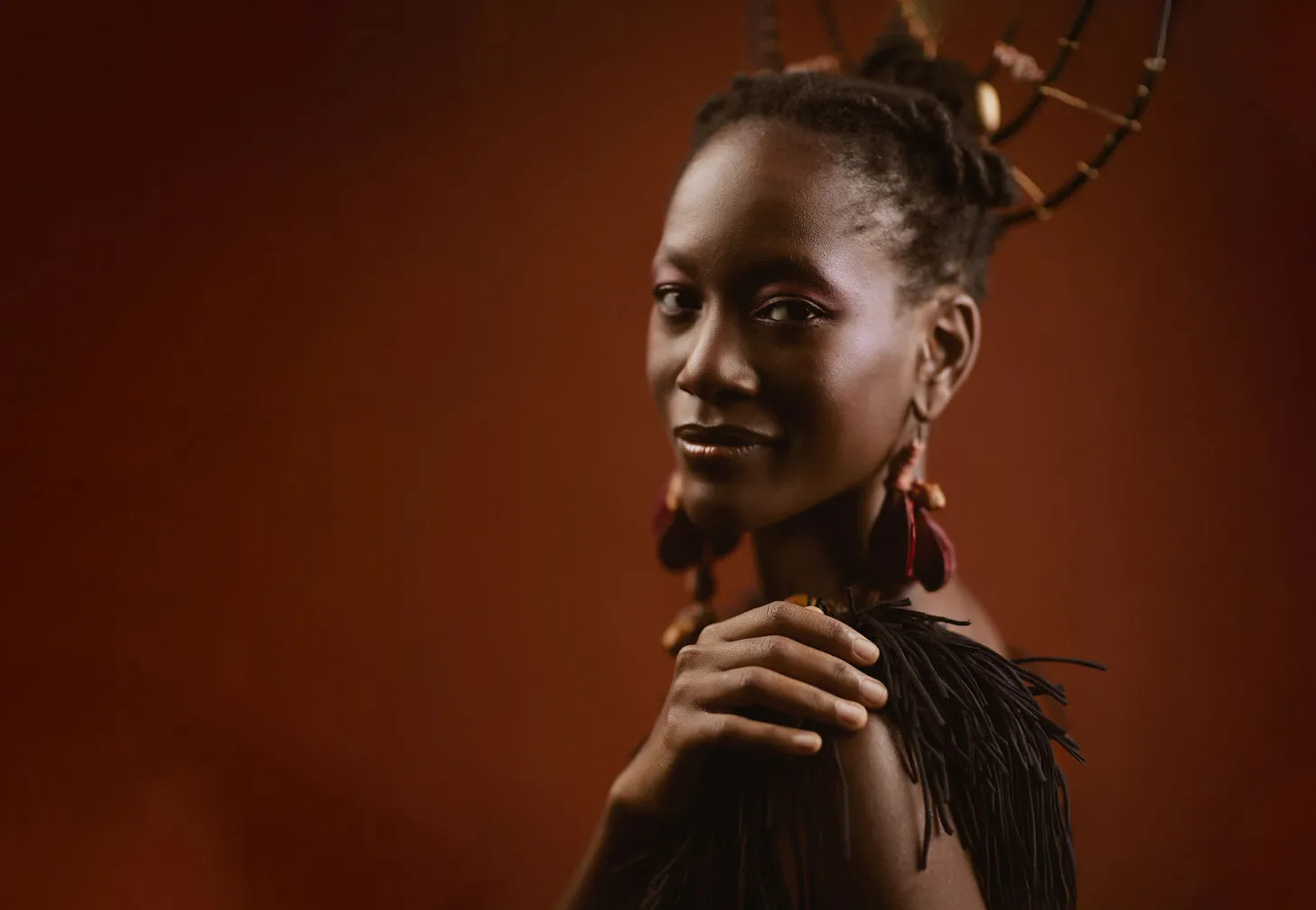
Listening to Lenna Bahule means entering a territory where the voice becomes both root and flight. Between Maputo and the world, she carries songs that are memory and invention, body and silence, tradition and future. Her music is a portal, and each song a passage. Born in Mozambique, but with a path that has taken her to São Paulo, Lisbon and other cities, Lenna carries the experience of being a nomad in her art. She crosses geographical and sonic borders, creating vocal languages that escape known words yet communicate in a visceral way. More than singing, Lenna summons the audience to an encounter: with ancestry, with community, with the body and with emotion itself.
When you sing in Changana, Portuguese, English or even in sonic codes, do you feel you are giving voice to different “selves”, or is it always the same Lenna?
I think the artist never has a single self. I really like looking at Beyoncé’s persona, for example. There came a moment when she realised this and created the alter egos she has. When I am on stage, I am also taken over by a different dynamic, different from my everyday life. As I took ownership of my work, I realised this more clearly. When we take power over what we want to materialise in the world, we need to face our ego honestly. The energy of achievement is the ego. So I had to access different versions of myself to occupy the stage and say what I want to say — whether it is criticism, sensuality, whatever it may be. Being African, a diasporic Mozambican, interacting a lot with the Brazilian public, I am always asked about my origins. And there is no way of avoiding language. I had to study identity and language seriously. Who am I beyond the colour of my skin? Beyond my nationality? And who am I within this multilingual and musical universe that Mozambique has? Language expresses thoughts, sensations, emotions. And this human being goes through many phases, many egos, many identities. Certainly, many Lennas. Never the same, but all from the same source.
Your body is often an instrument — percussion, breath, silence. Where does the voice end and the body begin in your creative process?
Mate, I am even going to take that question into my current creative process. Right now, I am climbing a hill towards my studio, and my breathless voice already betrays this living body that wants to express itself, that makes itself available so that the sound can come out. I chose this walk to keep my body alive and available. I work a lot with this idea of availability — sensory, physical, creative. For me, creativity cannot be separated from existence. Creating is intrinsic to human beings. Everything around us — the shoe, the clothes, the mobile phone — was born of a need. The more sensitive the body is to those needs, the more intimate the exchange. There are no rigid boundaries, only transitions, flows, movement. I like to think of my relationship with the body, the voice, silence, movement and breath as a continuity. Only the state of the matter changes. Sound is matter. Breath is too. Silence is not stillness — it is suspended movement, a preparation, a beginning. Everything is part of the same field of sensation, which only changes state.
Has there ever been a moment on stage when your voice failed and, instead of ruin, it turned into unexpected beauty?
That is my process. It was liberating. Because if there is one thing that was a trauma for me as a singer — and which is quite typical in Mozambique — it is this culture of mockery. People make jokes about voices that falter. That shows a lack of depth, and it is very crude. When I finally freed myself from the need to always sound perfect, I began to understand that a voice that “breaks” is a physical, physiological, emotional process. The voice is inside the body, and that body is a living being: it sleeps, it feels, it falls ill. It is not like an instrument that you tune and is ready — even those have their delicacies. The voice I have today is not the same one I will have tomorrow. It might have catarrh, a bad night’s sleep, an unresolved quarrel… all of that is expressed in the voice. The “break” is not a problem — it is proof that this body is alive and is not a machine. When I freed myself from that, that was when I truly took ownership of my voice. That was when I really began to sing — when I stopped meeting other people’s expectations of how I should sound.
Lenna Bahule speaks of nomadism as one speaks of a mirror. Only on leaving Mozambique did she realise the extent to which the body carries the territory — not just the mother’s house, but an entire ecosystem: sociopolitical, cultural, geopolitical.
“When we are at home, we are simply at home. But when we leave, everything changes — the language, the climate, the food, the air. And we gain distance. And distance gives us depth.”
This confrontation with other realities did not distance her from her origins — on the contrary, it brought her closer to herself. It gave rise to questions: who am I, what do I want to keep, what can I let go of?
“I started to disidentify from patterns that no longer served me. And, in that process, I became more African than ever — not in concept, but in practice.”
Over time, she stopped seeing Mozambique as an isolated point and came to understand it within an African cosmogony — and even a universal one. Her music mirrors this. “I am what I sing, and I sing what I am.” And the recognition of her African peers has given her meaning. “It is priceless to hear Mozambicans and Africans say they feel represented in my art.” But this place of return is also political. And not exempt from criticism.
“Today, Africa has become a trend. Everybody wants to be African, but nobody wants to live the pains of being African. Nobody wants to study the philosophies, get their hands dirty, understand the histories and the struggles behind what the world now admires”
What does it mean to you to sing for audiences who do not speak your language, but are moved all the same?
It is rich, isn’t it? Because it only proves that music goes beyond borders, music is universal. I always tell my colleagues, when we are working on new arrangements and opening up creative possibilities, I say: “music is sovereign”. Music is sovereign, it is an entity in itself, and it will say what it needs to say. It is just a matter of listening. And, when it arrives, it makes sense. We know: this is it, this is what needs to sound. Collaborating with artists from all over the world, this becomes more and more real and true. I am enormously grateful to be recognised and validated, I can even say worldwide, because my songs are now being played in the four corners of the world. That is really cool, really gratifying. Beyond borders. And considering that the language is not only the local language of Mozambique, but also a nomadic language, which, from my search for my identity, I have been exploring as a possibility to give vent to my ideas. Precisely so as to communicate with people in a more universal way. Sometimes there seems to be this place of not trying to be so regional, of seeking a balance between being regional and being global, planetary.
Your music speaks of freedom, the body, ancestry. In Mozambique, do you feel that the artist can still be a guardian of memory and, at the same time, a social provocateur?
Gosh, I am loving these questions, precisely because of this relationship. In fact, I have a project called Memórias D’Aqui. When we realise we are responsible for a power of access — not only to receive, but to transmit — we understand the social role of the artist. I always say: in the beginning, the artist was the one who received the world’s pains and turned them into art. That is still current. The pain changes form, but the artist still has this gift of transforming it into beauty to ease the collective pain. One of the ways of doing this is to return to the centre: to memory, to ancestry. And, inevitably, this makes us social provocateurs. After all, what is going on here? Why this pain? The artist notices when love is lacking and turns that sensitivity into a weapon for change. In Mozambique, this is serious. Many artists who fulfilled this role died poor — because the system does not want transformation. It is a much bigger machine that the artist fights against. And if the people do not engage, the artist dies — because they have already used everything they had. Look at Azagaia. He fought a good fight, he said everything he needed to say. We went years without hearing from him. Now he is becoming a martyr, being recognised after he has gone. What a pity that he could not enjoy the fruits of his struggle. The truth is that Mozambique is in a critical state. There was a recent episode that gave a minimum of hope, but the size of the problem is much bigger. For there to be social justice, many people would have to give up their privileges. And not everyone is willing to do that.
In Brazil, Lenna Bahule felt first-hand the power of collective creation among women. She worked with collectives such as Barbatuques and Clarianas, and saw something more than music come into being: she saw a network grow. “Power! If there is one thing that is very common here in Brazil, it is women coming together to make art together. One amplifies the other’s art.” This experience led her to rethink habits.
“I still trust male figures more than female figures to deliver my work. I think this has to do with the after-effects of the system. But the movement to empower women is happening — and it is lovely to see.”
In Mozambique, she acknowledges, it is still difficult. Women remain “held hostage by the patriarchal system”, fitted into the roles that were imposed on them. And there is a basic reality that makes transformation harder: “While we are worried about our stomachs, there is no room for poetry.” She learned, in Brazil, that reaching excellence requires time, networks, support and care. And although she recognises that Mozambique is still far from that reality, she tries to replicate what she can, whenever she can.
As an art educator, what do you most wish to awaken in others when you share your vocal research?
The possibility that everyone can. Everyone can occupy the place they want — as long as they dedicate themselves and commit to their pursuits, understanding what needs to move for things to happen. That is what I wish for: to help people find their creative authenticity. Every human being is creative and artistic, each in their own art, in their own talent. And we are versatile beings, capable of discovering new talents throughout our lives. I want to give people that potential to occupy their place.
We know you are a mother, a woman and an art educator. How do these intimate facets intertwine with your voice on stage? Has your motherhood, for example, ever whispered a song that you have not yet put on an album?
Yes. And as it happens, a song about that is going to come out, a single. Motherhood was one of the greatest gifts I have received in life. With all the hassles and challenges, I only see prosperity. It transformed me profoundly — as a human being and as an artist. My voice changed after motherhood, that is a fact. It changed physiologically — because a woman’s body changes — and I embraced that new power. The voice gained more maturity, more body. And my performance on stage changed too. I stopped being embarrassed. I thought: “Mate, I gave birth to a child, I looked after her practically on my own for four years… I couldn’t care less what you all will think. I am going to enjoy myself and do what I know how to do.” Motherhood brought me that courage. There is this superpower that all women feel: I gave birth to a person, I can do anything. And now that the child has grown, I feel the time has come to access other portals. That is what I am seeking at this moment.
If Kumlango means portal, what inner door is still waiting for you — what song, feeling or gesture have you not yet dared to cross in public?
I am in that moment right now. This interview has come at just the right stage. As an artist, I have a very strong tendency to collectivise my creative processes. Kumlango is my project, but it was born from a collective process. Now I feel the time has come to occupy more of my own space, to allow myself to be better. It is complex to say this out loud… But I am in that search: to understand my own doors. I know what they are, but perhaps I still do not know how to name them..
To finish, what is the dream that still sings in silence?
Oh, my God… The thing is, I am already living the pursuit of these dreams, so it is no longer so silent. At this moment, I am chasing a dream that previously remained quiet and which I have now found the courage to run after, to bring into being. That dream is to gain more intimacy with my own voice, accompanied by a stringed instrument. A dream that was in silence and is now beginning to be heard.


