
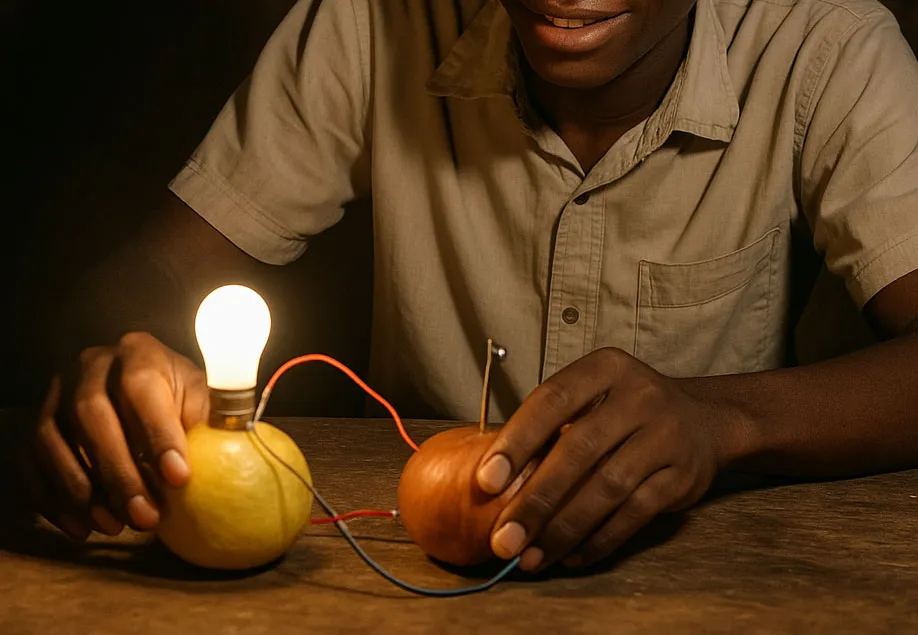
In Ribáué, more than 140 kilometres from the city of Nampula in northern Mozambique, a 21-year-old decided not to surrender to the darkness. Faced with constant power cuts that kept him from studying at night, Faife da Costa, a Grade 11 student at Ribáué Secondary School, found a luminous way out in science.
“The power cuts happened almost every night, and that made it hard to revise or do homework. That was when I thought, why not use what I learn at school to solve a real problem”, he told the Lusa news agency, with a shy smile.
Using copper wire, aluminium, lemon and onion, the young man built a homemade electrochemical cell. The reaction between the citric acid and the compounds in the onion produces enough voltage to light an LED bulb — a light that, although modest, has been enough to illuminate his room and keep his studies on track.
“For now my invention only serves to light the house. But I dream of perfecting the system so that it can also power small electrical devices, such as radios and mobile phone chargers”, he said.
Faife’s inventive spirit reaches beyond his room. He aims to take his solution to other areas without electricity, especially in the most isolated regions of the province. “Many places live in darkness. I would like my idea to help those people have light and improve their living conditions.”
Despite his motivation, financial limitations and the lack of technical support are real obstacles. “If I had support, I could test new materials, improve the system and even create a more resistant and durable prototype”, he said. Even so, he keeps his spirits up: “I want to show that you don’t need much to change something. Sometimes it’s enough to believe, to try and not to give up”.
Energy for all by 2030
Faife’s dream is in line with the efforts of the Mozambican Government, which announced that it had secured 434,289 new connections to the electricity grid in 2025, under the Energy for All Programme. According to the Minister of Planning and Development, Salim Valá, this represents 72.4% of the annual target.
“With the implementation of the programme, the connection rate is now more than 500,000. Before, the number of annual connections was below 150,000”, the minister explained, stressing that the goal is to reach 100% coverage by 2030.
The Executive intends to connect a further 600,000 homes this year, surpassing the 563,000 connections made in 2024. The bet has been placed — on large infrastructure and on small ideas that, like Faife’s, switch on lights where before there was only darkness.


