
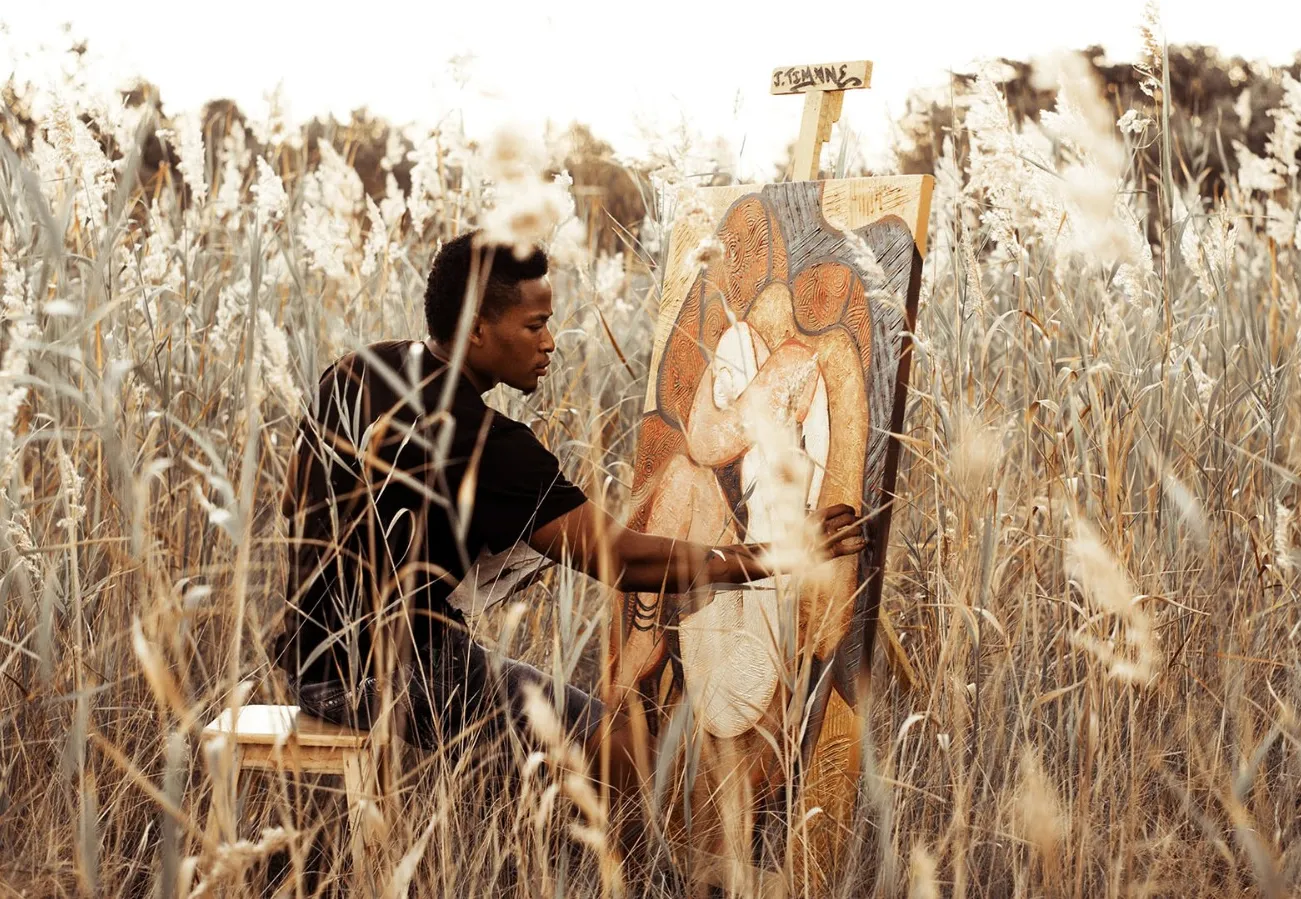
Some artists come into the world slowly, like those who listen first. João Timane is one of them. Before painting, he observes. Before choosing the colour, he looks for what was left unsaid. He grew up in Bairro do Aeroporto, a place where haste lives alongside tenderness, and today the man still carries the child who held the world in his eyes before taking it to the canvas. Perhaps that is why his work has such a rare mixture of energy and delicacy. The figures he creates hold memories, the streets reappear in their outlines, and there is always a line that seems to be longing. He now lives in Germany, surrounded by other landscapes and other silences, yet he still paints like someone returning home. Each canvas is an intimate gesture, almost a confession, in which he tries to preserve what is lost along the way and what still moves him from within. Here, he opens that door to us.
You grew up in Bairro do Aeroporto, a place where life rarely slows down. Anyone looking at your work today can see that you carry many of those memories in the gestures, the colours and the faces you paint. Which images from your childhood still whisper to you when you sit in front of the canvas?
When I sit in front of the canvas, Bairro do Aeroporto does not stay in the past; it sits there with me. I see the women of my family walking with a firm step. My eldest sister, who has since passed away, with the scarf tied around her head, solving difficult problems. The women of my neighbourhood, humble yet rich in joy.
Some artists enter art through restlessness and others through a need for expression. In your case, which came first: the urgency to say something or the discovery that you had a language of your own in drawing?
Art did not begin with restlessness or with urgency; it began with companionship, environment and heritage, if I may put it that way. I was born into an artistic milieu, surrounded by names that became great masters: Malangatana, Netto, Chissano, Mbique, Makazako, Mavec, and so on. They were not just celebrated artists; they were my neighbours. Growing up there gave me a quiet advantage, because I realised early on that art was not a luxury but a natural language, as everyday as breathing. I feel that I lived in a place where art was always part of daily life. I can say that I was privileged.
You have painted children, neighbours, streets and moments that seem like small fragments of everyday life seen with tenderness and attention. What did the neighbourhood teach you about humanity that no school teaches?
The neighbourhood taught me lessons that no school can teach. I learnt that when a neighbour has salt, they share it with others; that whoever has rice must not forget those who have none. That if a house burns down, the children of the affected neighbour sleep in the house of whoever was left with everything intact. I learnt that solidarity is not an option but a necessity. That unity saves, that attention to others transforms everyday life, and that humanity reveals itself in the simplest gestures. The neighbourhood taught me that looking out for others is as natural as looking within ourselves, and it is that gaze that I try to bring to every picture I paint.
When he speaks of the masters who marked him, João Timane describes a path made of decisive encounters. In Malangatana, he discovered that art can be memory and identity, that a drawing carries whole stories. In Chichorro, he found the power of colour, that brilliance that lights up a room and transforms everything around it. From Naguib Elias, he received the vision and presence of a leader, someone far ahead of his time, who showed him that an artist's strength also lives in the way he faces life. And, although he admires Picasso, it was in Makazako that he found his true guide, the master who believed in him, who gave him the impetus and the right gesture. Makazako's absence still visits him in dreams, a silence that hurts and comforts at the same time. In the end, each master left him an important part of himself, but all of them taught him the same thing: the courage to find his own voice.
Two years ago you decided to distance yourself physically from your country in order to come even closer to your art. Germany gave you silence, distance and new references. What has changed in the way you see, paint and feel since you arrived?
Germany is a country with a culture completely different from mine. The greatest lesson I have learnt is discipline. I withdrew a little and fell silent for two years because I needed to integrate and absorb what this country has to offer. The biggest difficulty has been the language, but everything suggests that within six months I will be 100% active again. I am looking forward to that moment, with a great thirst to colour my canvases. Since I arrived, I feel that I have developed my intellect. I no longer paint only Mozambique; I paint the world. I am surrounded by diversity, and that has taught me to respect and understand different cultures. Every person, every setting and every experience adds a new dimension to my work and to the way I see art.
Studying abroad is discovering where we truly belong. What did Germany offer you that Mozambique could not give at that moment, and what does Mozambique continue to offer you that nowhere else can replace?
Germany offers me financial stability, security and constant contact with culture in everyday life, things that, at that moment in my life, Mozambique could not guarantee. On the other hand, Mozambique continues to offer me something that no other place can replace: the warmth of the people, the joy even in the face of hardship, and the pleasant temperature that makes me feel alive. It is that energy that inspires me and fuels my art. I would like to be able to visit Mozambique at least twice a year. I feel that it would do me a great deal of good, because it is there that I recharge my strength and my creativity.
Many look at your colours as pure energy. Others see in them old scars and treasured affections. When you choose a saturated red or blue, are you thinking about what you feel or about what you want others to feel?
When I paint, most of the time I think of nothing. Everything flows naturally. Sometimes I may plan to use, say, red, but in the moment I end up using orange. I cannot explain exactly why. I only know that I paint to colour my soul. The work has to delight me first. It is a therapy like no other. I feel incredibly good when I finish a painting exactly as I wanted. The colours are an extension of what I feel, but also of what I need to release. I do not paint so that others feel something specific; I paint to feel whole, complete and at peace with what I have created.
Your portraits of women have a force that runs through the observer. They are central, solid women, almost monuments. What stories do you give them when you paint them? And what stories of theirs come back to you?
When I paint women, I see them as strong and central, almost like monuments. That is how I have always seen them in my life, in the family, in the neighbourhood, in the street. Every line and every colour tries to show that strength and presence. The stories I give them come from what I have lived: courage, sacrifice, quiet leadership, joy even in difficult moments. But when I paint them I feel that they also tell me things: looks that hold memories, smiles that show resilience, gestures that reveal care and power. It is a silent exchange. Every portrait I finish makes me respect and admire women even more, and realise that, in painting, I receive far more than I put on the canvas.
There is movement, texture and almost a musical cadence in your compositions. When you paint, are you listening to something inside?
I am a strong person on the outside but very sentimental on the inside. A bit like a poet who has not yet set himself free. I always paint while listening to music; I love music. Apart from painting, it is the only art that can transport me to another dimension and make me feel in a way that nothing else can. I listen to almost anything, depending on the moment and on what I feel. Sometimes calm music guides the rhythm of my brushstroke; at other times a more intense sound gives energy and strength to the work.
Your book covers have travelled between Mozambique, Brazil and Portugal. There are writers who paint with words and artists who write with colour. What did you discover on seeing your work rest upon books that tell other lives?
First, it brought me to another audience. It put me in contact with literature, even though I belong to a generation that can hardly bring itself to open a novel or a book of poetry, yet spends hours reading thousands of posts on social media. And that is not a criticism, because I am not very different myself. It is simply the reality of our generation, a silent struggle that each person faces in their own way. Seeing my work on books that tell other lives taught me that art can cross paths and experiences, and that a painting can converse with words, stories and emotions in ways I had never imagined.
You have said that you paint what you observe, but also what unsettles you. What restlessness still drives you when you think you have already said almost everything?
Even when I feel that I have already said a lot, the restlessness remains. There is always something that disturbs me, something I cannot ignore, whether it is an injustice, a memory that insists on returning or the simple curiosity to understand the world around me better. That restlessness keeps me looking, observing, feeling. It leads me to explore new colours, new forms and new expressions. Each painting is an attempt to give shape to emotions and thoughts that will not be silenced. Ultimately, that restlessness keeps my art alive, because there is always something to say, something to show, something to feel.
At the end of every work there is always a remnant of silence, a small margin where what you could not say remains. If one day your art asked you for a final answer, without canvas or colours, only truth, what light would you leave there for those who come after you?
This question is incredible. In truth, it is not a question for me, but for great masters such as Silvério Sitoe, Chocate, João Paulo Quehá, Gemuce, among others. But if I have to answer, I would say the following. If my art asked me for a final answer, without canvas or colours, only truth, I would leave there a light about courage, strength and humanity. I would let those who come after see that art is not merely technique or beauty; it is a way of existing, resisting and conveying what we feel and live. May every line or colour inspire others to be true to themselves and to respect the world around them. We need one another.


