
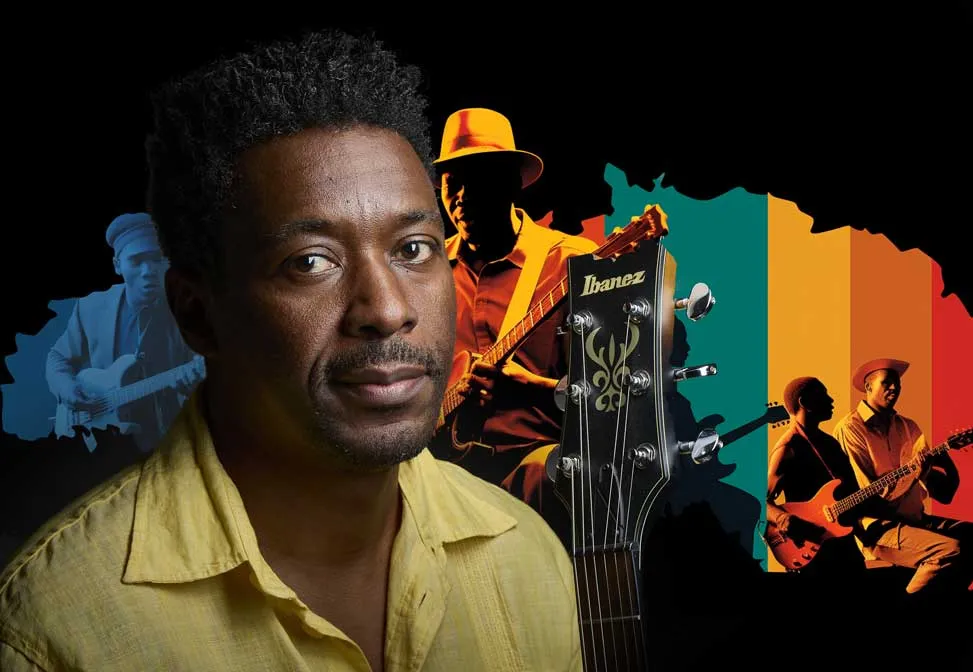
How did your musical journey begin?
My path began in church, as a drummer, but shortly afterwards I switched to the guitar as my main instrument. As time went by, I got to know local musicians and drew close to some of them in order to learn and interact musically. Among them, the standouts are Professor Orlando da Conceição, Angélico Manhique, Abílio Manjaze and the late Filipinho. In 1996 I met Jimmy Dludlu in person, at the time of the launch of his first album, Echoes From The Past, at the Clube Desportivo de Maputo. From that interaction and friendship came the opportunity to go and see, attend and experience some jazz concerts and festivals in Cape Town in 1999, and to get to know the South African College of Music at the University of Cape Town, which would become my music college from 2003 to 2007. I graduated, and during that period I had opportunities to play with professional musicians, students and music teachers, and to interact with North American musicians who were on the line-up of festivals and concerts, such as Marcus Miller, John Scofield, Lee Ritenour, Norman Brown, Mike Stern, Joe Mcbright, Pat Metheny, George Benson and others, during jam sessions, workshops, talks, conferences, masterclasses and performances.
What was it like to study Jazz Performance at the University of Cape Town (UCT)? What repercussions did it have on your work?
It was a striking, contagious and indescribable experience. After spending several years of my childhood and youth listening to, and trying to transcribe, works by various artists who loved this genre of music, I was thrilled to go to the South African College of Music at the University of Cape Town, to be able to absorb, retain and handle (scientifically or not) almost everything to do with the language and vocabulary of jazz: execution and improvisation (which is the focal point of jazz). After finishing my course, in 2007 – the following year and still in Cape Town –, I began recording my first album of original music, River of Dreams, which I finished and released in 2009. The album featured South African musicians and a few Mozambicans living in Cape Town.
What are your main musical influences, both within and outside jazz? In what way do these influences show in your style of music?
Joe Pass, Pat Metheny, Kevin Eubanks, Garrison Fewell, Mike Moreno, Teddy Pendergrass, Luis Salinas, Nelson Faria, João Bosco, Manu Dibango, Papa Wemba and Ernesto Ndzevo. For the most part, these influences help me decide which direction to take in how I compose, arrange, orchestrate and sequence songs on an album or musical show. I am always fascinated when, listening to someone's music, I notice that as well as having a lovely melody and harmony, it is also well orchestrated and arranged. I dream of collaborating one day with Richard Bona, Victor Wooten, Lizz Wright and Chris Potter.
Could you tell us a little about your experience as a music teacher at the Escola de Comunicação e Artes (ECA) of Universidade Eduardo Mondlane (UEM)? How do you manage to balance your work as a musician and as an educator?
My teaching career at the Escola de Comunicação e Artes of Universidade Eduardo Mondlane began in 2010, as a lecturer in music theory and instructor of music ensemble and big band (together with the American International School of Mozambique). From 2011 to 2015, while teaching, I also served as head of the music course. I also had the opportunity to teach on international exchange programmes at the University of Ghana (Ghana), University of Cape Coast (Ghana), Makumira University (Tanzania), Sibelius Academy (Finland), Rhythmic Music Conservatory (Denmark), Royal Academy of Music (Denmark), Estonian Academy of Music and Theatre (Estonia), Universidade Federal da Bahia (Brazil), Universidade Estadual da Bahia (Brazil), Faculdade Evangélica de Salvador (Brazil), Universidade Recôncavo da Bahia, Universidade Federal do Rio de Janeiro (Brazil), Universidade Estadual do Rio de Janeiro (Brazil), Universidade Federal do Rio Grande do Norte (Brazil), Universiti Teknologi MARA (Malaysia) and Berklee College of Music (United States of America). In this teaching work, I have not only had the opportunity to pass on and share musical knowledge (performative, scientific and pedagogical), but also to collaborate, interact and know how to maintain the student's motivation and enthusiasm for the subject. For me, being a musician and educating are interlinked: when I teach, I also learn and often revisit musical content learnt in the past. In this way, I revitalise those past subjects and incorporate them once more into my musical vocabulary and language. Of course, this requires planning and adapting to last-minute situations. At the moment, I am focused on presenting my second album of original music, Walks of Life, which has just been released, in May 2023.
What is your vision for the future of Mozambican music and of jazz in general?
As for the future of Mozambican music, I believe it will improve and overcome one of the greatest obstacles our music has: weak and/or poor harmony, and this is not only a problem of our folk music (known among us as “popular” Mozambican music), but of the whole African continent. Our harmony is simple, repetitive and static, and this needs to change, by exploring and developing the harmonic fields further, since our melodies and rhythms are very rich, and often dynamic too. When it comes to jazz, it is another matter altogether. There is an illusory fever in our musical society whereby almost everything played on our scene today is jazz or is associated with jazz. It is common to hear a radio advertising spot or see an advertisement saying that artist X is going to give a jazz or Afro-jazz show, even though it is known in advance that the artist's genre or style is traditional music, or pop, or pandza, or whatever. I have always had some doubts about the whole idea of emphasising the Americanness of jazz to the point of exclusivity, but that is another subject. One of the many things that makes jazz unique is how well suited it is to absorbing the infinite materials, styles and tones of human achievement. It can therefore embrace (if there is room for it) any culture. But one must not confuse or distort things. Jazz has its own form(s), language and vocabulary, and that has to be respected. So you cannot, for example, take a simple marrabenta and label it Afro-jazz just because one or a few seventh chords are included, instead of the triads that make up the harmonic field of marrabenta. It is in the very nature of jazz to change, develop and adapt to the circumstances of its environment. Jazz is a weightier idea than the details of its history; a concept bigger than anyone could ever hope to know or define in full. That being so, I think jazz will probably continue to thrive, though possibly in unexpected ways.
How do you see the evolution of your music in recent years, and what are your expectations for the future?
Positive and tending to improve, given the musical, cultural and educational opportunities, experiences and exposure I have had and acquired in recent years. As for expectations for the future, to keep investigating, researching and seeking more knowledge and experience in order to enhance and refine my own music even further.


