
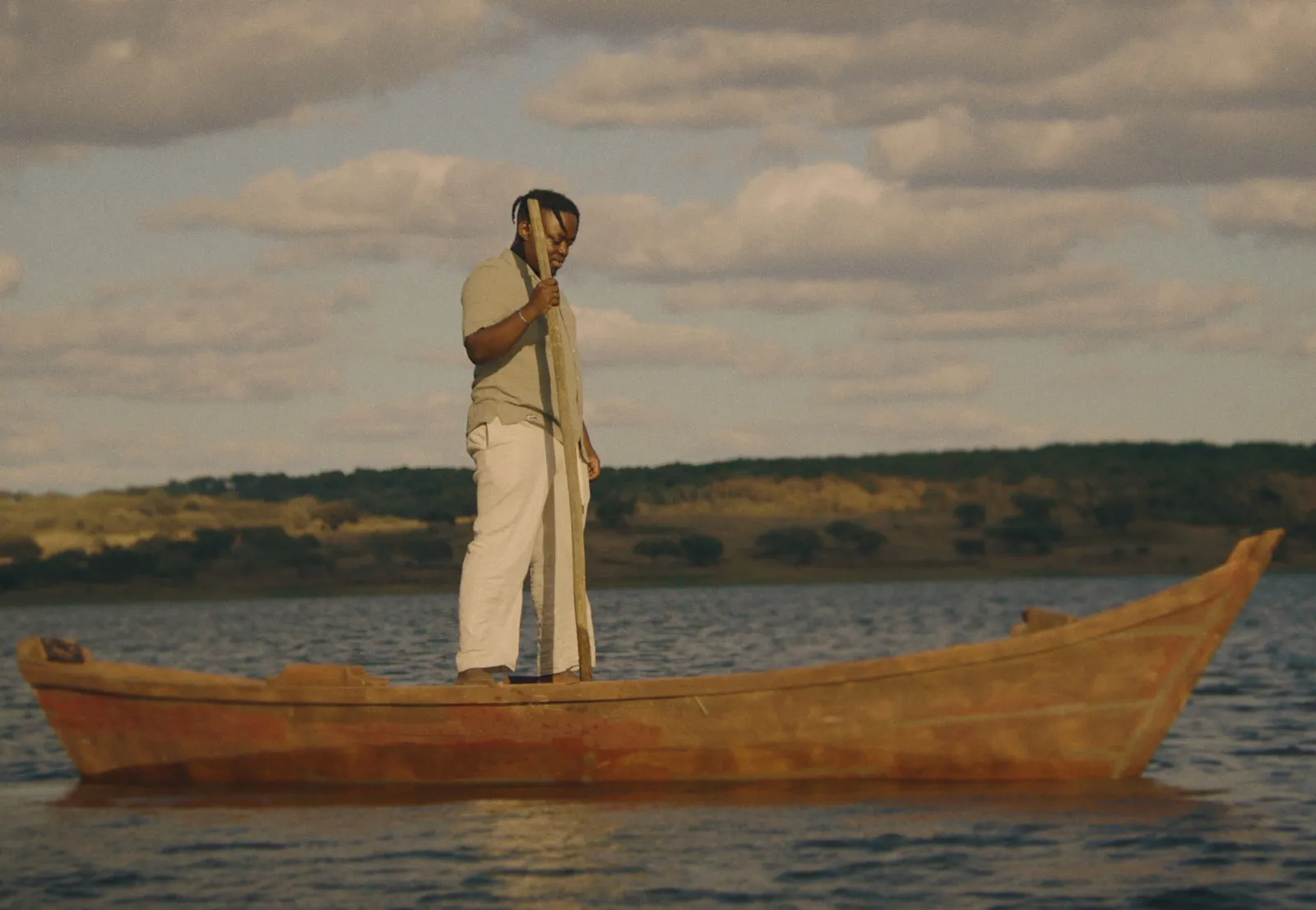
Born in Angola in 1998, he grew up in Rio de Mouro, a suburb on the Sintra line, in Portugal. Ivandro has established himself as one of the most authentic and versatile artists of the new generation of Lusophone music. With a career on the rise and a voice that crosses borders, he brings to his compositions the soul of a true storyteller. In an exclusive interview with Xonguila Magazine, the artist speaks about identity, spirituality, creative processes and the strong bond he maintains with Mozambique — a country that, in his words, made him travel all the way to the moon.
You have a strong connection to Africa and its musical roots. How has this African heritage shaped your path and the way you feel music?
I inherited a great deal of musicality from Africa, thanks to my parents and my family. We always had the habit of listening to the great musicians of our homeland and, without a doubt, that influenced my music. To this day, my biggest songs are almost always close to Afro, if not outright Afro. And I am also returning to my roots and creating more songs in that style.
Your music conveys a great deal of emotion and authenticity. How do you balance your personal truth with what the public expects of you?
That is a good question, and I think that, for me as for any artist, knowing what people want from us can create a certain pressure, but I think the secret to getting past it is to create, to create a great deal, to have plenty of options and, in that way, to feel that we are always releasing something that carries our truth.
I have already had the chance to play in Mozambique and the concerts were incredible. The audience there is very strong, very passionate. They embraced us and took us all the way to the moon.
Your album Trovador reflects an introspective journey, and you have said that "the melodies came where words could not reach". How has music allowed you to express emotions or thoughts that would otherwise be difficult to communicate?
I think that, for me, music has become a tool that does exactly what I said: it manages to reach where words cannot. The musicality, the instruments, everything that goes into a song allows me to convey what is inside my heart. It allows me, very often — imagine — to pass on to the person I want to reach the message that is in here. And sometimes it is hard to do that in a conversation. With a song, the magic happens, and it is much easier to give a person an open heart, 100%. I feel that the messages become so strong that they echo not just within us, and not just for the person we wanted to speak to, but for the whole world, the whole universe of people who are also going through the same thing.
In the track "Give God Praises", there is a strong spiritual element. What role does spirituality play in your life, and how does it influence your music?
Spirituality is a strong element in my music and in me. I grew up in a very religious environment, I practised until I was 17, and I would say I began already in my mother's womb, so to speak, you know? I have always been very close to God, not only me but also my family, and singing in church greatly influenced my musicality. And later on, I found my own truth. I know that God is in my life, I feel his blessings all around me and, because of that, it influences everything, everything… everything… everything… everything around me.
In the song Chakras, you say "I will leave my mark, fill my home with pride." Do you feel you have already achieved that goal, or is there something bigger you still want to accomplish?
I would say that, of that line, I have already managed, in a way, to fulfil both things I said: leaving my mark and filling my home with pride. But I think the mark can still be bigger and the pride can still be greater too. In other words, I think there is still more, a longer road ahead to walk and to strengthen even further what I said.
In previous interviews, you said you had not yet properly defined your sound. After the release of Trovador, do you feel you have found your musical identity, or are you still searching for it?
Yes, I said that in the past and I still feel exactly the same. Of course there are styles in which I feel more comfortable, namely Afro — and perhaps people even love hearing me in that style most — but I feel that I am a musician, I am versatile, I like exploring different sides of myself, I like listening to many styles of music, and I do not confine myself to just one. So I still cannot define what my style would be. But I would say it has a home base, which is Afro. But I like to explore, and I think life itself brings about that transformation. In this Trovador project, it really shows. It was an extensive project and it genuinely took me years to make. And you can see that: you can see several phases of mine, times when I was more into Afro, other times when I was more into hip-hop, and others when I was more in the "classic" vein, so to speak — in a bossa nova, for example, Noite, with Vitor Kley. And I think that is what defines me as an artist. I try to convey what life is conveying to me. In other words, at this stage my uniqueness will be one thing, but in the future I may well be in another style.
Was there a moment on stage so powerful that it made you rethink your relationship with music?
To answer this, I perhaps have to revisit my first concert in which the audience embraced me. Without a doubt, that made me rethink my relationship with music; it made me realise how many people were also connected by my words, how many people felt my music as if it were their own, and it made me hold on to my music with both hands and believe that this would be real, that one day I would be where I am, and that there would still be much more to dream of when I got there. And also, when I shared the stadium stage with Coldplay, with Bárbara Bandeira, I had another moment in which I rethought my relationship with music. I think life keeps on happening, we reach various goals, and I was at a point where, let us say, I was looking at a wall, so to speak, a metaphorical wall. What I mean by that is: perhaps I imagined I knew what tomorrow might bring and what my limits would be. But on that day, my mind opened up again, and so did my heart, and it allowed me to dream. I realised that we do not know the future, there is still so much more to happen, and that, if I work harder, if I dedicate myself more, if I put my heart out there even more, there are still many things I do not know about that could happen… that will happen.
Your music has led you to meet people and cultures that have changed the way you see life. Is there a memorable story you would like to share?
Yes, my music has made me meet different people and cultures, and I have had countless memorable moments on this journey. I think I can speak of one moment: for example, I realised that the songs are no longer just mine when I hear stories from people such as, for example, someone who had to go through a difficult time in life — say, seeing their father in a terminal condition, and the two of them choosing my song Lua as their farewell, because it was a song they both loved very much. And they decided to listen to it until the last day. That was very powerful, very powerful for me. We realise that the music is not only mine, but something that is now ours. When I say "ours", I mean mine and the world's, and everyone who has an open heart to receive it.
What plans follow Trovador? Can we expect new sounds or different projects?
The plans for the future… I am still thinking about them. I have been making a great deal of music. After making such an extensive project, I wanted to give myself the challenge of reinventing myself again and sounding even better than what I managed to do in that project, which I feel was incredible, and which I think people embraced in an incredible way. I want to feel that I have surpassed myself. And I am, at this moment, working on that — in the studio and in life — for example, I am building a family and living through this moment of life in order to learn from it and to be able to bring messages to my music that are truly relevant, not only to me but also to anyone who is willing to listen. To leave the same legacy, just as I did with songs on my Trovador project, to leave here once again songs that, I would say, are timeless.
Is there any emotion or message you have not yet managed to express in music but would like to explore?
There are still emotions and messages that I want to express in my music. My creative process involves a lot of living, living and letting life explain to me what I should convey in my music. And since there are some studio experiments that the public, as such, does not yet know about, I am still experimenting. But there are things here that I feel life will teach me to put down on paper with a pen and turn into music, and I am waiting for that to happen.
Your generation of artists is redefining the sound of Lusophone music. Do you feel that a new identity is emerging, or are we still in a process of discovery?
I feel that yes, I feel that my generation is redefining the sound of the Lusophone world. I think it has already happened; I think we have a very distinctive identity. And, clearly, there have always been people who bring something new and keep forging a path so that this becomes even more transformed and even more incredible. So, in a way, it is also always a process of discovery. But right now, I believe the new generation has an incredible sound and an incredible identity.
If you could collaborate with a Mozambican artist, from the present or the past, whom would you choose and why?
If I had the chance to collaborate with a Mozambican artist, I think I would choose someone from the present, most probably Mark Exodus, because, when I was in Mozambique, he welcomed us very warmly, we had a connection there, we talked, we exchanged ideas, and I am hoping that life brings us together again so that we can work and collaborate on a song.
Your Mozambican fans follow you closely and many are eagerly awaiting a concert by you in Mozambique. Are there already plans to perform in the country? When will we be able to see you live here? And what message would you like to leave for them?
I have already had the chance to play in Mozambique and the concerts were incredible. The audience there is very strong, very passionate. They embraced us and took us all the way to the moon. I think we went to play with them there, and it was they who made us travel. They are truly incredible. And, of course, I would like, in the near future — perhaps this year, perhaps next year — we will do everything possible to get there and embrace the audience again, because they are incredible, they welcomed us so warmly and I brought back only incredible memories from Mozambique. So, to my fans in Mozambique, I hope you know that I love you. You are incredible, and I want to take another journey with you, take you to the moon, align your chakras, and, as soon as it is possible, I will be there. A big hug.


