
How did your passion for art come about?
From an early age I showed signs of an ability to express myself through art; in primary school I was already filling my notebooks with comic-strip drawings and other images without much meaning. I never went to an art school, but I grew up in an artistic home. My mentor was my older brother, known at the time as Professor Roly, who was also a great artist and was highly respected in that field. He was my drawing teacher in secondary school, and at home he was my mirror in art. I copied the paintings he made. I remember that in 2008 we sat down to talk about art on only two occasions, once on the veranda of his house and once in the living room. In this conversation, he explained to me how to start a drawing and how to paint. We talked about opening an art gallery and forming a duo, but unfortunately, that same year, he fell ill and died. As he was the only brother I had, it was a shock to me. I was 15 when he died. Since then, my artistic journey has been, and still is, driven by his ideals.
When I finished secondary school, I wanted to study architecture. Unfortunately my family could not afford to support my studies and I ended up doing teacher training for a year. Then I went to work in Zambézia, as a primary school teacher, and for years I thought my dream of establishing myself in the art world had failed. In 2014, I began working as a Drawing teacher in Beira, and things began to shine. I enrolled at the Pedagogical University, on the Visual Education course, specialising in the teaching of technical drawing. In the Art History class, I discovered classical art (ancient Greece and Rome) and the Renaissance, which had realism as a common denominator. From that moment, a very great desire arose to make drawings with a great deal of realism, like the beauty of the world. My dissertation was even on realist drawing and painting.
How would you characterise your artistic style?
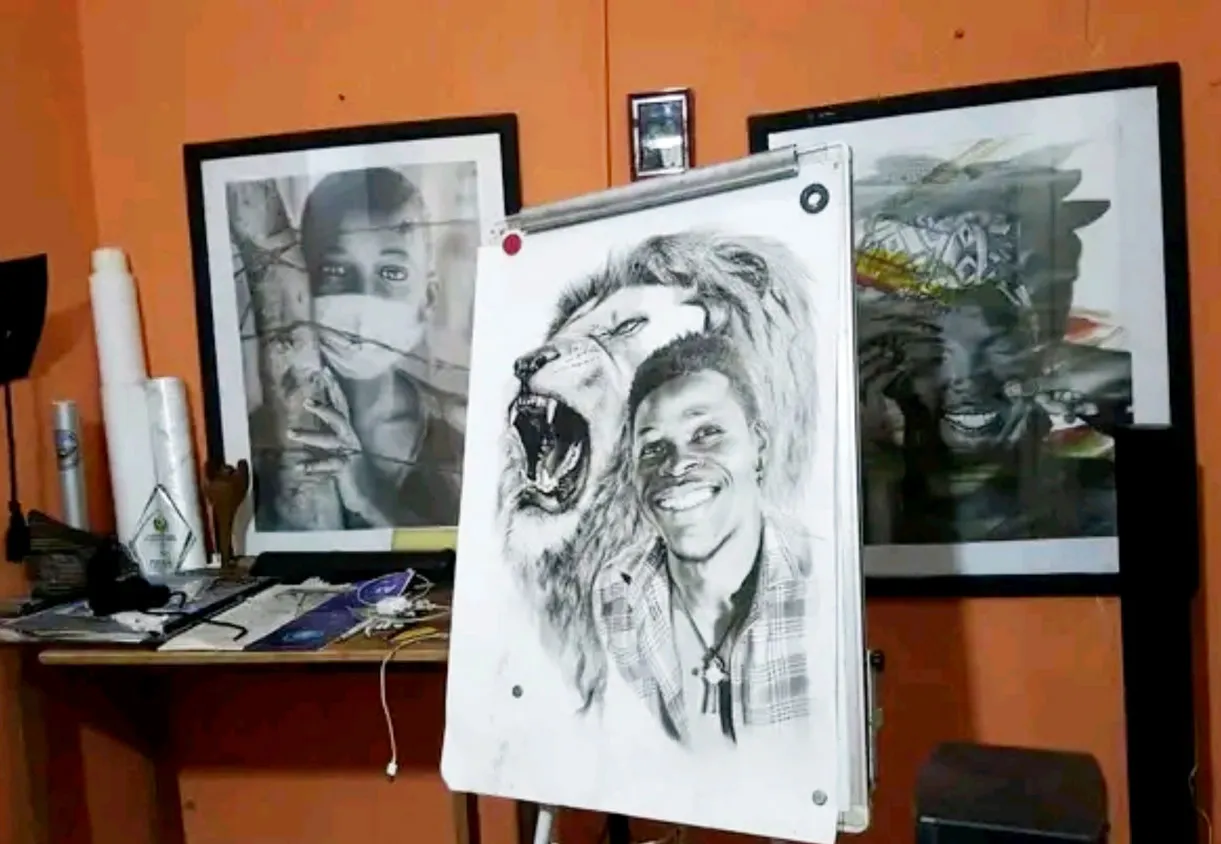
My obsession with detail makes me create hyper-realistic drawings that look like a high-resolution photograph. And I like that; I like it even more when the public doubts my work and wonders whether it is really a drawing or a printed photograph. I do not know whether there is a recipe for making this kind of drawing; it really is a matter of desire, of wanting to represent reality. But of course we must study the techniques for it a great deal; the creative life is not linear. It is not a straight line from A to B.
Who are your greatest influences?
Here in Mozambique there are many young people who also stand out with this style, but, as the greatest references, from my point of view, we have Dércio (the archer boy), Helton Carvalho and Skeitan. Internationally, my great references are three Nigerian artists and one South African: Arinze Stanley, Andrews Aggrey, Kelvin Okafor and Jono Dry. To be honest, I steal some ideas from my idols; I take what I need and leave the rest aside. Every artist does this, and I have found that it is from this that we become more creative. An artist who says they never steal ideas is not being honest. I am not saying that I plagiarise. All creative work is built on what came before; there is nothing new under the sun. “The only art I'll studiously ape is the art that I can steal from” – David Bowie. I would really like to have the privilege of working with these artists one day, or even the chance to see their work in person. I have collaborated with several national artists, not only those who work in styles similar to mine. For example, we are now working on the street art project we call Beira Street Art. The idea came from AfroIvan, a graffiti artist from Maputo. I have also painted in the studio of an abstract artist known as Rabanete.
How did the pandemic affect your work?
With the pandemic, galleries closed and a lot of things came to a standstill, and that gave me more time to draw at home. During that period of lockdown, I built up a number of works and, when the measures were eased, we were able to hold a group exhibition at the gallery of the Casa do Artista in Beira. Other works are being kept for future exhibitions. The expansion of the digital world and social media has had a positive impact on art, because through these platforms we can see the work of artists who are far from us, we can share our own work, and so on. In my own case, for example, the world came to know me much more because of social media; that is where I post my work and the whole creative process.
When it comes to national culture, how do you see its current state and what are the sector's great challenges?
I always say that we should invest heavily in arts education; it is the foundation for building any other knowledge that comes afterwards. Before learning A or B, or 1 or 2, we learn to draw, to colour, to sing, to dance, and so on; only then do numbers and letters come. This only shows that art has a fundamental role in developing psychomotor and cognitive abilities. Everyone is born an artist; the problem is how to grow up an artist. If I were Minister of Education and Culture, arts teaching in schools would be a priority; it would help children to think outside the box, and they would have more ideas, opinions of their own, more creativity. Perhaps mathematics, physics and chemistry would become easier. Society would not look at an artist as a marginal figure, because for many people, being an artist in Mozambique is synonymous with marginality and poverty. They are wrong; they call us mad for thinking differently.
To finish, can you tell us what your plans are for the future?
My plans for the future are to paint more walls in the city of Beira, to hold at least one solo exhibition in 2023, to try to win a scholarship to study Fine Arts in Europe, and to open my own art course at the Casa do Artista in Beira.


