
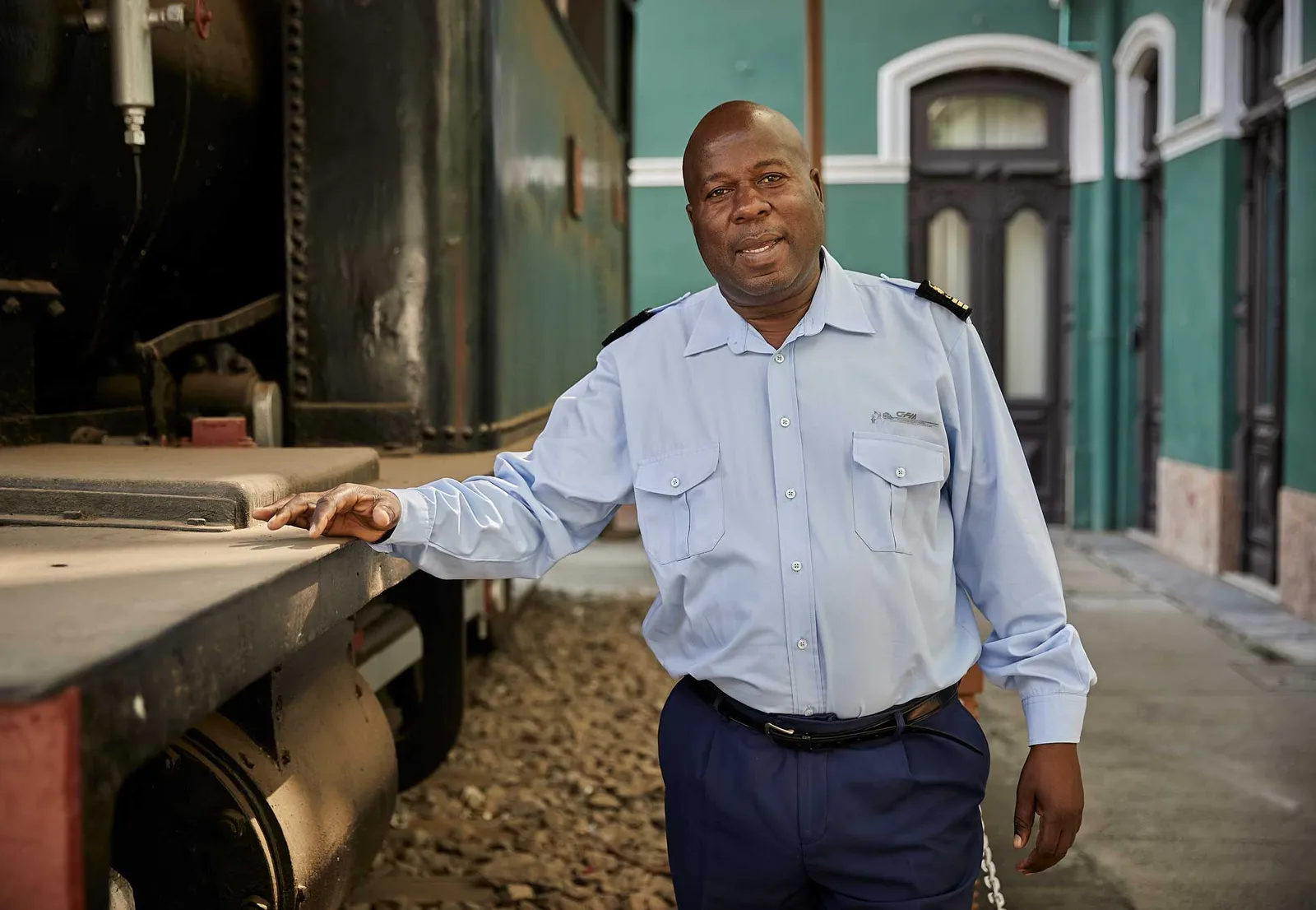
Henrique Languane, a 57-year-old train driver, joined Mozambique Ports and Railways (CFM) back when trains were still powered by coal. He made countless journeys over a 34-year career and was derailed five times, always emerging unharmed. He does not remember when he made his first journey at the controls of a locomotive, but he remembers the last, in May this year. Xonguila magazine went aboard Train 517, the one Languane feels closest to, to meet CFM’s longest-serving driver and bring his life on the tracks to these pages.
A whole lifetime devoted to work. Henrique José Languane was very young – 17 – when he started working. He had just finished sixth grade and would have become a teacher had his father, then a driver for Mozambique Ports and Railways, not found him a vacancy at the port of Inhambane, his home town. He joined CFM as a docker, before training as a train driver, and left the company 34 years later. His training began at the Inhambane Railway School in 1985. In 1991 he started working as a freight train driver at Maputo Station, followed by various stations in the Central (Beira) and Southern (Chicualacuala district, in the north-east of Gaza province) regions. He retired as a traction inspector, a post he held from 2011 until his retirement. Languane is married and the father of three children.
If I were not driving a locomotive, I would be flying a plane. I have always been passionate about big machines. – Henrique Languane, former CFM train driver
Danger lines...
Driver Languane is a true survivor of a film that repeated itself five times in his working life, with himself as the main protagonist. In 2004, he had his first accident, when he was going to help a colleague whose train had broken down at Machava, in Maputo province. “I was pulling a locomotive with no wagons, at high speed, and it derailed because of the condition of the track, which was buried, and I did not notice. As I passed through that area, my locomotive derailed completely and crashed into a pole. If it had not been for the pole, the train would probably have overturned, and the worst could have happened. The most serious of the five accidents involved wagons with passengers on board. It happened in Chicualacuala, in the Mapai area, in 2001. Nobody was seriously injured. The other four were minor derailments,” says Languane, who acknowledges that he has lost colleagues who, in similar accidents, were not so lucky.
“The first difficulty when I started working was with the wagons, which at the time had no brakes. The second was the railway track, which was in disrepair. Then there were the locomotives themselves, which broke down constantly. Lastly, the lack of a decent place to rest” – these, according to Languane, were the main problems behind railway accidents. “Conditions have already improved because there are now dormitories equipped with air conditioning and beds, enough to sleep comfortably and rest so as to return to service in good spirits,” says CFM’s longest-serving and most experienced driver, up until his retirement.
Another cause of accidents that Languane points to is human error, which can be brought on by tiredness. “During night journeys I avoided eating. I made long journeys without having eaten anything so as not to fall asleep. I only drank water. I preferred to go hungry but arrive at the destination with the passengers on board safe.” Another cause is lack of knowledge: “A good driver must, first of all, know his locomotive. Then he must know the profile of the track on which the train is going to run, he must know the type of wagon he will have, whether it brakes or does not brake, whether it grips or does not grip, and he must take into account when he is going to run, whether by day or by night” – this is the advice he leaves to the colleagues who remain.
Train 517: carrying stories
Languane made countless journeys over the course of his career. He does not remember when he made the first as a locomotive driver, but he remembers the destination, which he went on to repeat for several years. “I went to Komatipoort, in neighbouring South Africa. I was going to collect a consignment of citrus fruit. I pulled a total of 40 wagons from Komatipoort to Maputo. I did not tremble because I was very confident. After that journey of 103 km, the distance between the South African town of Komatipoort and the Mozambican capital, Maputo, came the certainty that my life would be on the rails,” he said.
Languane’s school friends nicknamed him Train, because his father worked for CFM, the state-owned company that runs Mozambique’s railway and port systems. From his father came his passion for trains and, from there, for big machines. “Thank God, I trained in traction. If I were not driving a locomotive, I would be flying a plane. My dream, since I was little, was to drive something bigger. I have always been passionate about big machines.” The machines brought him closer to people, his travelling companions. The passengers closest to him call him by his surname, that is, simply Languane. Everyone is treated alike, without formalities. There are no “ladies and gentlemen”; inside the locomotive he drives, everyone is family and friends: “I made so many friends along the line! People liked travelling with me because of my punctuality. I always left on time and arrived at the destination without delay. People recognised my discipline,” he recounted, revealing that “on almost every journey, I would go home with a gift from the passengers, who over the years became great friends”.
Languane has driven every kind of train, from freight locomotives to public and special passenger trains. But there is one with which he developed an emotional bond over time, Train 517 from Maputo Central Station, which ran from Chicualacuala to Maputo and back. “I made more journeys on Train 113, which leaves Maputo for Ressano Garcia. The 211, which leaves Maputo for Goba, was also special for me. But Train 517, which left Maputo Central Station at 8 pm for Chicualacuala, was the one that marked me most, because of the friendships I made along the line,” he explained. Languane made an average of 15 journeys a month before his appointment as inspector in 2011.
Mission accomplished!
This 57-year-old driver made his last journey in that role last May, before being granted retirement. He travelled the Maputo-Chicualacuala route, carrying CFM staff on a working visit.
“I devoted myself to this profession with all my passion, discipline and responsibility. I am going home with my head held high, because I did my duty with determination and professionalism. I leave happy, with my mission accomplished and proud of everything I have achieved,” he argued. “I was young when I joined CFM, 34 years ago. I trained here, I developed as a professional here in this house. Today I am a man, a father, the head of a family. What I am today I owe to CFM. I built a family along this line. It was not easy to say goodbye,” he continued, moved. Languane is awaiting a formal farewell being prepared by the institution, which should coincide with his birthday in August, and he warns that his departure from the company and from the machines with which he spent most of his life will not be definitive: “I have the mission of passing the baton to the new generation of drivers. So I am on standby for any request.” And he braked, with that loud and unmistakable sound of the train announcing the end of the line, or rather, the arrival at the destination.


